

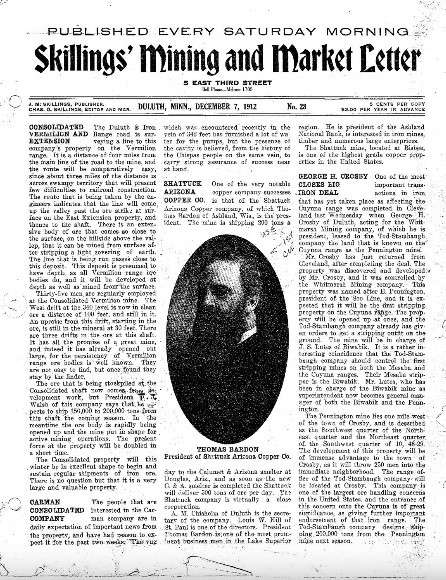
 First issue, 1912 — Duluth, Minnesota
Skillings Mining Review History: How a Weekly Mining Letter Became the Industry’s Longest-Running Intelligence Platform
Skillings Mining Review has published continuously since 1912. It began on the iron ore docks of Lake Superior. Today it covers critical minerals supply chains worldwide. It has run through every major commodity cycle, every technological shift, and every geopolitical realignment the mining industry has faced.
Why 1912, and Why Duluth: The Origins of Skillings Mining Review
The Skillings Mining Review history begins with a simple question: why 1912, and why Duluth? To answer it, it helps to understand what Duluth, Minnesota was in that period. The city sat at the western tip of Lake Superior. It was at the convergence of the Great Lakes shipping network and the vast iron ore ranges of Minnesota’s Mesabi and Vermilion formations. By the opening decade of the twentieth century, Duluth had become one of the busiest inland ports on earth. Ships carrying tens of millions of tons of iron ore moved through its harbor every season, feeding the steel mills of Pittsburgh, Cleveland, and Chicago.
A City Built on Mining
This was, in other words, a city built entirely on mining — on the extraction, transport, and commercial exchange of mineral resources at industrial scale. The men who ran that system needed timely, reliable market intelligence. Mine operators, shipping interests, steel buyers, and financiers all had to make decisions across a supply chain that stretched from underground mine faces to rolling mills hundreds of miles away. No general newspaper filled that gap. No dedicated channel for the mining trade yet existed in the region.
“The men running those mines, mills, and shipping routes needed market intelligence to make sound decisions. No general newspaper filled that gap — and so Skillings was founded to fill it.”
Filling the Gap: 1912
It was into this vacuum that Skillings’ Mining and Market Letter arrived in 1912. It was a weekly publication with one purpose: to give the mining and metals trade a dedicated, reliable, and technically literate source of market information. From its first issue, it covered ore pricing, shipping volumes, labor conditions, production benchmarks, and the financial health of the region’s major producers. That focus on consequence — not just what happened, but what it meant for the trade — became the publication’s editorial foundation. It remains so today.
The founding year itself is worth noting in context. In 1912, the Titanic sank, Woodrow Wilson won the U.S. presidency, and the first diesel locomotive entered service. More relevantly, U.S. steel production was approaching 30 million tons annually. Iron ore demand from the Great Lakes region was at record levels, and the Mesabi Range had become the most productive iron ore district in the world. Starting a mining intelligence publication in Duluth in 1912 was not a speculative venture. It was a direct response to an industry generating enormous wealth that needed a dedicated voice.
The First Publication: Skillings’ Mining and Market Letter
The original publication launched as a weekly letter, not a magazine. The format reflected the medium of the era. It was a focused, dense, and regularly scheduled dispatch of market intelligence that subscribers could act on before the next issue arrived. Coverage centred on the iron ore trade, shipping movements across Lake Superior, ore prices at Duluth and Cleveland docks, labor conditions at Minnesota mines, and production reports from the major operators across the Mesabi and Vermilion ranges.
The letter also covered what today would be called industry risk: labor disputes, weather disruptions to shipping, changes in railroad freight rates, and the financial position of the major steel buyers. This was not merely news reporting. It was a practical intelligence service — the kind of analysis that let a mine operator or ore buyer make better commercial decisions than a competitor who lacked access to it.
The weekly cadence also mattered. Daily newspapers covered mining only incidentally. Monthly trade journals lacked timeliness. Weekly publication hit the right interval for a market that moved in shipping seasons and weekly price cycles. That cadence established the rhythm of the publication for decades to come.
1916: From Letter to Review
In July 1916, four years after its founding, the publication renamed itself Skillings’ Mining Review. It dropped the “Market Letter” designation in favour of something that more accurately described what it had become. The shift from “letter” to “review” was not cosmetic. It reflected a genuine expansion in scope and ambition.
By 1916, the United States was supplying steel to a Europe already two years into the First World War. American mining production was under enormous pressure to scale. The Mesabi Range alone was producing over 40 million tons of iron ore per year. The mining industry that Skillings covered had grown considerably more complex. It now involved not only ore pricing and shipping, but also labour law, government procurement, international demand, and the strategic role of domestic mineral production in wartime supply chains.
The “Review” format allowed the publication to cover that expanded territory. Where a “letter” suggested a narrow market dispatch, a “review” implied editorial judgment across the industry — context, analysis, and interpretation alongside the raw data. That repositioning proved durable. The “Review” identity carried the publication for the next century.
1970s Industrial Cycles
Skillings Mining Review Through the Industrial Cycles
The decades between the First World War and the 1970s tested every American institution. Skillings Mining Review was no exception. The Great Depression of the 1930s devastated the mining sector. Iron ore shipments from Duluth collapsed, and mines closed across the range. The trade press that served them contracted sharply. Skillings nevertheless continued to publish through those years, maintaining its role as the industry’s record of continuity even when the industry itself was contracting.
The Second World War brought a reversal. Government demand for steel, copper, and other metals drove the highest levels of mining production in American history. The period also accelerated the diversification of what Skillings covered — not just iron ore, but copper from Arizona and Montana, coal from Appalachia, uranium from the Colorado Plateau, and lead and zinc from the Mississippi Valley. By the postwar boom of the 1950s and 1960s, the publication had evolved from a regional iron ore letter into a genuinely national mining trade publication.
Throughout this period, Skillings maintained its core editorial discipline: specific, sourced, commercially useful coverage of the events and trends that moved supply, capital, and risk in the mining sector. The editorial tradition established in Duluth in 1912 proved robust enough to survive the most severe commodity cycles of the twentieth century.
1993: The Apostrophe Drops
In 1993, the publication retired the apostrophe from its masthead, becoming Skillings Mining Review rather than Skillings’ Mining Review. This was a small typographic change, but it carried real significance. After more than 80 years, the publication’s identity had become institutional rather than proprietary. The name no longer belonged to a founder’s legacy alone, but to the mining industry as a whole.
The timing also aligned with a broader shift in the mining industry. By the early 1990s, the global mining sector was undergoing consolidation. The merger waves that would create BHP Billiton, Rio Tinto’s modern form, and the restructured majors of today were already under way. At the same time, junior mining exploration was expanding rapidly in Latin America, Africa, and Asia, as liberalised resource policies opened new frontiers to foreign capital.
Dropping the possessive apostrophe was a quiet signal that the publication’s frame of reference had expanded beyond its Duluth origins. It was now covering a genuinely global industry, and the modernised masthead acknowledged that fact without fanfare.
2020s Digital Transition
The Digital Transition: Skillings Becomes an Intelligence Platform
The shift from print to digital presented the same challenge to every trade publication that faced it. Publishing had become frictionless, and the field flooded with competitors who had never built the institutional credibility that sustains a century-old brand. How could a publication preserve its authority and usefulness in that environment?
Skillings Mining Review’s answer was to lean into what no competitor could replicate: its history, its archive, and its discipline. Where new entrants competed on volume, Skillings competed on relevance. The digital platform at skillings.net combined the monthly magazine, a multi-weekly newsletter, a global mining jobs board, webinars, podcasts, and a growing archive library. The editorial engine, however, remained the same one that had been running since 1912: cover the mining stories that move supply, capital, risk, policy, technology, and strategy. Do not report every story. Report the ones that matter.
The digital era also let Skillings reach a genuinely global audience for the first time in its history. Readers who would never have subscribed to a print publication dispatched from Minnesota could now access the full archive and subscribe to the newsletter from any country where mining is a serious industry. Today, Skillings reaches more than 15,000 followers on LinkedIn globally, in addition to its paid subscriber base.
How Skillings Covered Every Major Commodity Cycle
One instructive fact stands out in the Skillings Mining Review history: the publication has covered every significant commodity cycle since its founding. Each cycle brought a different primary mineral to the centre of the industry, and with it, a different editorial focus. The table below traces that progression, showing how the publication’s coverage evolved alongside the industry it served.
| Period | Dominant Mineral / Theme | What Skillings Covered |
|---|---|---|
| 1912–1930s | Iron ore, steel | Mesabi Range production, Lake Superior shipping, ore pricing, labour conditions, steel demand |
| 1940s | Wartime metals | Government procurement, copper demand, strategic mineral supply, mine production under wartime conditions |
| 1950s–1960s | Coal, copper, uranium | Postwar industrial expansion, Appalachian coal, Colorado uranium, national mine production |
| 1970s–1980s | Gold, energy minerals | Gold bull market, oil-driven mining investment, M&A, mine finance, coal policy |
| 1990s–2000s | Copper, gold, base metals | Global consolidation, Latin America, Africa, junior mining boom, M&A cycles |
| 2010s | Battery metals, iron ore | China demand cycle, lithium emergence, ESG, automation, mine technology |
| 2020s–present | Critical minerals | Energy transition minerals, supply-chain security, policy, rare earths, copper deficit, AI infrastructure demand |
Each era brought new minerals to the centre of global attention. Throughout each cycle, the editorial discipline remained constant: explain what is moving supply, capital, risk, and strategy — not just what happened.
The National Mining Hall of Fame and Museum: A Parallel Mission
Since 1987, the National Mining Hall of Fame and Museum in Leadville, Colorado has served as the nation’s foremost institution dedicated to honouring the men and women who have shaped American mining. Leadville was at various points the second-largest city in Colorado, built on silver, lead, and zinc. The Hall of Fame preserves and communicates the story of an industry that underpins modern civilisation.
The parallel with Skillings Mining Review is deliberate and meaningful. Both institutions exist because someone understood that mining’s story is too consequential to be left unrecorded. The Hall of Fame captures the human dimension — the engineers, geologists, financiers, and operators who built the industry. Skillings, meanwhile, captures the commercial and strategic dimension — the markets, projects, policies, and capital flows that drive the industry forward.
Together, they represent the two sides of what it means to take mining seriously as a subject: the people, and the forces those people navigate. Readers who want to understand both will find that Skillings and the Hall of Fame complement each other in ways that neither institution could achieve alone.
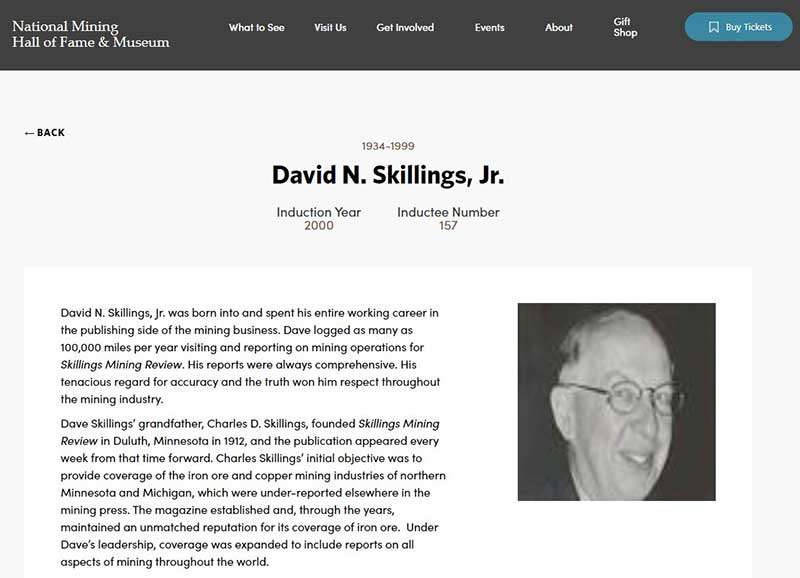
National Mining Hall of Fame and Museum, Leadville, CO — est. 1987.
The Critical Minerals Era: Why This Mission Matters More Now Than Ever
The history of Skillings Mining Review is, in important respects, the history of successive eras in which mining moved from the margins of public attention to the centre, then receded again as each commodity cycle matured. Iron ore was once a subject of national strategic interest. Coal was once the defining resource debate of its generation. Uranium carried geopolitical weight through the Cold War decades. In each case, Skillings was there, covering the story with the discipline and sourcing that the subject demanded.
The critical minerals era that has defined the 2020s is, in this respect, another chapter in a familiar pattern — but with a crucial difference. For the first time since the early industrial era, the full breadth of the periodic table is simultaneously in strategic focus. Lithium, cobalt, nickel, rare earths, copper, graphite, uranium, and manganese were once specialist subjects. Now they are subjects of parliamentary debate, presidential executive orders, and national security strategy documents across every major economy.
The supply chains at issue are genuinely complex: from mine development in remote jurisdictions, to processing in facilities controlled by a small number of countries, to battery and component manufacturing, to the end-use applications that depend on uninterrupted mineral supply. Understanding that chain — and explaining what moves along it, what disrupts it, and what capital and policy response is emerging — is precisely what this publication was founded to do. The commodity has changed; the editorial mission has not.
For readers who want to understand the critical minerals intelligence reshaping global supply chains, trade relationships, and industrial strategy, Skillings provides the analytical depth and sourcing discipline the subject demands. That is not a recent positioning. It is the continuation of a 110-year editorial tradition applied to the defining resource story of the current decade.
Access the Full Archive
Paid members receive the 3× weekly newsletter, monthly magazine, global mining jobs board, and full library access — including decades of coverage spanning every major commodity cycle since the publication’s founding.
Further Reading
Explore more of what this publication covers — from its editorial mission to the critical minerals intelligence it publishes today.
The full editorial mission, positioning, and what readers can expect from the publication.
Lithium, rare earths, copper, cobalt — the minerals at the centre of the energy transition and strategic supply-chain debate.
Full archive access, 3× weekly newsletter, monthly magazine, and mining jobs board.
Best value access to all Skillings content, including the complete publication archive.
Advertising, editorial inquiries, subscription support, and partnership questions.