

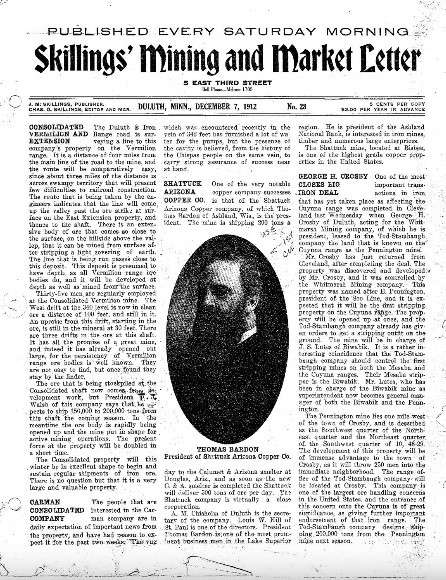
 Skillings Mining Review — trusted mining intelligence since 1912
Why Mining Executives Read Skillings Mining Review
Mining executives don’t have time to sort signal from noise. That’s precisely why Skillings Mining Review readers — from mine operators to investors to policymakers — treat it as a working tool rather than background reading.
The Problem With Generic Mining News
A quick search for mining news today returns dozens of aggregators, press-release mirrors, and general business outlets running a mining tag. Most of it suffers from the same three problems.
First, it is too broad. A single feed mixing junior exploration announcements, commodity price tickers, ESG press releases, and unrelated energy news forces a busy executive to do the filtering work themselves — the exact job a trade publication should be doing for them.
Second, it is too slow to reach a verdict. Many outlets report that something happened — a permit was granted, a deal was announced — without explaining what it means for supply, capital, or competitive position. Consequently, the story ends exactly where the useful analysis should begin.
Finally, it is too thin. Volume-driven publishing rewards quantity of headlines over depth of sourcing, which is a poor trade for anyone using the information to make a capital or operating decision. None of this makes generic mining news useless, however. It simply means it is built for browsing rather than for decisions — a different job than the one Skillings Mining Review readers need done.
What Mining Executives Actually Need From a Publication
Mining executives are not looking for more information. Instead, they are looking for less of it — filtered, sourced, and framed around consequence. In practice, that means a small number of specific things.
They need coverage that connects a single event to the broader system it sits inside. Not just that a mine received a permit, but what that means for regional supply, competing projects, and downstream buyers. Because project economics can shift faster than a monthly report can capture, they also need timely intelligence on capital flows and financing conditions. Beyond that, policy coverage matters too: it should translate government action into commercial implications, rather than restating a press release. Ultimately, they need a source they can trust enough to act on without independently re-verifying every claim — and that trust only comes from a demonstrated track record.
That combination — narrow focus, deep sourcing, and consequence-first framing — is exactly what generic mining news is structurally not built to deliver. As a result, it is exactly what defines the Skillings Mining Review readers who return to the publication issue after issue.
How Skillings Mining Review Covers Capital, Supply, Risk, and Policy Differently
Skillings Mining Review organizes its coverage around the forces that actually move decisions in the industry, rather than around a generic news feed. The distinction shows up clearly when you compare what each type of coverage focuses on.
| Coverage Area | The Skillings Mining Review Approach |
|---|---|
| Capital | Tracks financing conditions, M&A activity, and project economics in the context of the broader capital cycle, not as isolated deal announcements |
| Supply | Connects individual mine and refinery developments to regional and global supply concentration, not just local production figures |
| Risk | Flags labor, geopolitical, and logistical risk before it becomes a headline disruption, drawing on decades of pattern recognition across commodity cycles |
| Policy | Translates trade policy, permitting decisions, and national security strategy into concrete commercial implications for operators and investors |
| Technology | Covers automation, electrification, and processing innovation in terms of what it changes for cost curves and competitive position |
The Editorial Filter: Only Stories That Move Supply, Capital, Risk, or Strategy
The real differentiator behind Skillings Mining Review is not a formula or a beat list. Rather, it is a single editorial test applied to every story before it runs: does this actually move supply, capital, risk, or strategy for someone in the industry? If the answer is no, the story does not make the cut — regardless of how much traffic it might generate elsewhere.
That filter has run continuously since the publication’s founding in 1912, through every major commodity cycle the industry has faced. As a result, mining executives can treat the publication as a shortcut rather than one more feed to monitor. So when something appears in Skillings Mining Review, a reader can reasonably assume it already cleared a bar most industry news never has to meet.
This is also what separates Skillings review coverage from opinion or commentary. The goal is not to editorialize about the industry’s direction. It is to identify, with sourcing discipline, which developments genuinely change the calculus for the people who have to act on them.
What Skillings Mining Review Readers Get With Membership
Membership gives readers a 3× weekly newsletter built around the editorial filter above, a monthly magazine for deeper analysis, a global mining jobs board, and full access to a historical archive spanning every major commodity cycle since 1912. For an executive who needs to stay current without spending an hour a day sorting through generic mining news, that combination is the actual value proposition: less volume, more signal, delivered on a schedule built for people who have to act on it.
Further Reading
More on what Skillings Mining Review covers and why it has lasted this long.
A quick-answer guide to what the publication is, what it covers, and who reads it.
Why more than a century of continuous coverage matters to today’s readers.
Lithium, rare earths, copper, and cobalt — today’s defining resource story.
Full archive access, 3× weekly newsletter, monthly magazine, and mining jobs board.
Advertising, editorial inquiries, subscription support, and partnership questions.