

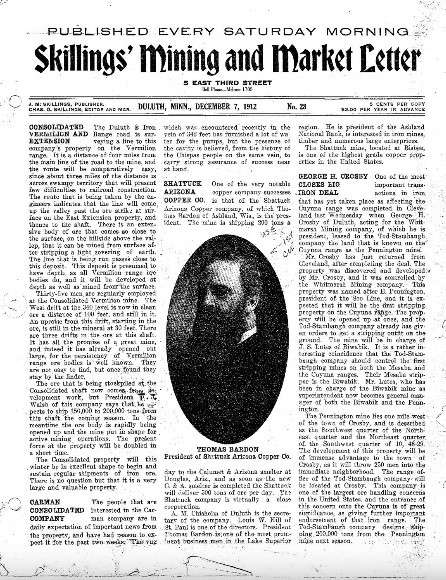
 The original 1912 issue that started it all — Duluth, Minnesota
Skillings Mining Review — 110 Years of Mining Intelligence
Very few mining publications can claim more than a century of continuous coverage. Skillings Mining Review can. This is the story of how a weekly iron ore letter from Duluth became the mining industry’s longest-running voice — and why that kind of Skillings Mining Review history still matters to readers today.
A Rare Thing in Trade Publishing: 110 Years Without Interruption
Most trade publications do not survive a single difficult decade, let alone eleven of them. Commodity cycles turn. Advertising models collapse and rebuild. Ownership changes hands. Readerships migrate from print to digital and scatter across dozens of competing feeds. Very few specialist publications in any industry make it past fifty years of continuous operation.
Skillings Mining Review has been publishing since 1912. That is not a claim about a brand that has existed on paper through a series of relaunches and rebrands. It is a claim about an editorial mission — tracking what moves supply, capital, and risk in mining — that has run uninterrupted for more than a century. Understanding why that record exists, and what it signals, is really the heart of the Skillings Mining Review story.
This kind of longevity is not simply a matter of pride. In an industry defined by long project timelines, cyclical capital, and generational shifts in which minerals matter most, a publication that has watched the whole arc — not just the current chapter — brings something that a five-year-old news site cannot: institutional memory.
1912: The World Skillings Mining Review Was Born Into
To appreciate what Skillings Mining Review set out to do, it helps to picture the mining industry it was founded to serve. In 1912, the industrial world ran on three minerals above all others: iron ore, copper, and coal. Iron ore fed the steel mills that built railroads, bridges, and the skeletons of the first skyscrapers. Copper wired the electrical grids and telegraph networks spreading across the country. Coal powered nearly everything else — factories, locomotives, ships, and home heating alike.
Duluth, Minnesota sat at the centre of one leg of that system. The city’s harbor on Lake Superior handled a staggering volume of iron ore shipped down from the Mesabi and Vermilion ranges to steel mills in Pittsburgh, Cleveland, and Chicago. Mine operators, ore buyers, shipping companies, and financiers all needed a reliable, technically literate source of market intelligence — something that told them not just what had happened in the market, but what it meant for their next decision.
That is the gap Skillings’ Mining and Market Letter was built to fill when it launched in 1912. It was narrow in geography — focused on Lake Superior iron ore — but wide in ambition. From its earliest issues, the publication treated mining not as a curiosity but as a serious economic subject worthy of the same rigor applied to finance or shipping. That founding instinct is the thread that connects the 1912 letter to the global publication operating under the Skillings Mining Review name today.
Every Mining Cycle Since Has a Skillings Byline
What makes Skillings Mining Review’s 110-year record unusual is not simply that it kept publishing. It is that the publication tracked every major turn the mining industry took along the way, rather than staying frozen in its original iron ore focus.
Through the Great Depression, the publication documented an industry in contraction — mine closures, collapsed shipping volumes, and a trade press that shrank alongside the businesses it covered. Through the Second World War, it tracked the opposite: a surge in wartime metals demand that pulled copper, coal, and strategic minerals into the national spotlight. The postwar decades brought uranium and a national buildout of mining infrastructure, and Skillings expanded its coverage accordingly, evolving from a regional iron ore letter into a genuinely national mining publication.
The pattern repeated through the gold cycles of the 1970s and 1980s, the global consolidation and junior mining boom of the 1990s and 2000s, and the battery metals surge of the 2010s driven by demand out of China. In every era, the minerals in focus changed. What did not change was the publication’s basic function: explain what is actually moving supply, capital, and risk for the people making decisions in the industry — not simply report the day’s headlines.
That continuity of function, sustained across nearly a dozen distinct commodity eras, is difficult to manufacture. It can really only be built the way Skillings built it: one cycle at a time, over more than a century.
From a Minnesota Mining Publication to a Global Voice
For much of its early history, Skillings Mining Review was, in practice, a Minnesota mining publication with a national readership — its reporting anchored to the Mesabi and Vermilion ranges even as its subscriber base grew. That regional identity made sense when Lake Superior iron ore genuinely was the centre of the American mining economy.
The shift away from that regional anchor happened gradually, then all at once. The 1993 decision to drop the apostrophe from the masthead — becoming Skillings Mining Review rather than Skillings’ Mining Review — was a small typographic change that captured a much larger reality: the publication’s identity had become institutional, not proprietary, and its coverage area had expanded well past Minnesota into a truly global mining industry.
The move from print to digital accelerated that shift further. A print publication mailed from Duluth had a natural ceiling on how far its readership could extend. A digital platform at skillings.net does not. Today, Skillings Mining Review reaches readers wherever mining is a serious industry — tracking lithium projects in Australia, rare earth processing in Malaysia, and cobalt supply chains in Central Africa with the same editorial discipline it once applied to iron ore docks on Lake Superior. For the full timeline of that transition, see the complete Skillings Mining Review history.
What 110 Years Hasn’t Changed: Consequence Over Noise
It would be easy to tell the Skillings Mining Review story purely as a series of transformations — new minerals, new geographies, new formats. But the more important part of the story is what has stayed exactly the same.
From the first issue in 1912 to the critical minerals coverage published this week, the editorial standard has not moved: report what changes supply, capital, and risk for the people who have to act on it, and skip the rest. That discipline is precisely why the publication survived commodity crashes, two world wars, and a full transition from print to digital, while countless competitors that chased volume instead of consequence did not.
It is also why the Skillings Mining Review history matters to a reader today who has never heard of Duluth’s iron ore docks. A publication that has applied the same editorial test — does this actually matter, and to whom — across eleven decades and every major commodity cycle has effectively run the test more times than any newer competitor ever could. That track record is not nostalgia. It is the reason the publication remains a reliable place to understand what is actually happening in mining now, in an era when lithium, cobalt, and rare earths carry the same strategic weight iron ore once did.
The commodity at the centre of the story keeps changing. The commitment behind the byline has not — and that, more than any single fact in this publication’s long history, is what 110 years of Skillings Mining Review actually stands for.
Read the Publication That’s Covered Mining for 110 Years
Paid members receive the 3× weekly newsletter, monthly magazine, global mining jobs board, and full archive access — including decades of coverage spanning every major commodity cycle since 1912.
Further Reading
Explore the full record behind this heritage piece and what the publication covers today.
The full chapter-by-chapter chronology, from the 1912 founding to the digital era.
A quick-answer guide to what the publication is, what it covers, and who reads it.
Lithium, rare earths, copper, and cobalt — today’s defining resource story.
Full archive access, 3× weekly newsletter, monthly magazine, and mining jobs board.
Advertising, editorial inquiries, subscription support, and partnership questions.