

 National Mining Hall of Fame and Museum — Leadville, Colorado
Skillings Mining Review and the National Mining Hall of Fame
A Colorado museum and a Duluth-born mining publication may seem like an unlikely pair. But the National Mining Hall of Fame and Skillings Mining Review share the same underlying mission: making sure the story of American mining, and the people who built it, does not disappear.
The National Mining Hall of Fame: Leadville, Colorado, Since 1987
The National Mining Hall of Fame and Museum sits in Leadville, Colorado, a town whose entire history is inseparable from mining. Leadville was, at various points, the second-largest city in Colorado, built on silver, lead, and zinc extracted from the surrounding mountains. Incorporated in 1987 and later granted a congressional charter, the museum is housed in a former Victorian-era school building and has been called “the Smithsonian of the Rockies.”
Inside, the museum tells the story of American mining through more than a thousand minerals, gems, and crystals, walk-through mine replicas, and the engraved photographs and biographies of the individuals inducted into its Hall of Fame. Its purpose is straightforward: honor the prospectors, engineers, financiers, geologists, and journalists who shaped the industry, and educate the public on why mining still matters to daily life.
How Skillings Mining Review Covered the Industry the Hall of Fame Honours
While the National Mining Hall of Fame preserves mining history through artifacts and biography, Skillings Mining Review has been recording that same history in real time since 1912 — one weekly issue at a time. The people the Hall of Fame inducts are, in large part, the same operators, engineers, and financiers whose projects, deals, and decisions Skillings Mining Review has covered as they happened.
That is not a coincidence. Both institutions emerged from the same conviction: that mining’s story is too consequential to be left unrecorded. The Hall of Fame captures the human dimension of that story after the fact — the individuals who built the industry. Skillings Mining Review captures the commercial dimension of it as it unfolds — the markets, projects, and capital flows those individuals were navigating in the moment.
Read side by side, the two sources complement each other. A Hall of Fame biography tells you who a mining leader was and what they achieved over a career. A Skillings Mining Review archive from the same period tells you what the market looked like while they were achieving it.
David N. Skillings, Jr. and the Family Legacy Behind the Publication
The Skillings name attached to this publication is not a brand invention. It belongs to a family that ran the magazine for three generations. Skillings Mining Review was founded by Charles D. Skillings, who led the publication from its first issue in June 1912 until 1943. He was succeeded by his son, David N. Skillings, who in turn passed the role of publisher to his own son, David N. Skillings, Jr., in 1975.
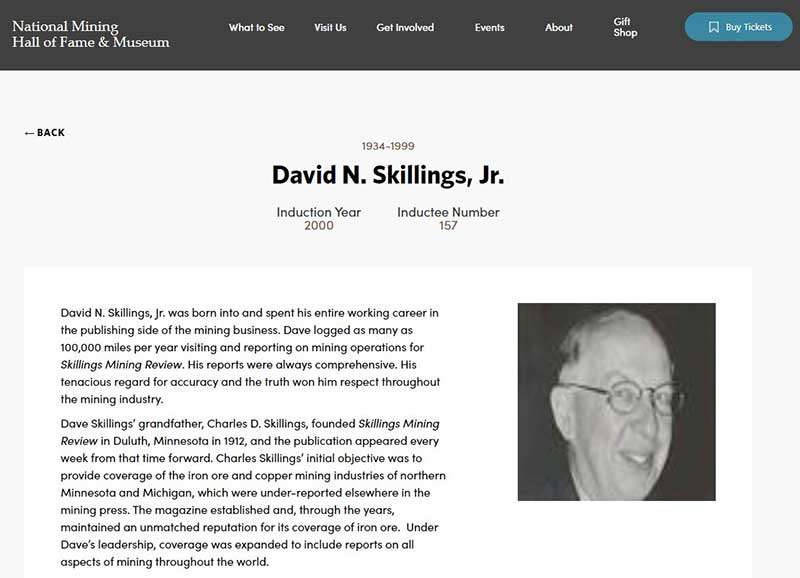
David N. Skillings, Jr. (1934–1999) had been associated with the magazine since 1958 and held a B.A. in economics from Carleton College in Northfield, Minnesota. As president of D.N. Skillings, Inc., he oversaw Skillings Mining Review and the Skillings Minnesota Mining Directory — an industry directory the company acquired in 1992 — from the company’s offices in Duluth. He also served as president of Skillings Conferences, which organizes the annual World Iron Ore Conference, launched in 1996. By his own account, he made regular trips to copper operations across Arizona and New Mexico for decades, continuing a family practice of first-hand mine visits that stretched back to his father and grandfather’s trips to the American Southwest and Mexico after the First World War.
In 1998, David N. Skillings, Jr. received the Medal of Merit from the Mining Foundation of the Southwest, in recognition of his career in mining journalism and his decades of firsthand reporting on the industry. That honor — distinct from, but in the same spirit as, the recognition given by institutions like the National Mining Hall of Fame — reflects the same underlying fact both organizations exist to record: that documenting mining well is itself a form of service to the industry.
From Iron Ore Ledgers to Critical Minerals: Why the Legacy Still Matters
The mining industry that Charles D. Skillings covered in 1912 ran on iron ore, copper, and coal. The industry that Skillings Mining Review covers today runs on lithium, cobalt, nickel, and rare earths — the raw materials behind batteries, magnets, and the broader energy transition. The commodities have changed almost completely. What has not changed is the underlying discipline: report what actually moves supply, capital, and risk, sourced with the same rigor the Skillings family applied to iron ore prices at the Duluth docks.
That continuity is exactly what institutions like the National Mining Hall of Fame exist to honour, and exactly what a three-generation family publication like Skillings Mining Review was built to sustain. Readers who want the human side of mining’s history can visit the Hall of Fame in Leadville. Readers who want the commercial and strategic side, tracked in real time from 1912 to today’s critical minerals economy, can find it in the full Skillings Mining Review history.
Read the Publication That’s Tracked This History Since 1912
Paid members receive the 3× weekly newsletter, monthly magazine, global mining jobs board, and full archive access — including decades of coverage spanning every major commodity cycle since the publication’s founding.
Further Reading
More on the family and editorial history behind Skillings Mining Review.
The full chapter-by-chapter chronology, from the 1912 founding to the digital era.
Why more than a century of continuous coverage matters to today’s readers.
The Mining Foundation of the Southwest’s 1998 Medal of Merit profile of David N. Skillings, Jr.
Lithium, rare earths, copper, and cobalt — today’s defining resource story.
Full archive access, 3× weekly newsletter, monthly magazine, and mining jobs board.