Diamond drilling at a copper-gold exploration site in British Columbia.

By Mo Shine
Kodiak Copper Corp. reported its strongest-ever drill intersection at the Ketchan zone of the MPD copper-gold project in southern British Columbia, highlighting near-surface mineralization as the company continues an exploration program aimed at expanding the project’s resource base.
Drill hole AG-26-019 returned 0.70% copper equivalent (CuEq) over 283.5 metres from 37.5 metres to 321 metres downhole, including a higher-grade interval of 1.02% CuEq over 108 metres from 85.5 metres to 193.5 metres, according to a company disclosure carried on OTC Markets and Kodiak’s technical release.
The result is significant for Ketchan, one of several mineralized zones at MPD. Kodiak said the intersection is the best reported to date at that deposit and could help improve and expand the Ketchan portion of the project’s mineral resource estimate.

Key results from AG-26-019
The headline interval contained 0.56% copper, 0.15 grams per tonne gold and 2.02 grams per tonne silver, for a calculated grade of 0.70% CuEq.

The higher-grade section contained 0.83% copper, 0.20 grams per tonne gold and 3.20 grams per tonne silver, equivalent to 1.02% CuEq.
| Drill hole | From | To | Interval | Copper | Gold | Silver | CuEq |
|---|---|---|---|---|---|---|---|
| AG-26-019 | 37.5 m | 321.0 m | 283.5 m | 0.56% | 0.15 g/t | 2.02 g/t | 0.70% |
| Included interval | 85.5 m | 193.5 m | 108.0 m | 0.83% | 0.20 g/t | 3.20 g/t | 1.02% |
| AG-26-009 | 46.5 m | 141.0 m | 94.5 m | 0.31% | 0.06 g/t | 1.38 g/t | 0.37% |
The mineralized zone in AG-26-019 is characterized by potassic alteration, a feature commonly associated with the hotter, more central parts of porphyry copper systems. Kodiak also identified a higher-grade hydrothermal breccia between 85.5 metres and 193.5 metres.

The company said a sample from the breccia between 145.5 metres and 147 metres assayed 3.14% copper and 0.5 grams per tonne gold. The reported sulphide minerals include bornite, chalcopyrite and pyrite.

Copper-gold porphyry drill core showing sulphide-rich mineralization.
A result within the existing resource area
AG-26-019 was drilled centrally within the existing Ketchan mineral resource estimate. Kodiak said the hole, along with earlier holes AG-26-003, AG-26-004, AG-26-005 and AG-26-006, is expected to contribute to an updated block model.
That distinction matters. While the result is the best reported at Ketchan, it does not replace the longest or highest-grade historical intersections elsewhere at MPD. The broader project has previously returned substantial mineralization at the Gate zone, including a 535-metre interval grading 0.49% copper and 0.29 grams per tonne gold in an earlier hole.
The latest Ketchan result instead adds evidence that mineralization is both laterally extensive and close to surface in another part of the district. For a potential open-pit development concept, near-surface continuity can influence future drilling, resource classification, mine planning and stripping assumptions. Those implications remain subject to additional drilling, geological interpretation, metallurgical work and economic studies.
The company cautioned that the reported lengths are downhole intervals. Current drilling data is not sufficient to determine the true width of the mineralization.
MPD’s position in the Quesnel Trough
Kodiak describes MPD as a 100%-owned, 357-square-kilometre land package in south-central British Columbia’s Quesnel Terrane. The property lies in the southern Quesnel Trough, a copper-producing belt that includes several established alkalic porphyry systems.
The project is near existing roads and infrastructure and includes multiple mineralized zones, including Gate, Ketchan, Man, Dillard, West, Adit and South. Kodiak’s MPD project overview says the property has been consolidated from several historic land packages and is being evaluated as a single, district-scale porphyry system using modern exploration methods.
Porphyry copper deposits are generally large, lower-grade systems that can contain copper, gold, silver and other by-products over broad areas. Their scale has made copper porphyries a central focus of exploration as governments and manufacturers seek additional metal supply for power grids, electric equipment and energy infrastructure.
MPD’s copper-gold potential gives it relevance to the wider critical minerals discussion, although the project’s formal development status and economic potential will depend on future technical work. Copper remains the main commodity focus.

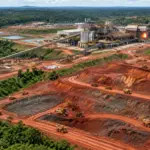
Exploration infrastructure within a forested British Columbia mountain setting.
Exploration program continues
Kodiak reported that it had drilled 9,067 metres in 46 holes at Ketchan, West and South during its 2026 program at the time of the release. The company plans to complete approximately 16,500 metres of drilling, with work expected to continue into the fourth quarter.
At Ketchan, upcoming holes are expected to test potential extensions to the south. Historical drilling encountered mineralization about 400 metres south of the current deposit, while a three-dimensional induced-polarization chargeability anomaly extends approximately one kilometre farther along trend.
Kodiak said the geophysical anomaly coincides with anomalous copper-in-soil and surface rock-sample results. These targets could help determine whether Ketchan represents a relatively contained deposit or part of a longer mineralized corridor.
The company is also drilling at other MPD zones to expand existing deposits and evaluate new exploration targets. Results from the 2026 program are intended to support an updated MPD mineral resource estimate planned for the first quarter of 2027.

Close-up view of mineralized porphyry core from a copper exploration setting.
What investors and operators will watch next
The next stage of evaluation will extend beyond the headline grade and length. Key questions include whether drilling confirms continuity of the higher-grade breccia, how the mineralization connects with adjacent holes, and whether further drilling can expand the resource envelope beyond the current model.
Metallurgy will also remain important. Kodiak’s CuEq calculations use assumed recoveries of 82% for copper, 60% for gold and 54% for silver, based on the company’s metallurgical testing. The calculation uses metal prices of US$4.75 per pound for copper, US$3,500 per ounce for gold and US$40 per ounce for silver.
CuEq is useful for comparing combined metal content, but it is not a measure of economic value or recoverable production. Future studies will need to assess recoveries, mineral processing, infrastructure, environmental requirements, capital costs and operating costs.
For now, AG-26-019 strengthens Kodiak’s case that Ketchan contains a substantial, near-surface copper-gold system within the larger MPD district. The follow-up drilling and the next resource update will determine how much of that potential can be converted into a more defined mineral inventory.
Sources: Kodiak Copper Ketchan drill results, Kodiak MPD project overview, OTC Markets disclosure page for KDKCF.