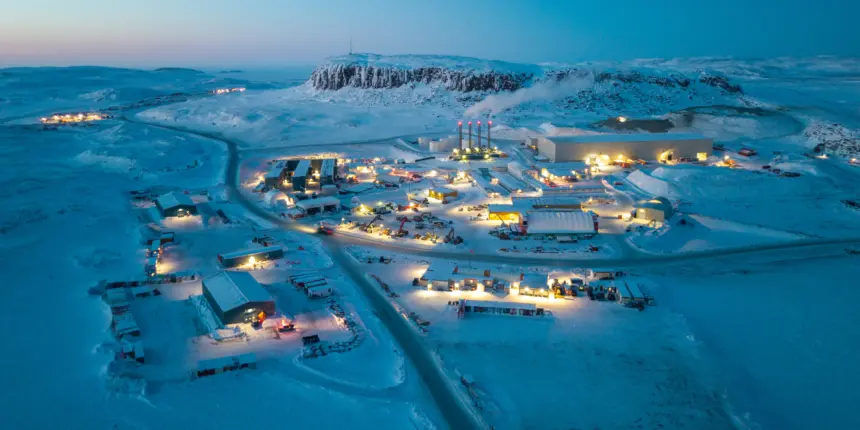
Agnico Eagle said construction at its Hope Bay gold project in Nunavut, Canada, was approximately 13% complete as of September 30, 2026. In its third-quarter 2026 results, released on October 28, the company said the project remained on schedule for construction completion in 2029, with first gold production expected in 2030, in line with the preliminary economic assessment published in May.
The US$2.4 billion development is planned as an underground mining operation supported by a processing facility designed to handle 6,000 tonnes of ore per day. The update provides an early construction benchmark for a project whose execution depends on coordinating underground development, infrastructure construction and seasonal deliveries in a remote Arctic location.
US$2.4 Billion Investment Follows Preliminary Economic Assessment
Agnico Eagle announced its positive investment decision for Hope Bay on May 19, 2026, alongside a preliminary economic assessment (PEA). The study estimated initial development capital at approximately US$2.4 billion, including US$1.5 billion for surface infrastructure, US$700 million for underground development and infrastructure, and US$200 million for mobile equipment.
The PEA outlines an initial mine life of 11 years and approximately 4.5 million ounces of total gold production. Average annual production is projected at about 408,000 ounces across the full mine life. The company forecasts a higher average of 435,000 ounces annually during steady-state operations from 2032 to 2038.
The production schedule reflects a ramp-up period, with 319,000 ounces forecast for 2030 and 380,000 ounces for 2031. Production is then expected to average 435,000 ounces annually from 2032 to 2038, before declining to 382,000 ounces in 2039 and 357,000 ounces in 2040.
The PEA is preliminary and includes inferred mineral resources, which are too uncertain to be classified as mineral reserves. Agnico Eagle cautions that forecast production and other economic assumptions may not be realised. The investment decision therefore represents the company’s commitment to advance the development based on its disclosed assessment, not the elimination of technical or operating risks.
Remote Logistics Will Test the Development Plan
Agnico Eagle completed its 2026 sealift campaign, delivering approximately 207,000 cubic metres of cargo and 16 million litres of fuel and construction materials. The operation involved nine cargo vessels, a dedicated vessel for wind turbine equipment and a fuel tanker, according to the company’s third-quarter results. The company said all planned materials and equipment had been received ahead of the next shipping season.
The timing matters because Hope Bay has a limited summer window for marine deliveries. A Reuters report published on May 22, 2026, described a roughly six-week window for barge transport through the Northwest Passage. Agnico Eagle chief executive Ammar Al-Joundi told Reuters it is “much less expensive to barge than to bring in goods via air,” and the company is counting on barging to keep Hope Bay’s production costs below US$1,000 per ounce.
At the Doris site, construction has advanced on accommodation facilities, the power plant structure, the mill services building and the Roberts Bay fuel farm. Underground development has also progressed at Madrid, where the Naartok East ramp reached 139 metres in depth and the Naartok West ramp reached 115 metres by September 30, according to the same results.
The completed sealift supports the current construction programme, but future delivery cycles remain an important constraint on the timing of work in this remote location.
Cost Forecasts Compared With an Operating Nunavut Mine
Hope Bay’s preliminary economic assessment forecasts average total cash costs of US$942 per ounce of gold, using a gold price of US$3,600 per ounce and a C$/US$ exchange rate of 1.35. That gold price is below the US$4,264 per ounce Agnico Eagle realised in the third quarter of 2026, according to its third-quarter results. The same study release gives total cash costs of about US$958 per ounce at US$4,500 gold and a 1.36 exchange rate, and its sensitivity table shows costs moving by only about US$2 per ounce for each US$100 change in the gold price.
For comparison, Agnico Eagle’s operating Meliadine mine in Nunavut reported actual total cash costs of US$1,067 per ounce in 2025, according to the company’s full-year 2025 results, and US$1,080 per ounce in the first nine months of 2026, according to the third-quarter results. All of these are total cash costs per ounce on a by-product basis. Agnico Eagle revised how it calculates the measure from 2026 to adjust for payments to Nunavut Tunngavik Inc., but the change affects Meadowbank and regional totals, not Meliadine’s own figure. Even so, Meliadine’s figures reflect an operating mine, while Hope Bay’s is a forecast that depends on study assumptions, future gold prices, exchange rates and the planned production profile. The two should not be read as a direct comparison of operating performance.
The comparison highlights the challenge Hope Bay must meet as it moves towards production. The project will need to convert its capital investment and remote logistics strategy into reliable output at the forecast cost level.
Inuit-Led Wind Project Adds to Existing Power System
The project’s energy strategy also includes renewable power. According to Natural Resources Canada, the federal government is providing C$25 million for the Hope Bay Wind Project, led by the Inuit-owned Kitikmeot Tugliq Limited Partnership. The project will add 4.2 megawatts of wind generation and 4 megawatts of battery storage to the mine’s existing power system, supplying cleaner electricity and reducing fuel use as Hope Bay moves into construction and operations. It is expected to cut diesel consumption by about 3 million litres a year and greenhouse gas emissions by more than 8,000 tonnes a year; these are projected savings, not yet demonstrated in operating conditions.
The initiative adds a wider infrastructure dimension to the project: energy supply, fuel transport and cost control are closely linked in remote Arctic mining, where access to reliable power is essential.
Water Licence and Inuit Agreement Remain Key Milestones
In October, Agnico Eagle finalised a framework agreement with the Kitikmeot Inuit Association, extending the Hope Bay Inuit Impact and Benefit Agreement to 2056 and expanding its coverage across the Hope Bay Belt, according to the company’s third-quarter results.
The water licence amendment process also progressed, with the Nunavut Water Board’s public hearing completed in October. The company’s results say it expects licence approval in the first quarter of 2027; approval remains pending.
The Hope Bay project page provides further material for checking regulatory filings and supporting technical information.
These milestones will be important to follow alongside construction. The company’s ability to maintain its schedule will depend on progressing development while meeting regulatory requirements and its commitments to Inuit partners.
2027 Will Be an Important Execution Test
The 13% construction-completion figure records progress as of September 30, roughly four months after Agnico Eagle’s May investment decision. It is not a measure of the percentage of the overall schedule elapsed, nor does it establish that future work will progress at the same rate.
The company reports that the project remains on track for completion in 2029. The next evidence of execution will come from construction progress through 2027, continued underground development and the outcome of the pending water licence process.
For mining investors, Hope Bay combines a large capital commitment with the logistical demands of Arctic development. Its progress over the coming year will help show whether the company can convert the PEA’s production and cost projections into a viable operating mine.