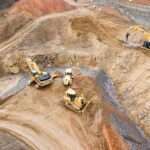
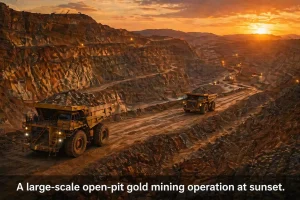
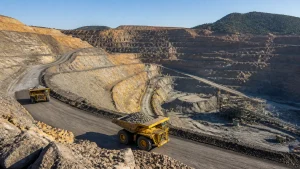
Of the $60.1 billion in income earned by 33 members of the World Gold Council last year, 63 percent, or $37.9 billion, stayed in the countries where gold mining activities were located.

The trade association’s members account for almost 40% of worldwide production. The group noted that gold mining supported more than 3% of national GDP in five countries. That figure is close to globally recognized overseas development aid levels.
A recent analysis titled “The Social and Economic Contribution of Gold Mining” found that gold mining companies generated more than 5% of total government revenue in eight nations.
“In Suriname the contribution is as high as 16.3 percent, Malawi is 8 percent and 6.6 percent in Burkina Faso,” said WGC Chief Financial Officer Terry Heymann.
Gold Mining’s Environmental Record
The gold mining sector is eager to show off its environmental credentials.
You might be interested in
- Unlike Its Predecessors, U.S. Gold Corp., Established In Nevada, May Succeed
- Canadian Miners Solgold And Aurania Resources Have Applauded Ecuadorian President Guillermo Lasso’s Decree
- New Employees Are Less Productive Than Experienced Workers…Turnover Is Preventing Nevada Gold Mines From Fully Optimizing Its Operations
- Birmingham spinout Salinity Solutions enters lithium ‘gold rush’
- Metso Outotec to deliver a raw water treatment plant to a gold mine in the Middle East
How Gold Mining Gives Back to Host Communities
Mining companies often build infrastructure well beyond what a site strictly needs. New roadways constructed inside a site may extend past its borders. Energy sources built to power a mine may produce more than the operation requires. These extras are tax-deductible. As Heymann put it, “the excess energy is then fed back into society.”

Canada’s Barrick Gold employs hydroelectric power plants at its Kibali gold mine in the Democratic Republic of Congo. The mine sits near the northeastern Haut-Uele region. In Burkina Faso, the Bassi and Bouly mines run partly on solar electricity supplied by UK-based Nordgold.
A mining site requires a healthy and educated workforce. “Mines typically assist pay schools, hospitals, and health clinics,” Heymann said.

A Long-Term Window of Opportunity
The WGC study argues that host countries and communities may see responsible and sustainable gold mining as a genuine “window of opportunity” for growth. That window can last a long time. Mining projects typically run for 30 to 50 years. Exploration alone can take up to 10 years, with development adding another five.
Despite this, the world’s largest gold producers are mature nations that don’t depend on mining for growth. China currently leads global output, mining 368.3 tons of ore last year. Russia followed with 331.1 tons, Australia with 327.8 tons, and the US with 190.2 tons. The COVID-19 pandemic had only a small impact on gold output, which fell 4% to 3,400.8 tons last year.
Gold Prices and the Outlook Ahead
Quarterly gold output hit a record 960 tons in the third quarter of 2019. That marked a 4% increase over the same period the previous year. During the pandemic, investors sought gold as a safe haven, pushing prices above $2,000 an ounce for the first time last August.
Since the discovery of the Omicron COVID-19 variant, gold has given up those gains. Prices now sit roughly 6% lower than a year ago, at around $1,793 an ounce. Analysts remain divided on whether gold will reach $3,000 an ounce in 2022. Some expect prices to rise due to persistent negative real interest rates, inflationary pressure, and a weakening US dollar.
Others predict gold will drop to about $1,700 an ounce next year. They point to increased production and easing political tension between China and the United States as the health crisis fades. New digital currencies like Bitcoin and Ether have made recent financial headlines, but Heymann said gold remains an essential store of value. “Gold has a place in investors’ portfolios,” he said.
The pandemic has demonstrated gold’s stability as a long-term store of value. It’s a tangible asset, so investors know precisely what they’re dealing with. As a market, it has endured for millennia.