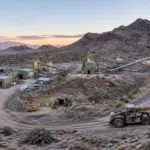
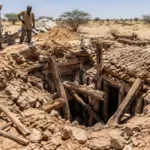
An arid artisanal mining site in Niger State, Nigeria.

Thirty-seven people arrested during a Nigerian crackdown on suspected illegal mining died in custody in Minna, Niger State, triggering protests, a curfew and growing scrutiny of the government’s campaign to formalize the country’s mining sector.
The detainees were arrested during raids on suspected gold-mining sites in the Wushishi-Lukoto area west of Minna, according to reports from the BBC, Al Jazeera and other international media. The arrests were carried out by the Nigeria Security and Civil Defence Corps, or NSCDC, a paramilitary agency responsible for protecting critical infrastructure and supporting enforcement against illegal mining.
The NSCDC initially referred to a suspected disease outbreak. The agency later said the cause of death had not been established and that medical examinations and investigations would be required. An intelligence report cited by AFP suggested the detainees may have died from overcrowding and inadequate ventilation. Survivors and relatives also described conditions in which detainees struggled to breathe.
The competing explanations have made the incident a test of Nigeria’s mining governance, detention safeguards and wider approach to artisanal and small-scale mining.
What happened in Minna
More than 50 people were reportedly arrested during the raids, while 37 died inside an NSCDC detention facility in Minna. Some of those detained were young miners, and families said they were unable to secure their release before the deaths were discovered.

Relatives gathered outside Minna General Hospital after the bodies were transferred there. Reuters footage reviewed by international media showed 33 bodies at the hospital, while Niger State officials confirmed the total death toll at 37.
A survivor told journalists that detainees had been packed into a poorly ventilated cell and that people had repeatedly called for help after struggling to breathe. Those accounts have not been independently verified, but they are consistent with the intelligence report cited by AFP and with concerns raised by relatives.
The NSCDC has not publicly accepted overcrowding or inadequate ventilation as the confirmed cause. Authorities said medical examinations and official investigations would determine what happened.
The Niger State government declared three days of mourning. The state NSCDC commandant, Suberu Siyaka Aniviye, was suspended pending investigation, according to the Interior Ministry. Nigeria’s president also ordered a full inquiry and said officials found responsible for abuse or negligence should face prosecution.
| Key detail | Reported position |
|---|---|
| Location | Minna, Niger State, north-central Nigeria |
| Mining activity | Suspected illegal gold mining |
| Arresting agency | Nigeria Security and Civil Defence Corps |
| Number detained | More than 50, according to the NSCDC |
| Deaths in custody | 37, confirmed by Niger State officials |
| Disputed cause | Suspected disease outbreak versus overcrowding and poor ventilation |
| Immediate response | Police investigation, commandant suspended, mourning period and curfew |
Source: reporting by Reuters, BBC, Al Jazeera and Associated Press.
Protests raise a second security concern
News of the deaths led to demonstrations in Minna. Hundreds of residents reportedly gathered near government facilities, with some protesters attacking public buildings and transport vehicles. Security forces used tear gas, while witnesses told Reuters that shots were fired during the unrest. It was not immediately clear whether live ammunition or riot-control rounds were used.
Governor Mohammed Umaru Bago imposed a 24-hour curfew as authorities attempted to restore order.
The protests underline the difficulty of enforcing mining rules in communities where informal extraction is tied to household incomes and local trading networks. A crackdown that is viewed as arbitrary or abusive can quickly become a broader dispute over security force conduct, youth employment and access to mineral wealth.
For Nigeria’s mining authorities, the incident also complicates an effort to shift operators from informal activity into a regulated system. The country has promoted mining as a way to diversify beyond oil, attract domestic and international capital, expand critical-mineral production and create jobs outside the petroleum sector.
That strategy requires trust between government agencies, local communities, license holders and investors. The Minna deaths threaten that trust at a time when Nigeria is trying to demonstrate that it can enforce mining laws while maintaining basic legal and human-rights protections.

A generated editorial illustration of a plain institutional detention facility in a dry West African setting.
Formalization cannot rely on enforcement alone
Nigeria’s illegal-mining problem is linked to several overlapping factors: limited access to formal licenses, weak local enforcement, poverty, informal gold trading and the presence of armed groups in some mining regions.
In Niger State, gold is among the resources attracting small-scale miners. The sector can operate beyond the reach of formal regulators, with limited geological data, weak mine planning and poor occupational-safety controls. That creates risks underground and at processing sites, but it also makes enforcement more difficult.
A policy focused primarily on arrests may remove workers from mine sites without addressing why they entered informal mining in the first place. It can also leave authorities managing large numbers of detainees without adequate capacity for screening, medical checks, legal processing or safe accommodation.
Nigeria’s constitution requires people detained on suspicion of a criminal offense to be brought before a court within a reasonable period. The deaths are therefore likely to intensify questions about whether those arrested had been charged, how they were classified and why so many people were held in one facility.
For mining companies, the issue extends beyond public security. Investors assessing a new gold, copper, lithium or critical-minerals project will examine whether government agencies can manage illegal mining, protect licensed concessions and resolve community disputes without creating additional liabilities.
A wider African ASM risk pattern
The Minna incident follows a series of deadly events linked to artisanal and small-scale mining across Africa.
In Sudan, a collapse at an informal gold mine in West Kordofan killed at least 60 people, according to reports cited by Al Ahram. Other accounts put the toll higher as rescuers searched for missing miners.
In Mali, an artisanal mine collapse in the Kangaba area killed more than 70 people in 2024, according to Reuters. Another collapse in 2025 killed more than 48 miners. Ghana has also experienced deadly confrontations between security forces and informal miners operating on or near industrial concessions.
These incidents are different in immediate cause. Some involve unstable shafts, others conflict or enforcement actions. But they share a common structural problem: informal mining often operates without adequate geological assessment, ventilation, emergency planning, worker training or independent oversight.
The risks are not confined to miners. Communities can face mercury contamination, damaged farmland, unsafe open pits and the financial effects of sudden enforcement campaigns. Mining companies can face trespass, production interruptions, reputational exposure and disputes over whether security providers used excessive force.

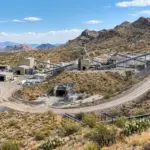
Small-scale mining and processing equipment in an arid West African setting.
What the deaths mean for investors and operators
The Minna deaths are likely to increase the premium investors place on jurisdictional and social-license risk in African mining markets.
That does not mean Nigeria’s mining potential has disappeared. The country has significant mineral resources, a large domestic market and a government seeking to expand the sector. But companies considering projects will need to assess more than geological quality and commodity prices.
Key questions will include:
- Can authorities distinguish licensed operators from informal miners without relying on mass arrests?
- Are local enforcement agencies trained and resourced to manage detention, evidence and medical emergencies?
- What independent mechanisms exist to investigate deaths or alleged abuses?
- Can mining companies maintain community engagement when enforcement operations are underway?
- How are artisanal miners incorporated into legal supply chains or alternative livelihoods?
- Are security arrangements governed by clear rules on use of force and accountability?
These questions are increasingly relevant to responsible-sourcing requirements. Gold buyers, banks, insurers and institutional investors are paying closer attention to supply-chain controls and human-rights due diligence. A custody-death investigation can therefore affect not only public confidence but also the perceived bankability of projects connected to a region’s mineral economy.
For operators, the practical lesson is that formalization must include more than licensing. It requires transparent land access, workable permits, safety standards, traceable mineral trading, local consultation and credible enforcement oversight.
Nigeria’s mining ambitions face a credibility test
The investigations into the 37 deaths will determine whether the crisis produces accountability or becomes another unresolved episode in the region’s long history of mining-related fatalities.
The cause of death remains disputed. That makes an independent investigation, including a credible review of detention conditions and the treatment of the bodies, central to restoring confidence. The government’s response will also be watched by communities living near mining areas and by companies considering investment in Nigeria’s gold and broader minerals sector.
Nigeria wants mining to play a larger role in economic diversification and future supply chains for critical minerals. That ambition depends on the state’s ability to enforce rules without undermining the rights and safety of the people it seeks to regulate.
The Minna deaths show how quickly a mining crackdown can become a governance crisis. Until the facts are established and responsibility is addressed, the incident will remain a warning to operators and investors that jurisdictional risk in African mining is shaped not only by permits, taxes and geology, but also by the conduct and capacity of public institutions.
Read more mining industry news and analysis from Skillings, including coverage of gold mining, critical minerals and the wider energy-transition supply chain.