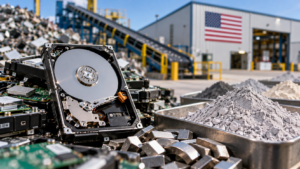

Phoenix Tailings announced on Tuesday that it will build a $375 million rare earth separation facility in Rochester, New York. The plant, called Freedom Separation, would process more than 18,000 tonnes of feedstock annually and produce over 4,400 tonnes of separated rare earth oxides per year at full capacity. Production is scheduled to ramp up in 2027 and reach full capacity in 2028.
The company selected Eastman Business Park in Rochester for the 500,000-square-foot facility, citing the site’s existing industrial infrastructure and a local workforce with experience in engineering, manufacturing and chemical processing operations.
This is one of the most significant rare earth midstream announcements made on US soil. Understanding what the project would and would not deliver requires reading the details carefully.
Why Separation Matters More Than Mining
The bottleneck in the US rare earth supply chain is not ore in the ground. It is the ability to chemically separate individual elements from mixed concentrates so that manufacturers can actually use them.
Rare earth elements share nearly identical chemical properties. Seventeen elements with similar atomic structures occur together in ore and behave almost identically in solution. Pulling them apart requires iterative solvent extraction — a process in which a rare earth leachate is mixed with an organic phase that selectively binds individual elements, then stripped and recycled through the same sequence repeatedly. A single full separation across the lanthanide series can require hundreds of cycles. The process is energy-intensive, chemically demanding and expensive to operate at commercial scale.
More Read
China mastered this at scale over decades and now controls approximately 91% of refined magnet rare earth output globally, according to the IEA. The United States has virtually no commercial-scale separation capacity outside of MP Materials’ Mountain Pass operation in California, which separates light rare earths — primarily neodymium and praseodymium. No domestic facility currently separates the full spectrum of rare earth elements at the volumes the magnet and defence industries require.

That gap is what the Phoenix Tailings Rochester plant targets.
What the Rochester Plant Would Do
Freedom Separation would take mixed rare earth feedstocks — both mined concentrates and recycled materials — and isolate individual rare earth oxides from them. The plant targets output of more than 4,400 tonnes of separated oxides per year at full design capacity. To put that figure in context, MP Materials produced approximately 1,757 tonnes of NdPr oxide in the first half of 2026, according to ING. However, the two operations target different product mixes, so the figures describe different outputs and should not be treated as equivalent.
More Read

Phoenix Tailings CEO and co-founder Nick Myers described the reasoning behind the Rochester location directly. Rochester has people who know how to build, innovate and run world-class industrial operations, he said in the company’s announcement. The site at Eastman Business Park, historically one of the largest industrial campuses in the northeastern United States, provides the physical and infrastructure foundation the project requires.
The plant is the centrepiece of Phoenix Tailings’ broader Freedom project, a $1.2 billion initiative spanning facilities across New York, Massachusetts and New Hampshire. The wider programme integrates separation at Rochester with existing metallization operations the company runs in Burlington, Massachusetts and Exeter, New Hampshire. Together those facilities would form a vertically connected midstream platform — separating oxides in Rochester and converting them into pure rare earth metals and alloys elsewhere in the network. The Freedom project aims to create more than 500 jobs across the three states.
The Funding Structure
Three financial instruments are relevant to the Freedom project. The most significant is the $500 million conditional loan commitment from the Department of War’s Office of Strategic Capital. That commitment has been secured, but conditional is the operative word. The loan has not been drawn down. It remains subject to completion of due diligence, finalisation of documentation and the satisfaction of other specified conditions. It does not represent money in the company’s account today.
New York State will provide $3 million in performance-based tax credits, Reuters reported, citing New York Governor Kathy Hochul. That credit is tied to performance, meaning Phoenix Tailings receives it only as the project delivers measurable outcomes. Governor Hochul and Senator Chuck Schumer have both publicly endorsed the project. Their backing is political support, not financing. The two funding instruments are the conditional DoD loan and the state tax credit.
The $375 million plant cost sits inside the broader $1.2 billion Freedom programme budget. The balance of the project financing beyond the conditional DoD commitment is expected to come from additional private capital, which has not yet been disclosed or finalised.
Phoenix Tailings also received a $66 million grant from the Department of Energy’s Rare Earth Demonstration Facility Programme in June 2026, as part of a $147.8 million project developed in partnership with MIT and the University of Minnesota. That award advances the company’s proprietary separation technology. It is separate from the Freedom Separation project financing.
Three Questions the Announcement Does Not Answer
What the 4,400 tonnes actually contains. Phoenix Tailings says the plant will produce light and heavy rare earth oxides. It has not disclosed the specific product mix. That distinction carries strategic weight. Light rare earths — primarily neodymium and praseodymium — are the main inputs for permanent magnets and the elements most domestic projects target. Heavy rare earths — dysprosium and terbium — are the performance additives that no US facility currently separates at meaningful scale and that China’s April 2025 export controls targeted directly. A plant producing 4,400 tonnes per year of NdPr oxide sits in a different strategic position from one producing a significant share of that as dysprosium or terbium. The company should clarify the product split before investors or policymakers use the headline tonnage to assess the project’s contribution to the heavy rare earth gap specifically.
Where the mined feedstock comes from. Phoenix Tailings describes its inputs as “mined and recycled” rare earth feedstocks. The recycled component draws on domestic secondary materials and aligns with the company’s established tailings-processing approach. The mined feedstock component requires offtake or supply agreements with specific mines. Those contracts have not been disclosed. A separation plant operating at 18,000 tonnes of annual feedstock throughput needs a reliable, contracted upstream supply. The security of that supply is a material risk factor that the announcement leaves open.
Whether the technology performs at this scale. Phoenix Tailings currently operates metallization facilities at commercial scale. Separation at the scale and complexity implied by Freedom Separation represents an upstream step that the company is scaling from demonstration to full commercial operation, supported in part by the DoE grant and the MIT partnership. That trajectory is credible but not yet proven at this volume. The ramp-up period in 2027 before full capacity in 2028 reflects that reality.
The Context the Numbers Sit In
Rare earth separation at commercial scale outside China is rare by any measure. Lynas Rare Earths operates the only significant non-Chinese rare earth separation facility, processing Australian ore through its plant in Malaysia. MP Materials separates light rare earths at Mountain Pass. Energy Fuels is building heavy rare earth separation capacity at its White Mesa Mill in Utah, targeting 120 tonnes per year of dysprosium oxide and 20 tonnes of terbium oxide by late 2027. Those are the principal non-Chinese separation assets either operating or in development.
A 4,400-tonne-per-year output from Freedom Separation, if Phoenix Tailings delivers it on schedule with a product mix that includes meaningful heavy rare earth content, would substantially expand non-Chinese separation capacity. If the output is primarily light rare earths, it adds to a category where supply constraints are real but somewhat more tractable than the heavy rare earth gap.
That distinction is why the oxide mix question matters. It is not a secondary detail. It determines which part of the supply chain problem the plant actually addresses.
What the Industry Should Watch
The oxide mix disclosure. When Phoenix Tailings releases detailed technical specifications for Freedom Separation — through project permits, investor materials or further announcements — the light-to-heavy ratio in the product mix will define the project’s strategic significance. Watch for that data before drawing conclusions about the project’s contribution to the heavy rare earth gap.
Feedstock supply agreements. Downstream capacity without contracted upstream supply is incomplete. The first signed offtake or supply agreements between Phoenix Tailings and specific mine operators will tell investors and buyers whether the 18,000-tonne feedstock input is real or theoretical.
The DoD conditional loan conditions. The $500 million commitment from the Office of Strategic Capital is the project’s financial anchor. The conditions under which it converts from commitment to drawn loan — and the timeline for that conversion — will determine whether the 2027 ramp-up schedule is achievable. Monitoring the progress of documentation and due diligence is as important as monitoring construction.
The technology’s performance at pilot scale. The DoE Rare Earth Demonstration Facility award provides the technical validation pathway for Phoenix Tailings’ proprietary separation process. The outcomes of that programme — recovery rates, product purity, energy consumption, waste outputs — are the data points that will tell the industry whether the process scales as intended.
Eastman Business Park as a sector signal. Rochester’s selection reflects a broader industrial logic: rare earth processing fits best at sites with existing chemical processing infrastructure, utility scale and workforce depth. Eastman Business Park, historically home to Kodak’s chemical manufacturing operations, offers all three. That site selection may influence where other separation and processing projects look for anchor locations.
A Real Project With Open Questions
Phoenix Tailings is a credible operator. It runs commercial metallization facilities, holds demonstrated technology, has secured federal grant funding and a significant conditional loan commitment, and has chosen a site with genuine industrial credentials. The Freedom Separation announcement represents real progress toward closing the US rare earth separation gap.
At the same time, 4,400 tonnes of separated oxides per year by 2028 is a design figure at a plant that has not yet broken ground. The feedstock is described but not contracted in detail. The oxide mix is undisclosed. The $500 million loan is conditional. The technology is moving from demonstration to commercial scale.
None of those open questions are reasons to dismiss the project. They are the specific things that need to close between now and 2028 for the design figure to become actual production. Separation is where the US rare earth supply chain has been most exposed. A plant that delivers on what Freedom Separation has announced would materially change that exposure. The next disclosures will show how close the project is to actually delivering it.
Sources
Phoenix Tailings to Build $375M Rare Earth Plant in New York — Mining.com
Phoenix Tailings Press Release — phoenixtailings.com
Freedom Facility Project Profile — Engineering News
DoE $66M Grant Award — Engineering News
Pentagon $500M Conditional Loan — Bloomberg Law
Rare Earth Separation Technical Context — Chemistry World
Department of War Office of Strategic Capital — osc.gov