When Reuters reported this week that the United States and Myanmar’s military-backed government held a second round of undisclosed talks in Tokyo, heavy rare earths were among the items on the agenda. That detail explains more about why Washington is willing to engage a sanctioned government than any other single factor.

To understand why those minerals matter so much, it helps to start with a distinction that most rare earth coverage blurs. Light rare earths and heavy rare earths are not the same supply problem. They come from different deposits, in different countries, and serve different functions in the magnet supply chain. Treating them as one category produces a misleading picture of where the real chokepoints are.
Seventeen Elements, Two Very Different Situations
Rare earth elements are a group of seventeen metals — fifteen lanthanides plus yttrium and scandium. The convention divides them into light and heavy, broadly following atomic weight.
The light rare earths include lanthanum, cerium, praseodymium and neodymium. The pair that matters most for magnets is neodymium and praseodymium, abbreviated as NdPr. These are the primary components of the neodymium-iron-boron magnet, the most powerful permanent magnet commercially available and the type used in electric vehicle motors and wind turbine generators.
The heavy rare earths run from gadolinium through lutetium and include yttrium. The two that matter most industrially are dysprosium and terbium.
More Read

Light rare earths are scarce in a conventional sense — demand is growing faster than non-Chinese supply. But they are mined and produced in several countries. Hard-rock deposits like Australia’s Mount Weld and California’s Mountain Pass contain them in commercially significant quantities.

Heavy rare earths present a different problem. Their geology is different, their deposit type is different, their processing is different and their geographic concentration is far more extreme.
What Dysprosium and Terbium Actually Do
Neither dysprosium nor terbium is the main ingredient in a permanent magnet. They are performance additives.
More Read
A standard NdFeB magnet begins to lose its magnetic properties at elevated temperatures — a problem for an electric vehicle motor that generates heat under load, or a wind turbine operating in variable conditions. Adding dysprosium or terbium to the alloy raises the magnet’s resistance to demagnetisation, allowing it to maintain performance across a wider temperature range.
Without that additive, the magnet fails under precisely the conditions that EV and wind applications create. Substituting a different element is possible in some configurations but typically involves a tradeoff in performance, cost or both.
The quantities involved are small relative to the weight of neodymium and praseodymium in the same magnet. However, that small quantity is what makes the magnet function in demanding applications. MRI scanners can contain dysprosium at concentrations of 13% to 16% of the magnet’s composition. Military hardware, industrial robotics and aerospace systems present similar requirements.
The result is a material where a small volume commands a very high price and where there is no widely deployed, commercially viable substitute.
The Tonnage Gap Explains the Problem
The best way to understand why heavy rare earths are structurally different from light rare earths is through the numbers at Meteoric Resources’ Caldeira project in Brazil, recently agreed for acquisition by Lynas Rare Earths in a deal valued at approximately A$968 million. Caldeira is the largest known ionic clay rare earth resource outside China under JORC reporting standards.
The deposit contains an estimated 802,000 metric tonnes of neodymium-praseodymium oxides and 41,000 metric tonnes of dysprosium-terbium oxides in its reported mineral resources. At full production, the project’s feasibility study forecasts annual output of approximately 3,862 tonnes of NdPr oxide per year and 127 tonnes of DyTb oxide per year.
The ratio — roughly 30 to 1 in resource tonnage and 30 to 1 in annual output — reflects geological reality. Heavy rare earths are simply less abundant in the deposit, even in one of the world’s most significant ionic clay accumulations. A project of this scale would add meaningful DyTb production to the global market, but that output is modest relative to what advanced economies need.
That scarcity is reflected in pricing. In September 2026, terbium oxide traded at approximately $7,500 per kilogram on a CIP North America basis. Dysprosium oxide traded at around $3,250 per kilogram. NdPr oxide assessed at roughly $110 per kilogram over the same period. The heavy elements command prices twenty to sixty times higher than the light elements, per kilogram.
How Ion-Adsorption Clay Deposits Work
Understanding where heavy rare earths come from requires understanding a deposit type that does not resemble conventional hard-rock mining.
Ion-adsorption clay deposits form through the long-term chemical weathering of granite and similar rock types in subtropical and tropical climates. As parent rock breaks down over geological timescales, rare earth elements are released and become weakly adsorbed — chemically attached at low bonding strength — onto the surface of clay minerals in the weathered zone.
The ore grade in these deposits is low, typically between 0.05% and 0.2% total rare earth oxide. However, the concentration of heavy rare earths relative to light rare earths is much higher than in hard-rock deposits such as bastnäsite or monazite. Ion-adsorption clay deposits supply more than 90% of global heavy rare earth production. That single geological fact defines the strategic landscape.
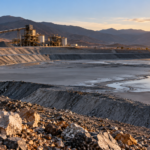
Extraction uses in-situ leaching. An ammonium compound solution is injected into the deposit, which displaces the adsorbed rare earth ions through an ion-exchange reaction. The resulting leachate is collected in tanks positioned downslope and then processed to recover rare earth oxides. The technique avoids the blasting and grinding required for hard-rock deposits, reducing energy input and processing complexity.
However, the leaching process carries well-documented environmental consequences in regions where it has been used at scale. Peer-reviewed studies of southern Chinese mining sites have recorded heavy REE contamination in surrounding water bodies, agricultural soils and stream sediments. The low-grade, diffuse character of these deposits also makes monitoring their footprint difficult. USGS researchers have used satellite imagery to identify leachate collection tanks in both China and Myanmar as a way of tracking extraction activity that is otherwise hard to observe from the surface.
China’s Position and What April 2025 Changed
Southern China — particularly Jiangxi, Fujian and Guangdong provinces — is the historical centre of ion-adsorption clay mining. Chinese deposits account for the overwhelming majority of processed heavy rare earth output, and China accounts for approximately 91% of refined magnet rare earth production globally, according to the IEA.
That concentration explains why China’s export controls on medium and heavy rare earths, introduced on April 4, 2025 through MOFCOM Announcement No. 18, caused an immediate market response. The announcement placed terbium, dysprosium, samarium, gadolinium, lutetium, scandium and yttrium under export licensing requirements. In October 2025, China extended those controls further, adding restrictions on rare earth technologies and applying licensing requirements to foreign entities operating within China.
The controls are not an outright ban. Exporters must apply for MOFCOM licenses, and approvals have been granted. However, the regime creates uncertainty, introduces delays and gives Chinese authorities discretionary control over which buyers receive material and at what volumes. That discretion is the key instrument of leverage.
Terbium oxide prices, already elevated before the controls were introduced, rose further following them. Dysprosium availability tightened. Market participants noted that a finite supply of legacy Chinese-origin material had been exported before the controls took effect — a supply that will not be replenished without license approval.
Why Myanmar’s Clay Deposits Matter
Myanmar’s Kachin State contains ion-adsorption clay deposits that extend the same geological formation responsible for China’s heavy rare earth production. The deposits sit in the northern reaches of the country along the border with China.
Together, Myanmar and China account for approximately 83% of global mined supply of heavy-magnet rare earths, according to IEA data. Myanmar supplied around 52.8% of China’s rare earth imports in 2025, according to S&P Global. The specific minerals extracted from Kachin — dysprosium and terbium — are the same elements now subject to Chinese export licensing controls.
That combination is what makes Kachin strategically significant. The deposits are not a minor or speculative resource. They are a substantial source of the exact materials that are now hardest to obtain outside China, located in territory adjacent to the country that controls processing.
The Kachin Independence Army seized the main rare earths belt, including the Chipwe-Pangwa mining area, in October 2024. The KIA subsequently raised taxes on mining operations and reduced production volumes. Terbium prices surged. China’s imports of rare earth material from Myanmar fell by approximately 50% in the first five months of 2025, before partially recovering.
China responded by pressing the KIA to stand down from its push to capture Bhamo, the garrison town that controls access to the main mining corridor, threatening to halt purchases from KIA-controlled areas entirely. That threat alone was sufficient to cause supply anxiety across global markets.
The Non-China Pipeline Is Small but Growing
Beyond Myanmar and the question of access to Kachin, several non-Chinese projects are building heavy rare earth production capacity. None are yet operating at a scale that matches China’s output.
Energy Fuels is investing approximately $104 million in a White Mesa Mill expansion in Utah, targeting annual capacity of up to 120 metric tonnes of dysprosium oxide and 20 metric tonnes of terbium oxide, with production aimed for late 2027. The company produced its first kilogram of terbium oxide and approximately 30 kilograms of dysprosium oxide in 2026.
Lynas Rare Earths began producing dysprosium and terbium oxide in the fourth quarter of its fiscal year ending June 2025 and has since added samarium to its separated heavy rare earth range. Its acquisition of Meteoric Resources, if completed by the targeted March 2027 close, would add Caldeira’s 127 tonnes per year of DyTb oxide over a 23-year mine life. The processing pathway through Lynas’s Malaysian facility gives it a route to qualified non-Chinese output.
MP Materials expected to begin initial terbium and dysprosium refining in the second half of 2026.
These projects represent genuine progress. However, the combined annual output they can reasonably deliver by 2028 remains a fraction of what the magnet industry requires at current and projected demand levels.
What the Industry Should Watch
Processing, not mining, is the binding constraint. Several countries host ion-adsorption clay deposits. The binding constraint on heavy rare earth availability is not the ore in the ground but separation and refining capacity outside China. Projects that can demonstrate processing capability and customer qualification — not just resource tonnage — carry the strategic weight.
The DyTb-to-NdPr ratio defines project value. A deposit with a high proportion of dysprosium-terbium content relative to its light rare earth endowment offers disproportionate strategic value. Investors and offtakers evaluating ionic clay projects should pay close attention to the HREE fraction, not just total rare earth oxide grades.
China’s licensing regime is discretionary, not binary. The April 2025 export controls give Beijing selective leverage over which buyers receive material and when. Western buyers who cannot demonstrate a non-Chinese supply option are effectively price-takers with no contractual certainty.
Myanmar’s deposits cannot be accessed without resolving the KIA question. The Kachin Independence Army controls the mines. Any supply chain relying on Kachin material must account for that reality, regardless of which government holds diplomatic standing.
The Caldeira acquisition is the most significant non-China ionic clay development. If the Lynas-Meteoric transaction closes and Caldeira reaches production, it will be the largest source of DyTb outside the China-Myanmar corridor. That makes it the most important project to track for anyone monitoring heavy rare earth supply.
The Magnet Supply Chain Has Two Chokepoints, Not One
The rare earth discussion frequently treats NdPr and DyTb as parts of the same supply problem. They are related but structurally different.
NdPr is available from multiple non-Chinese hard-rock sources and its supply picture, while imperfect, is more diversified. DyTb comes overwhelmingly from ion-adsorption clay deposits in southern China and Kachin State in Myanmar. Its production outside that corridor remains small, its prices reflect genuine scarcity and its function in the magnet supply chain cannot be easily removed.
China’s April 2025 export controls targeted the heavy elements specifically. That was not an accident. Heavy rare earths are where the leverage is most concentrated, the geology most restricted and the non-Chinese alternatives least developed.
The US engagement with Myanmar that Reuters has documented over the past month is a direct product of that landscape. Whether it produces anything that reaches a processing facility outside China depends on questions that are political and logistical rather than geological.
The ore is in the ground. So are most of the obstacles.
Sources
Lynas Acquires Meteoric in A$968m Deal — Northern Miner and Argus Media
Energy Fuels White Mesa Expansion — Metal Tech News
China MOFCOM Announcement No. 18 — IEA Policy Record and Holland and Knight
Terbium and Dysprosium Price Assessments — S&P Global Platts
Myanmar Rare Earths and KIA — Reuters via Mining.com
Myanmar as Strategic Hedge — S&P Global
Ion-Adsorption Clay Environmental Impacts — peer-reviewed study via AGRIS/FAO
USGS Satellite Dataset on Leachate Tanks in Myanmar and China — ScienceBase
US-Myanmar Tokyo Talks — Reuters via WHBL