By Charles Pitts

USA Rare Earth’s planned acquisition of Brazil’s Serra Verde is more than a mining transaction. It is an attempt to connect a non-Asian rare-earth resource with U.S.-backed financing, long-term offtake and future magnet supply chains.
The proposed deal values Serra Verde at approximately $2.8 billion and would give USA Rare Earth control of the Pela Ema mine and processing operation in Goiás. The transaction is supported by a package that includes $565 million in financing from the U.S. International Development Finance Corporation (DFC), a $750 million Department of War investment in a dedicated special purpose vehicle, an up-to-$500 million bank revolver and at least $300 million in forward purchases by the U.S. government.
Serra Verde expects to produce approximately 6,400 tonnes per year of rare-earth oxides by the end of 2027. That output would not make Brazil a replacement for China across the entire rare-earth market. It would, however, add a significant non-Asian source of neodymium, praseodymium, dysprosium and terbium : four elements central to permanent magnets, defense systems, electric motors and wind turbines.
The transaction therefore sits at the intersection of mining finance, industrial policy and the strategic race to build a more diversified critical-minerals supply chain.
More Read

Why Serra Verde matters to the rare-earth market
Pela Ema is an ionic-clay deposit near Minaçu in central Brazil. Unlike hard-rock rare-earth deposits, where valuable elements are locked inside minerals such as monazite or bastnaesite, ionic-clay deposits hold rare-earth ions on the surfaces of weathered clay particles.

That distinction affects the mine and processing design. Serra Verde’s operation uses shallow, soft material that can be extracted without the drilling, blasting and crushing circuits common in hard-rock mining. The rare-earth ions can then be released through leaching and recovered into a mixed rare-earth carbonate.
The process does not produce separated neodymium, praseodymium, dysprosium or terbium oxides at the mine site. Instead, Serra Verde produces an intermediate product containing a basket of rare earths. Downstream separation, refining and magnet manufacturing remain necessary before the material can enter many high-value industrial applications.
More Read

Even with that limitation, the resource is strategically differentiated. Serra Verde is described as the first scaled producer outside Asia to supply all four of the key magnetic rare earths:
- Neodymium and praseodymium (NdPr): Used in high-strength permanent magnets for electric vehicles, wind turbines, industrial motors, robotics and electronics.
- Dysprosium (Dy): Improves magnet performance at high temperatures, making it important for electric motors and aerospace or defense applications.
- Terbium (Tb): Used in smaller quantities but is highly valuable for high-temperature magnet performance and advanced technologies.
Industry estimates indicate that the 6,400-tonne annual TREO output could contain roughly 1,400 tonnes of NdPr, approximately 160–170 tonnes of dysprosium and around 30 tonnes of terbium, based on the reported product basket. These are oxide-equivalent estimates rather than separate products currently sold by Serra Verde.

Ionic-clay processing can reduce the need for hard-rock crushing and intensive mining circuits.
The support package changes the project’s risk profile
The acquisition is significant because the financing structure addresses several problems that have historically slowed non-Chinese rare-earth projects: large upfront capital requirements, uncertain pricing, limited downstream customers and difficulty securing commercial debt.
| Support mechanism | Amount | Function | Supply-chain significance |
|---|---|---|---|
| DFC financing | $565 million | Funds optimization and expansion toward positive cash flow | Supports mine and plant development at Pela Ema |
| Department of War SPV investment | $750 million | Capitalizes the special purpose vehicle purchasing Phase 1 output | Provides government-backed demand and working capital |
| Senior secured bank revolver | Up to $500 million | Funds the SPV’s purchases of rare-earth products | Adds liquidity for inventory and customer deliveries |
| U.S. government forward purchase | At least $300 million | Purchases rare-earth payable products over five years | Creates a contracted demand floor |
| Phase 1 offtake agreement | 100% of output for 15 years | Directs all Phase 1 production to the SPV | Reduces initial sales and customer-qualification risk |
The SPV’s disclosed capitalization totals approximately $1.55 billion when the Department of War investment and revolving facility are combined with the forward-purchase commitment. The structure effectively places the U.S. government closer to the role of anchor customer and project financier, rather than treating the mine as a conventional standalone producer.
That matters because rare-earth projects compete against established Asian supply chains with lower costs and much deeper processing capacity. Government-backed offtake can help bridge the gap between what a project costs to produce and what industrial customers are initially willing to pay.
The reported offtake structure also includes price floors for magnetic rare earths, including dysprosium and terbium. Those floors may improve revenue visibility for Serra Verde, but they do not remove operational exposure. The mine still has to achieve planned recovery rates, meet product specifications, ship material reliably and maintain a downstream route to separated products.
Brazil adds feedstock, but not yet a complete mine-to-magnet chain
For Brazil, the transaction could establish a larger role in the global rare-earth supply chain. Serra Verde is already in commercial production and operates in a region with established mining infrastructure, road access and grid power. The company says the operation uses electricity from a Brazilian grid with a high proportion of renewable generation.
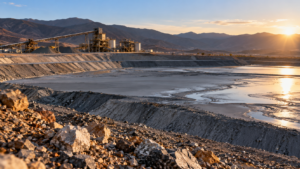
The project also benefits from a relatively shallow deposit and a processing route that does not require the same scale of crushing and grinding as many hard-rock operations. Serra Verde has highlighted drained tailings and the absence of wet tailings dams as features of its operating model.
Those advantages do not make the project risk-free. Brazil remains primarily a source of mine output and mixed intermediate material. It does not yet provide the full separation, metal-making and NdFeB magnet manufacturing chain required to convert Pela Ema’s product into finished components.
The U.S. strategic benefit will therefore depend on what happens after the material leaves Goiás. If the mixed carbonate is separated in China, the mine would add geographic diversity at the extraction stage while leaving a major downstream dependency intact. If USA Rare Earth and its partners establish reliable separation and magnet capacity in the United States or allied countries, Serra Verde could become part of a more complete non-Asian chain.
That distinction is central to the transaction’s strategic value. Diversifying mining is useful; diversifying processing is more difficult and may be more important.
Readers tracking the broader policy environment can compare the transaction with Skillings’ analysis of the 2026 critical-minerals supply chain, the China critical-minerals controls timeline and Energy Fuels’ mine-to-magnet strategy.
The main execution risks
1. Ramp-up risk
The 6,400-tonne target is an end-2027 production objective, not current output. Reaching it will require stable mining, consistent feed quality, reliable leaching performance and sustained plant availability.
Ionic-clay deposits can offer simpler extraction, but recoveries may vary with clay chemistry, moisture, mineralogy and feed blending. A plant that performs well during commissioning may still face variability when it moves to full-scale operations.
2. Intermediate-product risk
Serra Verde’s mixed rare-earth carbonate is not equivalent to separated oxides or metals. The project’s commercial success will depend on qualified separation capacity and customers willing to accept the product under the offtake structure.
The SPV reduces demand risk for Phase 1, but it does not by itself create a Western separation plant. Downstream bottlenecks could affect realized prices, delivery schedules and the timing of revenue conversion.
3. Financing and transaction risk
The acquisition is structured around a substantial equity component alongside cash consideration. USA Rare Earth has also had to assemble multiple government and commercial financing commitments.
Closing conditions, final documentation, regulatory approvals and funding availability remain important milestones. Delays could push back expansion spending or change the timing of the production ramp.
4. Concentration risk
The SPV is expected to purchase 100% of Phase 1 output for 15 years. That provides visibility, but it also concentrates the initial sales channel around one structure.
For operators and investors, the relevant questions are whether the SPV can resell or process the material competitively, how price floors interact with market prices and whether future expansion output will have a broader customer base.
5. Geopolitical response
China remains dominant in rare-earth separation, refining and permanent magnets. New U.S.-backed supply could prompt lower pricing, tighter technology controls or changes in export policy.
The transaction is therefore not only a Brazilian mining investment. It is also part of a larger geopolitical contest over the industrial capacity required for energy transition technologies and defense manufacturing.
Base, bull and bear scenarios
| Scenario | Operational outcome | Supply-chain impact | Key trigger |
|---|---|---|---|
| Base case | Serra Verde approaches the 6,400-tonne target, with periodic ramp-up delays | Brazil adds meaningful non-Asian feedstock, but separation remains a constraint | Expansion is completed while downstream capacity develops gradually |
| Bull case | Pela Ema reaches nameplate capacity on schedule and future expansion advances | Serra Verde becomes an anchor for a Brazil-U.S. mine-to-magnet chain | Government support, separation investment and customer qualification align |
| Bear case | Plant or mining variability delays the ramp and raises unit costs | The project supplies material but does not materially reduce downstream dependence on Asia | Commissioning delays, financing changes or weak separation economics |
The most important monitoring points through 2027 are plant throughput, recovery rates, mixed-carbonate specifications, DFC drawdowns, SPV purchasing activity and progress on non-Asian separation capacity.

Dry handling and filtered tailings are central features of the project’s operating model.
What the acquisition means for 2026 supply-chain strategy
USA Rare Earth’s planned Serra Verde acquisition demonstrates how critical-minerals projects are increasingly being financed as strategic infrastructure rather than ordinary mining assets.
The transaction combines a producing Brazilian resource, U.S. public capital, contracted demand and a long-term offtake structure. That combination could improve the bankability of a rare-earth operation whose value is not fully captured by spot-market pricing.
It also exposes the limits of mine-focused supply-chain policy. Serra Verde can provide important NdPr, dysprosium and terbium feedstock, but the strategic objective will not be complete until separation, metal-making and magnet production are available on a competitive basis.
For Brazil, the deal creates an opportunity to move up the critical-minerals ladder while retaining mining, processing and infrastructure responsibilities at home. For the United States, it provides a potential source of magnetic rare earths outside Asia, but one that still requires international logistics and downstream industrial investment.
The decisive test is therefore execution. If Serra Verde reaches production targets and the U.S. builds credible separation and magnet capacity around the project, Brazil could become a durable pillar of the non-Asian rare-earth supply chain. If downstream investment lags, the transaction may diversify ore supply without fully breaking the processing bottleneck.