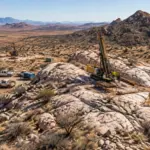
Diamond drilling at a remote copper exploration site.

Recent drill results from Alaska, Arizona, Peru and Canada illustrate why copper exploration is attracting renewed attention: and why headline intercepts must be read carefully.
Vizsla Copper reported 49.2 metres grading 4.7% copper equivalent (CuEq) at its Palmer project in Southeast Alaska. Faraday Copper reported 19 metres at 0.55% copper at Copper Creek in Arizona. Pecoy Copper outlined 804 metres at 0.34% copper in southern Peru, while Sterling Metals extended the mineralized strike of its MEPS discovery to more than 1.3 kilometres.
Taken together, the results show four different ways a copper exploration program can add value: high grade, near-surface mineralization, broad bulk-tonnage continuity and district-scale strike. They do not, however, represent four new mines or an immediate increase in global supply.
The key question for operators, investors and policymakers is what each result proves: and what remains unproven.

Four results, four exploration signals
| Project and company | Reported result | Deposit or target style | What the result supports | What it does not yet prove |
|---|---|---|---|---|
| Palmer, Vizsla Copper | 49.2 m at 4.7% CuEq, including 27.0 m at 8.4% CuEq | Polymetallic VMS | High-grade continuity and a stronger geological model | A mineable reserve or final economic case |
| Copper Creek, Faraday Copper | 19 m at 0.55% Cu from 42 m | Porphyry and breccia system | Near-surface mineralization and potential resource growth | That every mineralized zone can support profitable open-pit mining |
| Pecoy, Pecoy Copper | 804 m at 0.34% Cu from 24 m | Large porphyry copper-gold-molybdenum-silver system | Broad mineralized volume and continuity | Sufficient grade, recovery or infrastructure for development |
| MEPS, Sterling Metals | More than 1.3 km of mineralized strike; key hole 451 m at 0.30% CuEq | Copper-molybdenum porphyry system | Scale, strike continuity and additional targets | A resource estimate based on defined tonnage and confidence categories |
The comparison is useful precisely because the numbers are not measuring the same thing. Palmer’s headline is a grade-and-thickness result from a high-grade polymetallic system. Pecoy’s result is primarily a scale result. Faraday’s intercept is important because it is shallow and located within a broader exploration district. Sterling’s 1.3-kilometre figure is a strike-length measure, not a single continuous drill intercept.

Comparing them without that geological context can produce misleading conclusions.
Palmer: grade, thickness and continuity
Vizsla’s Palmer release reported results from drill holes CMR26-199 and CMR26-201 in the South Wall Zone 1.
Hole CMR26-199 returned 49.2 metres at 4.7% CuEq, consisting of 3.05% copper, 4.85% zinc, 21.88 grams per tonne silver and 0.33 grams per tonne gold. Within that interval, 27 metres graded 8.4% CuEq, while a narrower 13.1-metre section returned 9.03% copper and 10.3% CuEq.
A second hole, drilled approximately 50 metres downdip, returned 40.4 metres at 3.0% CuEq, including 12.2 metres at 4.9% CuEq.
That second intersection matters as much as the headline number. A single high-grade interval can reflect a local lens or structural feature. A second hole that confirms mineralization downdip provides evidence that the high-grade core may have meaningful continuity.
Palmer is a volcanogenic massive sulphide, or VMS, project with copper, zinc, silver and gold. Its CuEq calculation therefore depends on metal prices, recoveries and the relative contribution of byproducts. Readers should not treat 4.7% CuEq as equivalent to 4.7% copper.
The immediate exploration implication is strong: Vizsla expanded its 2026 program from 10,000 metres to approximately 12,250 metres, with additional drilling at the HG prospect and Palmer Extension target. The next test is whether the high-grade core can be linked across enough strike, depth and width to materially change the project’s resource model.

Copper sulphide mineralization in diamond drill core.
Copper Creek: shallow mineralization and resource growth
Faraday’s Copper Creek results provide a different type of signal.
Drill hole FCD-26-192 intersected 19 metres at 0.55% copper from 42 metres, within a previously undrilled breccia and porphyry trend in the American Eagle area. The company also reported other near-surface intervals, including 20 metres at 0.52% copper and 31 metres at 0.25% copper.
The value of these results is not determined by grade alone. Near-surface mineralization can reduce future stripping requirements and may be more compatible with open-pit mining. At Copper Creek, the results also help connect separate breccia and porphyry targets across a large district-scale system.
Faraday reported oxide mineralization east of the Copper Giant breccia over intervals ranging from approximately 50 to 100 metres. Oxide material can potentially support a different processing route from sulphide ore, although recovery tests, leach kinetics, acid consumption and water management remain essential.
The company said the drilling will be incorporated into a planned mineral resource update. Until that update is complete, the results should be viewed as evidence of potential resource expansion rather than as additional declared tonnes.
Pecoy: scale matters, but low grade raises the economic bar
Pecoy’s 804-metre intercept at the South Breccia zone demonstrates why porphyry copper systems are often evaluated differently from high-grade VMS deposits.
Hole PEC26-072 intersected 804 metres at 0.34% copper from 24 metres, with associated gold, silver and molybdenum. Within the broader interval, Pecoy reported 485.2 metres at 0.40% copper and a 100.8-metre section at 0.56% copper.
This type of result can support a large, near-surface mineralized envelope. It may also improve confidence in the continuity of an existing resource model. But a long interval at 0.34% copper does not automatically translate into economic ore.
At this grade, project economics are highly sensitive to:
- Mining scale and strip ratio
- Processing recovery and throughput
- Power, water and transport infrastructure
- Copper and byproduct prices
- Capital intensity
- Permitting and community agreements
- Dilution and material movement within the mine plan
A low-grade porphyry can be commercially viable when it has exceptional scale, favorable metallurgy and efficient infrastructure. The same grade can be uneconomic if the deposit is remote, deeply weathered, difficult to process or expensive to permit.
Sterling’s MEPS discovery: strike length is a scale indicator
Sterling Metals’ MEPS discovery at the Soo Copper Project highlights another important distinction: strike length is not the same as resource tonnage.
Sterling reported that drilling extended the MEPS mineralized trend to more than 1.3 kilometres. The company’s SC-26-16 hole returned approximately 451 metres at 0.30% CuEq, including 101 metres at 0.50% CuEq and 12 metres at 1.70% CuEq, according to the company’s MEPS exploration update.
The result supports continuity along a broad copper-molybdenum corridor and identifies a mineralized porphyry stock at depth. That expands the geological target and could provide more volume for future drilling.
However, a 1.3-kilometre trend still requires information on average thickness, depth, density, grade distribution and the orientation of mineralized domains. A long, narrow zone may contain less material than a shorter but thicker body. Conversely, broad near-surface porphyry mineralization can support substantial tonnage even at moderate grades.
Why a drill intercept is not an economic resource
A drill intercept is a measurement along a borehole. A mineral resource is a three-dimensional estimate supported by geological evidence, sampling quality, density data, estimation methods and reasonable prospects for eventual economic extraction.
The difference can be summarized in five steps:
- Geology: Drill holes must establish the shape and geological controls of mineralization.
- Continuity: Results must demonstrate that grade and thickness can reasonably be projected between holes.
- Estimation: The mineralized volume must be modeled using appropriate domains, assays, densities and interpolation methods.
- Metallurgy: Testwork must show how much copper and byproduct metal can be recovered using a practical flowsheet.
- Modifying factors: Mining, infrastructure, permitting, environmental, social and economic constraints must be considered.
The CIM Best Practice Guidelines and comparable reporting frameworks distinguish mineral resources from mineral reserves for this reason. Resources have reasonable prospects for eventual economic extraction; reserves require additional confidence and the application of modifying factors through a pre-feasibility or feasibility study.
That distinction is particularly important for copper supply analysis. Exploration results may expand the future project pipeline, but they do not add refined copper to the market until a project secures approvals, financing, construction capacity, processing infrastructure and a production schedule.
What these results change for future supply
The four exploration updates improve the outlook for potential copper supply in different ways:
- Palmer adds evidence that high-grade mineralization may be continuous enough to support resource growth.
- Copper Creek strengthens the case for near-surface expansion and future oxide-sulphide development options.
- Pecoy reinforces the presence of a very broad, low-grade mineralized system.
- MEPS increases confidence in the size and continuity of a copper-molybdenum exploration corridor.
None removes the development risks facing new copper projects. They do, however, show why the industry needs a portfolio of exploration styles. High-grade deposits can improve project economics, while large porphyry systems provide the volume required for long-life production.
For decision-makers tracking the energy transition and critical minerals supply gaps, the next milestones are more important than the initial headlines: updated resources, metallurgical recoveries, drill spacing, permitting progress, infrastructure studies and economic sensitivity analysis.
The most useful conclusion is therefore measured. New drilling can change the geological model and improve the probability of future supply. It becomes a supply story only after the deposit survives the technical, economic, regulatory and construction tests that separate an exploration result from an operating mine.