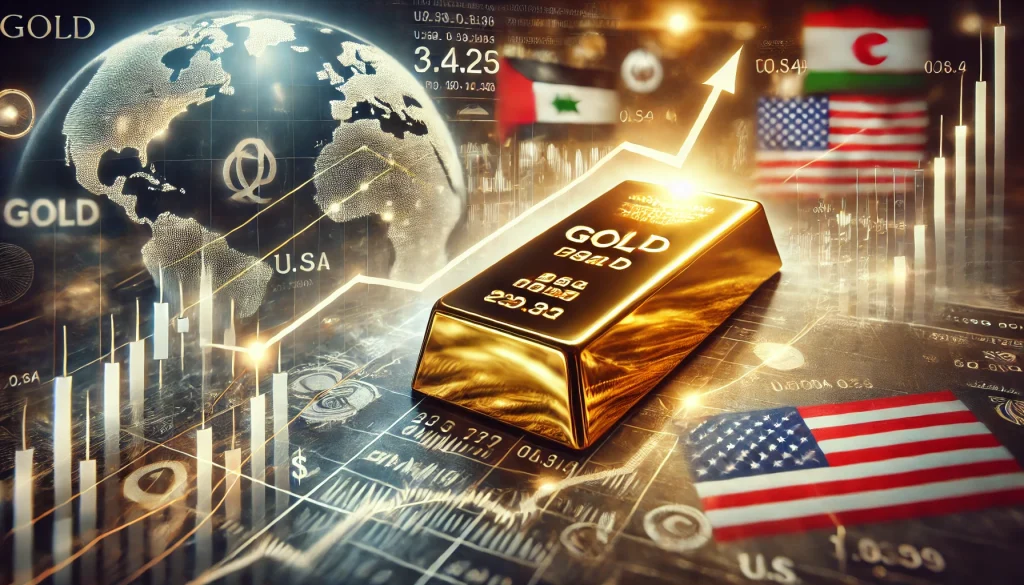
Gold futures reached a record high on Wednesday, with December contracts briefly hitting $2,801.70 per ounce in CME’s overnight trading. The metal’s ascent—up roughly 34% for the year—defies usual trends, where a stronger dollar and rising bond yields typically dampen demand for gold. However, sustained geopolitical tensions, fueled by the ongoing Middle East conflict and uncertainty surrounding the U.S. presidential election, have kept investors turning to bullion as a safe haven.

Election Uncertainty Fuels Demand for Safe Assets
The U.S. election, with its sharply divided political landscape, has injected volatility across financial markets. Analysts say a second Trump presidency could increase the likelihood of trade tariffs and other inflationary pressures, driving investor interest in gold as a hedge against policy-driven disruptions.
Market positioning is elevated ahead of the election, but also in anticipation of further Fed rate cuts and broader market and geopolitical uncertainty,” said Suki Cooper, an analyst at Standard Chartered Plc. She noted that, regardless of the election outcome, investors are preparing for volatility, anticipating that potential tariffs or other policy shifts could lead to further price appreciation for safe-haven assets like gold.
Saxo Bank added, “Gold trades up on the week, despite deflating risk premiums elsewhere,” noting that the market’s focus remains firmly on the potential impact of a Trump 2.0 administration. Saxo’s analysis highlights concerns over possible policy disruptions, renewed trade tariffs, and heightened geopolitical risks, which could add further momentum to gold’s rally.
Third-Quarter Gold Demand Sets New Record
The World Gold Council reported a 5% increase in global gold demand in the third quarter, pushing gold consumption past the $100 billion mark for the first time. Volumes reached 1,313 tons, driven largely by increased investment flows from high-net-worth individuals in the West. This demand spike reflects a growing appetite for secure, tangible assets amidst global instability and indicates that gold may continue to play a central role in investment strategies.

Investment flows have grown significantly, particularly in Western markets where high-net-worth investors are seeking protection against both market volatility and policy shifts,” said Juan Carlos Artigas, Head of Research at the World Gold Council. This surge in demand underscores gold’s staying power, even in the face of rising yields and other factors that traditionally lessen the metal’s appeal.

Fed Rate Expectations Keep Gold’s Momentum Intact
Adding to gold’s momentum is the Federal Reserve’s potential shift on interest rates. Investors have factored in nearly a 100% chance that the Fed will implement a 25-basis-point rate cut in November, creating an environment likely to support continued gold price growth. Recent economic data has shown mixed signals: U.S. job openings dropped sharply, but consumer confidence exceeded expectations, keeping investors on edge for further clues about the Fed’s policy direction.
“Gold should retain its upward bias and may even flirt with $2,800 in the days ahead,” said Han Tan, chief market analyst at Exinity Group, citing election-related market jitters and the likelihood of Fed rate cuts as sustaining factors for gold’s current trajectory.

Outlook: Can Gold Sustain This Record-Breaking Rally?
With the election fast approaching, analysts generally agree that the near-term outlook for gold remains bullish. However, significant uncertainties persist, especially regarding potential policy changes post-election. If the Fed pauses rate cuts or the geopolitical landscape shifts dramatically, the metal’s rally could face pressure.
At present, gold’s year-to-date gains underscore a sustained demand for assets that buffer against volatility. This year’s trajectory reinforces its traditional role as a safe haven, especially when economic and geopolitical uncertainties converge.
For now, gold remains a favored asset among investors seeking stability, with analysts suggesting that its recent record highs could be only a stepping stone if current trends continue.