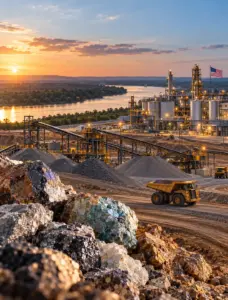
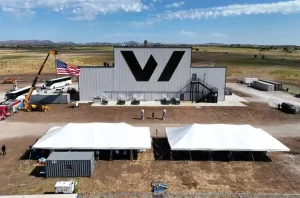
The global rare earth supply chain is a house of cards, and 2026 is the year the wind starts blowing.

For decades, the West treated rare earth elements (REEs) as a niche commodity: a specialty chemical concern tucked away in the shadows of bulk iron ore and copper. That era is dead. Today, REEs are the nervous system of the global battery revolution, the muscles of wind turbines, and the brains of precision-guided munitions.
But there is a fundamental tension in 2026: demand is skyrocketing while the supply chain remains dangerously concentrated. China still controls roughly 91 percent of the total supply chain, from the initial blast at the mine face to the final sintering of high-performance magnets.
This guide serves as a clear-eyed assessment of the rare earth mining landscape in 2026. We aren't here for the hype; we’re here for the geology, the permitting realities, and the brutal chemistry of extraction.
The Exploration Landscape: Beyond the "Rare" Misnomer
Here is the first uncomfortable truth: rare earths aren’t actually rare. Cerium is more abundant in the Earth’s crust than copper. The "rare" in rare earths refers to the difficulty of finding them in concentrations that make economic sense to dig up.
More Read

In 2026, the exploration focus has shifted from "finding anything" to "finding the right thing." The industry is zeroing in on Neodymium and Praseodymium (NdPr), the workhorses of the permanent magnet market.

Where the Money is Going
Exploration capital is currently terrified of geopolitical risk. As a result, 80 percent of global exploration budgets are concentrated in just four jurisdictions: Australia, Brazil, the USA, and Canada.
Junior explorers are doing the heavy lifting. While the majors: Rio Tinto, BHP, Vale: are sniffing around the edges, the real boots-on-the-ground work is being done by small-cap companies trying to prove up the next Mountain Pass or Lynas.
More Read
We are also seeing significant interest in Europe. The Per Geijer discovery in Sweden remains the poster child for domestic European supply, but the timeline from discovery to first ore remains a decade-long marathon.

Permitting: The Invisible Bottleneck
You can have the highest-grade REE deposit on the planet, but if you can’t get a social license to operate, you have a very expensive rock collection.
In 2026, permitting is no longer just about environmental impact statements. It’s about the "S" and "G" in ESG. The mining industry has a history of messy tailings and radioactive byproducts (specifically Thorium and Uranium) associated with rare earth deposits.
The Regulatory Gauntlet
Regulators are no longer accepting "we'll handle it later" as a waste management strategy. To navigate this, operators must avoid the 7 mistakes often made in mining ESG reporting.
In the United States, the permitting process remains a quagmire of federal, state, and local approvals. However, the Trump administration’s 2025 push for critical mineral independence has started to streamline certain environmental reviews for projects deemed "strategically vital." That sounds good on paper, but in the field, it still takes years to move the needle.
The strategy for 2026 is clear: Permitting is the primary project risk. Investors are no longer looking at drill results alone; they are looking at the tenure of the water rights and the proximity to protected habitats.
Extraction and Processing: The Chemistry War
Mining the ore is the easy part. The real nightmare starts at the mill.
Rare earth elements are chemically similar, meaning they "stick" together. Separating them into 99.9% pure individual oxides requires a complex process called solvent extraction (SX). This involves hundreds of stages of chemical baths: a process that is capital-intensive, chemically aggressive, and technically demanding.
The Technical Divide
China’s dominance isn't just a result of cheap labor or lax regulations; it’s a result of 30 years of refined chemical expertise. While the West is trying to "re-learn" how to separate heavy rare earths (HREEs) like Dysprosium and Terbium, China is already optimizing the next generation of automation.
In 2026, we are seeing three distinct extraction trends:
- In-Situ Recovery (ISR): Adapted from the uranium industry, ISR is being tested for certain ionic clay deposits to reduce the surface footprint.
- Hydrometallurgical Innovation: New reagents are being developed to reduce the acid consumption in bastnaesite and monazite processing.
- Direct Magnet Recycling: Because mining is so hard, companies are increasingly looking at "urban mining": extracting REEs from old hard drives and EV motors.

The 2026 Market Outlook: Bull vs. Bear
The strategic calculus for rare earth mining in 2026 is defined by a massive investment gap. Global mining capital spending reached $186 billion in 2024, but to meet the 2035 targets for the energy transition, that number needs to hit $260 billion annually.
The Bull Case
- US Government Support: The $1.4 billion public-private partnership announced in late 2025 is finally hitting the ground. This includes CHIPS Act incentives and Department of Defense loans specifically for magnet production.
- The "China Plus One" Strategy: Western OEMs (Original Equipment Manufacturers) are now willing to pay a premium for "clean" and "secure" rare earths that don't originate from the Chinese monopoly.
- Defense Demand: With global tensions rising, the military-industrial complex is demanding a domestic supply of Samarium-Cobalt magnets for missile guidance systems. This demand is price-inelastic.
The Bear Case
- Substitution Risk: If prices spike too high, engineers will do what they always do: innovate around the problem. We are already seeing "heavy-rare-earth-free" magnets entering the market.
- The Kazakhstan Effect: Much like how western explorers abandoned the world's top uranium producer, there is a fear that geopolitical shifts in Central Asia or Africa could suddenly flood or choke the market, rendering new Western mines uncompetitive.
- Capital Starvation: Despite the talk, the "big money" is still hesitant. Rare earth projects are complex and have a high failure rate during the commissioning phase.
Critical Minerals: A Comparative View
It is easy to get tunnel vision with rare earths, but they exist in a broader ecosystem of critical minerals.
| Mineral | 2026 Status | Comparison to REE |
|---|---|---|
| Lithium | Supply surplus easing | Price outlook 2026 shows more volatility than REE. |
| Copper | Structural deficit | Higher volume, lower technical processing hurdle than REE. |
| Uranium | Bull market | Similar permitting hurdles (radioactivity) as REE. |
Rare earths are the most "policy-sensitive" of the group. A single trade tweet or an export ban on processing technology can swing the market 20% in a week.

Summary for Decision Makers
If you are an operator or an investor in the rare earth space in 2026, you need to accept three realities:
- You cannot disrupt geology. The timeline for a new mine is 10 to 15 years. Anyone promising a "fast-track" to production in 24 months is selling fantasy.
- Processing is the moat. Owning the mine is good; owning the separation plant is better. The value-add happens in the chemistry, not the crushing.
- The government is your partner (and your problem). You will rely on subsidies and "strategic" designations, but you will also be subject to the whims of shifting trade policies and tariffs.
2026 marks the inflection point where the industry moves from talk to steel in the ground. The demand is there. The technology is maturing. The question is whether the Western capital markets have the stomach for the 15-year horizon required to break the stranglehold.
There is not enough to go around. Those who secure supply now will win the decade. Those who wait for "market stability" will be left behind.
Social Media Snippet:
Rare earth mining in 2026: 91% of the supply chain is still in China, but a $1.4B US push is finally fighting back. From the Per Geijer discovery to the "chemistry war" of separation, here is the comprehensive guide for operators and investors. #RareEarths #Mining #CriticalMinerals #EnergyTransition