By Charles Pitts

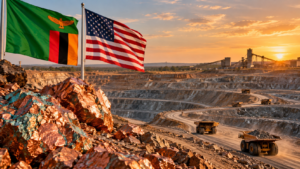
A technician monitors operations at a Canadian uranium facility as supply chains tighten globally.
NEW DELHI : Diplomacy is cheap. Uranium is expensive. After years of frosty relations and diplomatic theater, India and Canada have decided that energy security is more important than political posturing. The two nations signed a landmark $2.6 billion (CAD) uranium supply agreement on Friday, signaling a massive strategic reset that prioritizes the nuclear fuel cycle over lingering grievances.
Under the terms of the deal, Saskatoon-based Cameco Corp. will supply approximately 22 million pounds of uranium ore concentrate to India’s Department of Atomic Energy. The contract spans nine years, from 2027 to 2035, ensuring a steady stream of “yellowcake” to power India’s rapidly expanding fleet of nuclear reactors.
This isn’t just a trade agreement. It’s a lifeline. India produces roughly 600 tons of uranium annually but requires more than 1,800 tons to keep its current grid operational. The math doesn’t lie: without Canadian supply, India’s clean energy ambitions are effectively dead on arrival.
More Read

The Brutal Reality of India’s Energy Gap
India is currently operating 24 nuclear reactors, with dozens more in various stages of planning or construction. The goal is audacious: 100 GW of nuclear capacity by 2047. To get there, New Delhi needs a partner that won’t blink when the geopolitical winds change.

Canada, home to some of the world’s highest-grade uranium deposits in the Athabasca Basin, is that partner. The strategic calculus here isn’t subtle: India needs the atoms, and Canada needs a diversified customer base that isn’t the United States or China.
“This is a fundamental shift in how we view bilateral energy cooperation,” said one senior Indian official on the sidelines of the signing ceremony. “We are moving past the friction of the last few years and focusing on the 20-year horizon.”
More Read

For Cameco, the deal is a massive win. At CAD $2.6 billion, the contract reflects market-related pricing terms that protect the producer against the volatility that has historically plagued the uranium sector. It also solidifies Cameco’s position as the primary Western alternative to state-controlled supply chains from Russia and Kazakhstan.

Three mining professionals collaborate at an open-pit mining site with heavy machinery.
Beyond the Yellowcake: The Carney Factor
The timing of the deal coincides with Canadian Prime Minister Mark Carney’s first official state visit to India. It’s no secret that relations under the previous administration were, to put it mildly, abysmal. Carney appears determined to wipe the slate clean with a “business-first” approach that skips the moralizing in favor of market share.
Beyond uranium, the two nations have agreed to accelerate negotiations on a Comprehensive Economic Partnership Agreement (CEPA). The target? Completion by the end of 2026. They’ve also set an ambitious goal to grow bilateral trade to $50 billion by 2030.
This is a complete reversal of the trend line. In 2024 and 2025, trade discussions were largely shelved. Now, they are the centerpiece. The deal also includes memorandums of understanding on critical minerals: think lithium and copper: which are essential for the electric vehicle supply chain.

Table: India-Canada Strategic Trade Targets (2026-2035)
While the uranium deal is the headline-grabber, the underlying movement into critical minerals is where the real competition lies. As China tightens its grip on mineral exports, Western-aligned democracies like India and Canada are being forced into a marriage of convenience.
The Nuclear Stranglehold
Let’s look at the numbers. They’re nasty.
The global uranium market is currently in a state of structural deficit. Demand from AI-driven data centers and the global push for decarbonization has sent prices to decade highs. India’s decision to lock in 22 million pounds now is a hedge against a future where supply might not just be expensive: it might be unavailable.
Per facility, the consumption rates are staggering. That’s not a typo. India’s current shortfall of 1,200 tons per year is only going to grow as new 700 MW Pressurized Heavy Water Reactors (PHWRs) come online. The Cameco deal covers a significant portion of that gap, but it doesn’t close it entirely. India will still be shopping in the global market, likely looking toward Namibia or Uzbekistan to fill the remainder.
However, the Canadian deal is the “gold standard” for New Delhi. Canadian uranium is high-grade and, more importantly, it comes with the transparency required for international civil nuclear cooperation agreements.
A Strategic Reset with Teeth
The geopolitical context here is the “uncomfortable truth” that both sides have finally acknowledged. Canada’s economy is heavily tied to the extraction of resources, and India’s economy is a resource-hungry engine that needs to maintain 7-8% GDP growth.
“You can’t disrupt geology,” says an industry analyst. “Canada has the rocks, India has the demand. Everything else is just noise.”
The agreement also signals that Canada is ready to diversify its exports. For too long, the Canadian mining sector has been a junior partner to the U.S. industrial machine. By securing a nine-year deal with India, Cameco and the Canadian government are planting a flag in the Indo-Pacific.
This isn’t just about electricity. It’s about semiconductors, AI, and quantum computing. The joint statement released by Carney and Indian Prime Minister Narendra Modi specifically mentioned cooperation in advanced technologies. You don’t get to play in the AI revolution without a stable power grid. In India, that grid is being built on a foundation of nuclear energy.

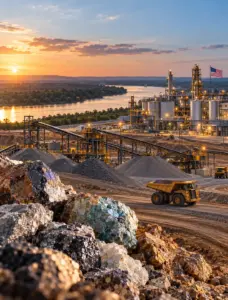
A modern mineral processing plant at sunrise, illustrating the scale of industrial infrastructure required for the nuclear pivot.
The Bottom Line for Investors and Operators
For the mining industry, this deal is a signal that the “Nuclear Renaissance” has moved from the PowerPoint stage to the procurement stage. We’re seeing massive capital being deployed to secure long-term supply.
If you’re an operator in the Athabasca Basin or an investor looking at the uranium space, the message is clear: the floor for uranium prices is being set by sovereign-level demand. India isn’t buying this uranium to speculate on the price; they’re buying it because they’ll have a national crisis if they don’t.
And here is what makes this particularly nasty for latecomers: the supply is already being spoken for. Between the U.S. banning Russian imports and India locking up Canadian production, the “free” supply of uranium is evaporating.
There’s not enough to go around.
What Happens Next?
Expect the CEPA negotiations to dominate the headlines for the remainder of 2026. If India and Canada can truly normalize their relationship, we could see a flurry of investment in Canadian junior mining firms by Indian state-owned enterprises. India has the capital and the hunger; Canada has the projects that need de-risking.
The 2026 inflection point is here. The “Nuclear Pivot” isn’t a theoretical exercise anymore. It’s a $2.6 billion reality.
Key Takeaways:
- Provider: Cameco Corp.
- Volume: 22 Million lbs of U3O8.
- Timeline: 2027–2035.
- Value: CAD $2.6 Billion.
- Strategic Goal: India aims for 100 GW nuclear capacity by 2047.
India and Canada have realized that in the race for energy dominance, you don’t have to like your partner: you just have to trust their supply chain. The frost has melted, replaced by the warm glow of a nuclear-powered future.