Geology is no longer just about what is in the ground. In 2026, geology is statecraft. For decades, the global lithium market functioned like a traditional commodity play: cyclical, price-sensitive, and dominated by whoever could dig it out the fastest. That era ended in January 2025.

The US-Chile alliance isn’t just a trade agreement; it is a tactical realignment of the Western hemisphere’s industrial base. By funneling over $1 billion into Latin American critical minerals in just the last fourteen months, Washington has signaled that the “free market” in battery metals is officially a matter of national security. The goal is blunt: bypass the Chinese processing stranglehold and secure a direct pipeline from the Atacama to the American gigafactory.
The $1 Billion Strategic Pivot
The strategic calculus here isn’t subtle. The United States has spent the better part of the last decade watching Beijing secure long-term offtake agreements and equity stakes in the “Lithium Triangle.” But the tide is turning. Since the start of 2025, the U.S. has ramped up investment focus on Latin America with surgical precision.
This isn’t venture capital money. This is defense-adjacent funding aimed at de-risking the supply chain. While junior miners often struggle to bridge the gap from exploration to production, the US-Chile pact provides a framework for institutional stability. It’s a move to ensure that when a company like Rio Tinto expands its footprint, the infrastructure exists to move that product north, not just east.
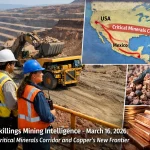
The numbers are brutal for those trailing behind. Latin America holds roughly 60% of the world’s lithium reserves. Until recently, a significant portion of that was destined for Chinese refineries. By establishing “The Critical Corridor,” the U.S. is essentially building a dedicated lane for refined battery grade carbonate.
More Read

Nova Andino Litio: The Corporate Weapon
At the heart of this geopolitical shift is a massive corporate restructuring. The merger of Codelco and SQM’s lithium subsidiaries into Nova Andino Litio is perhaps the most significant public-private partnership in Chile’s history. This joint venture doesn’t just consolidate exploration; it secures Chilean state leadership through 2060.

For global strategists, Nova Andino Litio represents the new “Gold Standard” for mining partnerships. It balances resource nationalism with the operational expertise of SQM.

More Read

The JV is tasked with managing the Salar de Atacama, a region that remains the lowest-cost lithium source on the planet. For investors, this provides a rare commodity: long-term certainty. In a market where lithium carbonate prices have rebounded to $18,200 per tonne as of January 2026, having a 35-year clear runway is an asset that cannot be overstated.
Breaking the Processing Chokepoint
Extraction is only half the battle. The real “chokepoint” has always been processing. China currently controls the vast majority of the world’s refining capacity for lithium and rare earths. Even if the lithium is mined in Chile, it often travels 11,000 miles to be processed before it can ever sit in an EV battery in Michigan.
The US-Chile pact seeks to shorten this loop. By incentivizing the development of regional processing hubs, the alliance aims to keep more of the value chain within the hemisphere. This mirrors trends we are seeing elsewhere, such as the Per Geijer rare earth project in Sweden, where the focus has shifted from “just mining” to “integrated supply.”

The “Critical Corridor” isn’t just about lithium, either. Copper, the “indispensable metal,” is the other pillar of this alliance. Chile remains the world’s top copper producer, but the industry is staring down a $2.1 trillion investment gap to meet 2050 goals. The US-Chile pact provides the diplomatic and financial scaffolding to bridge that gap by de-risking high-altitude Andean projects.
Regional Cooperation vs. Global Chokepoints
The US strategy isn’t limited to Santiago. It’s a continental play. While Chile is the anchor, the Inter-American Development Bank recently approved a $100 million loan for a $2.5 billion project in Argentina. Simultaneously, the U.S. Development Finance Corporation is eying a nearly half-billion-dollar investment in Brazilian rare earth operations.
This regionalism is a direct response to the weaponization of supply chains. When global trade routes face tension: whether in the South China Sea or through tariffs: the North-South axis of the Americas becomes the safest bet for Western manufacturers.
However, this isn’t without its friction. Resource nationalism in the region remains a “known-unknown.” Governments are no longer content with just receiving royalties; they want technology transfers and domestic processing. This is why the PDAC 2025 conference was such a pivotal moment: it was the first time we saw a unified front between North American capital and South American resource holders.

2026 Market Outlook: The Inflection Point
As we look toward the World Lithium Conference in Santiago this April, the market is at an inflection point. The surplus of 2024 has been digested. Grid-scale energy storage systems are expanding at a rate that is hammering out the remaining volatility in lithium prices.
For investors, the US-Chile alliance offers a clear signal: the “Critical Corridor” is the safest jurisdiction for long-term capital. While projects in frontier markets struggle with infrastructure and political instability, the Chile-US axis is being built on a foundation of legal certainty and shared geopolitical interest.
But there’s a catch. This alliance requires a massive leap in mining technology. To maintain the “social license” to operate in sensitive areas like the Atacama, companies must adopt eco-friendly mining technology and more efficient water management systems. Direct Lithium Extraction (DLE) is no longer a “future tech”: it is a baseline requirement for new permits.
The Investor’s Reality Check
Let’s be clear: you can’t disrupt geology. China’s head start in the battery race was significant, but it wasn’t insurmountable. The US-Chile pact is the first real evidence that the West is willing to play the long game.
Here is the kicker for those managing portfolios: the “Critical Corridor” effectively bifurcates the market. We are moving toward a two-tier pricing system: one for minerals sourced from “friendly” jurisdictions with high ESG standards, and one for the rest. If you are holding assets that rely on the old, fragile supply chains, the clock is ticking.
The strategic calculus isn’t subtle:
- National Security: Critical minerals are now treated with the same urgency as oil in the 1970s.
- Supply Chain Resilience: Bypassing the 11,000-mile processing loop is a necessity, not a luxury.
- Capital Flow: Expect the $1 billion in regional investment to triple by 2028.
The Bottom Line
2026 marks the year that the US-Chile alliance moved from a diplomatic talking point to an operational reality. With Nova Andino Litio leading the charge and US defense funding de-risking the junior sector, the global lithium map is being redrawn in real-time.
The corridor is open. Those who understand the geopolitical weight of this shift will find themselves positioned for the next decade of the energy transition. Those who treat it as “just another mining deal” will likely be left wondering where the supply went.
There’s not enough to go around. The US just made sure they were first in line.