By Charles Pitts

The United States currently produces zero commercial tungsten. Not a small amount. Not a negligible percentage. None.
In a world where tungsten is the “heavy metal” backbone of everything from armor-piercing munitions to the semiconductor chips powering the “shiny AI revolution,” that’s not just a supply chain gap. It’s a strategic liability. While the defense industry stares down a looming 2027 deadline to decouple from Chinese-linked supply chains, the domestic mining sector has been slow to move.
Viking Mines isn’t waiting.
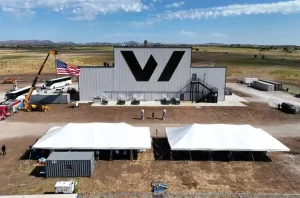
The company is moving to end the U.S. tungsten drought by partnering with Mineral Technologies, a subsidiary of the Downer Group, to deploy a modular processing solution at its Linka Project in Nevada. By opting for the “FlexSeries” modular plant design rather than a traditional, static mill, Viking is attempting to bypass the years of construction delays and capital bloat that typically kill junior mining projects before they ever break ground.
More Read

The strategic calculus here isn’t subtle: speed is the new currency.

The Modular Pivot: Plug-and-Play Production
The traditional model for building a mineral processing plant is, quite frankly, broken. You spend three years on engineering, another two on concrete and steel, and by the time the first ore hits the crusher, the commodity cycle has already turned.
Viking’s partnership with Mineral Technologies shifts the paradigm. The “FlexSeries” units are pre-assembled, plug-and-play systems. They are built off-site, tested in a controlled environment, and shipped to Nevada in containers. On-site, it’s an assembly job, not a construction project.
More Read


This approach de-risks the project from the “nasty” labor shortages currently hammering the Great Basin. By moving the bulk of the technical construction to a specialized facility, Viking avoids the logistical nightmare of housing and managing a massive construction crew in rural Nevada.
For the mining industry, this is a watershed moment. We’ve seen similar shifts in other sectors, such as the pivot to vertical roller mills in green steel, where efficiency and modularity are replacing the “bigger is better” ethos of the 20th century. In 2026, the winners aren’t the ones with the largest footprints; they’re the ones who can reach nameplate capacity the fastest.
The Metallurgy: 16-Fold Grade Increases
You can have the best plant in the world, but if the rocks don’t cooperate, you’re just processing expensive dirt.
Linka’s recent metallurgical tests suggest the rocks are cooperating. Gravity separation testing on high-grade ore showed a 16-times grade increase. That’s not a typo. The tests successfully lifted 1.4 percent tungsten trioxide (WO3) ore to a 22.9 percent concentrate.
With a recovery rate of 63.7 percent, the economics of the Linka Project are beginning to look brutal for any competitors. High recovery rates in the initial gravity circuit mean less waste, lower chemical costs, and a much cleaner environmental profile.
Linka isn’t just a “maybe” project anymore. Recent digitization of historical drilling data revealed high-grade intercepts that the market hadn’t fully priced in. At the Conquest prospect, Viking found 12.2 meters at 1.3 percent tungsten starting at just 26.5 meters deep. That’s near-surface, high-grade material: the kind of ore that makes modular plants incredibly profitable very quickly.

The Geopolitical Stranglehold: 2027 is the Deadline
Why does this matter now? Because the clock is already ticking.
The U.S. government has set a hard line. By January 2027, defense procurement restrictions on tungsten from “covered nations”: namely China and Russia: will go into full effect. Before that, a December 2026 deadline marks the final window for transitioning supply chains.
China currently controls the vast majority of global tungsten production and processing. They have the throttle, and they know how to use it. We’ve seen this play out before with gallium and germanium, and the results were grim for Western manufacturers.
Ammonium paratungstate (APT) prices are currently hovering around US$2,200 per metric tonne unit. This isn’t a temporary spike. It’s the new floor. As the U.S. military-industrial complex realizes it cannot fulfill its shell and missile contracts without domestic tungsten, the pressure on projects like Linka will only intensify.

Viking’s move into Nevada positions them squarely in the Critical Minerals Corridor, a region becoming the center of gravity for U.S. resource independence. Nevada is no longer just about gold and silver; in 2026, it is the frontline of the mineral cold war.
Scale: The 5.5-Kilometer Target
The current focus is on the known mineralization, but Viking believes they’ve only scratched the surface. The company recently doubled the known mineralized corridor at Linka to 1.6 kilometers.
Here is the kicker: that 1.6 kilometers represents only about 29 percent of a much larger 5.5-kilometer conceptual target.
If the modular plant proves the concept at the current scale, scaling up is simply a matter of adding more “FlexSeries” units. It’s an iterative approach to growth that avoids the “all-or-nothing” risk of traditional mining finance.
The strategy is reminiscent of how USA Rare Earth has consolidated control at Round Top. It’s about securing the resource, proving the tech, and then scaling to meet defense needs.
The Bottom Line for 2026
Viking Mines is playing a very specific game. They aren’t trying to build the world’s largest tungsten mine; they are trying to build the first functional U.S. tungsten mine in a generation.
By partnering with Mineral Technologies, they’ve solved for the two biggest hurdles in the current market: capital costs and construction timelines. The “FlexSeries” plant is the right tool for a high-grade, near-surface deposit like Linka.
Is there risk? Of course. Metallurgy at scale is never as clean as it is in the lab. But in a market where the primary supplier is a geopolitical adversary and the primary consumer is the U.S. Department of Defense, the “Linka risk” looks a lot more attractive than the “China risk.”
The 2027 deadline isn’t moving. Viking Mines is.

Market Intelligence Summary
- Project: Linka Tungsten Project, Nevada.
- Technology Partner: Mineral Technologies (Downer Group).
- Innovation: “FlexSeries” modular processing units.
- Resource Stats: 16x grade increase in tests; 63.7% recovery.
- Geopolitical Trigger: U.S. defense restrictions on Chinese tungsten (Jan 2027).
- 2026 Outlook: Fast-tracked production pathway to fill domestic supply void.