TARKWA, Ghana : Engineers & Planners (E&P) is doubling down on West African gold. The local powerhouse announced a $1.2 billion capital injection into the Damang and Tarkwa mines, a move that signals more than just a capacity bump. It is a calculated declaration of indigenous dominance in a sector traditionally ruled by offshore multinationals.

The investment aims to modernize operations, scale production, and cement E&P’s position as a tier-one contract miner. This isn’t a tentative step. It is a massive, capital-intensive surge intended to exploit current market tailwinds while gold prices hover near historic highs.
For an industry often characterized by cautious incrementalism, E&P’s billion-dollar bet is a loud outlier.
The $1.2 Billion Hardware Play
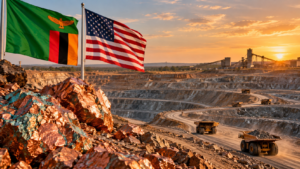
The centerpiece of this expansion involves a massive logistical undertaking: the deployment of 30 semi-knockdown Caterpillar 785D dump trucks. These aren’t standard utility vehicles. They are the workhorses of large-scale open-pit mining, designed to move massive volumes of ore with high mechanical availability.
By integrating these units into the Tarkwa operational base, E&P is targeting a drastic reduction in cost-per-ton. Efficiency in the pit translates directly to the bottom line, especially when dealing with the complex geology of the Tarkwaian and Birimian systems.
More Read



The 785D fleet expansion follows a familiar pattern for the company. In 2018, E&P committed roughly $650 million to enhance these same operations. With this latest $1.2 billion infusion, the company’s total capital deployment since 2018 stands at a staggering $1.85 billion.
That is not a rounding error. It is a concentrated attempt to buy productivity through superior hardware and operational scale.
More Read
Financing the Local Giant
Secure financing for indigenous mining firms has historically been a bottleneck in sub-Saharan Africa. The tide, however, appears to be turning. E&P recently secured a $205 million loan package from a consortium led by Stanbic Bank Ghana and Standard Bank of South Africa.
This five-year credit facility is structured in two tranches: $110 million and $95 million. It represents one of the largest financing agreements ever secured by a locally owned mining entity in Ghana.
The strategic calculus here isn’t subtle: E&P is using this capital to bridge the gap between “contract miner” and “mine owner.” The funds are earmarked to support hard-rock extraction and scale equipment to meet global mining standards.

But there is a deeper narrative at play. This level of institutional backing suggests that regional lenders now view local operators with the same: if not more: confidence as their international counterparts.
The mining finance landscape in 2026 is increasingly looking toward regional stability and local content as hedges against global geopolitical volatility.
Efficiency and the Productivity Gap
In mining, you can’t disrupt geology. You can only disrupt the cost of moving it.
E&P’s focus on the Caterpillar 785D units addresses a specific problem: the productivity gap. As mines like Tarkwa and Damang age, haul distances increase and ore grades can fluctuate. To maintain margins, operators must move more material, faster, and with fewer maintenance interruptions.

The decision to opt for semi-knockdown units also reflects a sophisticated understanding of local logistics. Assembling these machines on-site allows for faster deployment and integrates local technical expertise into the commissioning process.
It is about more than just “buying trucks.” It is about building a sustainable, high-output ecosystem that doesn’t rely on overseas technicians for every mechanical hiccup. This aligns with broader industry trends where next-generation mining gear is being optimized for remote and challenging environments.
The Damang Acquisition: A Historic Shift?
Perhaps the most significant aspect of E&P’s current trajectory is its interest in acquiring the Damang Mine outright. Currently operated by Gold Fields, Damang has been a cornerstone of Ghanaian gold production for decades.
If successful, this would mark the first time in recent history that an indigenous Ghanaian firm takes control of a large-scale, world-class gold mine. For decades, the narrative of African mining has been one of extraction by foreign giants. E&P is attempting to rewrite that script.
This isn’t just about pride; it’s about the “circular economy” of mining.
A locally owned mine keeps a higher percentage of procurement, profits, and technical development within the national borders. It supports thousands of jobs and forces the development of a local supply chain that can compete globally.
Sector Confidence and the Gold Nexus
E&P’s $1.2 billion move comes at a time of significant transition for the global gold sector. While some analysts warn of a potential gold price crash due to shifting macroeconomic pressures, E&P is clearly betting on the long-term fundamentals of the Ghanaian resource base.
Ghana remains the leading gold producer in Africa, having overtaken South Africa years ago. Its regulatory environment, while occasionally prone to fiscal shifts, remains a relative beacon of stability in the region.

The investment also sends a signal to the broader market: the “inflection point” for indigenous mining is here.
We are seeing a shift where local firms are no longer content with sub-contracting crumbs. They are moving into the driver’s seat, backed by regional capital and world-class equipment.
The Risks Ahead
No billion-dollar investment is without its “nasty” variables. The mining industry in 2026 faces a trio of pressures: energy costs, regulatory shifts, and labor demands.
- Energy Intensity: Operating a fleet of 30 new heavy-duty trucks requires a massive fuel and maintenance tail. Any spike in global energy prices or local supply disruptions could hammer the operational margins E&P is working so hard to protect.
- Geopolitical Jitters: While Ghana is stable, the surrounding Sahel region is not. Security costs and supply chain integrity remain top-of-mind for any operator in West Africa.
- The “Multinational” Response: How will the established majors react? As local firms like E&P grow, competition for prime concessions and skilled labor will intensify.
E&P seems prepared for these headwinds. Their $1.85 billion cumulative investment since 2018 suggests they are playing a long game that accounts for the cyclical nature of the industry.
Final Assessment
The $1.2 billion injection into Damang and Tarkwa is a watershed moment. It proves that with the right combination of technical expertise, regional banking support, and aggressive capital deployment, local players can compete at the highest level.
Efficiency. Productivity. Indigenization.
These are the pillars E&P is building on. By the time the last of the 30 Caterpillar 785D trucks rolls into the pit, the landscape of Ghanaian mining will have fundamentally shifted.
The days of local firms being relegated to the sidelines are over. E&P isn’t just participating in the gold rush; they are attempting to own the ground it’s built on.