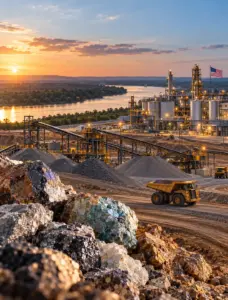
The traditional mining playbook says that if you want more product, you need a bigger footprint. More land, more trucks, more massive evaporation ponds baking under the Andean sun. But in the Salar de Atacama, that old-school logic is hitting a wall: a wall made of environmental regulations, indigenous rights, and finite water resources.

Albemarle, the world’s heavy hitter in the lithium space, isn’t just trying to climb that wall. They’re trying to move it.
The company has officially filed its environmental impact study (EIA) for “Project TED”: a $3.1 billion pivot toward Direct Lithium Extraction (DLE). This isn’t just another expansion. It is the largest lithium investment currently under review in Chile, and it signals a fundamental shift in how the industry views resource management. The message is clear: the era of “growth at any cost” is over. We’ve entered the era of “Efficiency Over Scale.”
The Brutal Numbers of Brine
For decades, the lithium industry has relied on a simple, if slow, process: pump brine into giant ponds, let the sun evaporate the water over 18 months, and harvest the concentrated salts. It’s cheap, but it’s incredibly inefficient. You lose the water to the atmosphere, and you only recover about 40-50% of the lithium.
Albemarle’s $3.1 billion DLE project flips that script. By moving to a modular DLE system, the company aims to nearly double its recovery rates. But here’s the kicker: they plan to do it while drastically reducing their impact on the salt flat.
More Read

Currently, Albemarle extracts about 442 liters of brine per second (L/s) at its Atacama operations. Once the DLE facility’s six processing trains are fully operational, net brine extraction is expected to plummet to just 142 L/s. That’s a 68% reduction in net extraction.

Per facility. That’s not a rounding error. That’s a total reimagining of the extraction process.
The secret sauce? DLE allows Albemarle to pull the lithium out of the brine and then: this is the critical part: return 90% of that brine back into the salt flat. No new evaporation ponds. No massive loss of water to the air.
More Read


Why Efficiency Is the Only Path Forward
Chile’s National Lithium Strategy, spearheaded by the Boric administration, has made one thing very certain: if you want to stay in the Atacama past your current contract, you have to play by new rules. The government is demanding higher environmental standards and a smaller physical footprint.
Albemarle’s current contract expires in 2043. By launching a project with a 20-year lifespan that stretches to 2045, they are effectively laying the groundwork for their next two decades in the country. They are de-risking their presence by proving they can produce more lithium with less “theft” from the ecosystem.
This is a strategic necessity. Native communities in the Atacama have long been vocal: and rightfully so: about the depletion of freshwater and brine resources. The industry’s social license to operate is tied directly to its water usage.
“Innovation is not just about producing more; it is about producing better,” says Sebastián Carmona, Albemarle’s Vice President of Sustainability and External Affairs. “Project TED represents our commitment to the sustainability of the Salar de Atacama and the integration of technologies that allow us to move towards a more efficient and circular production model.”
The Infrastructure: More Than Just Pipes
You can’t run a massive DLE plant on hope and good intentions. It takes power: and a lot of it.
Part of the $3.1 billion price tag includes a 220-kV transmission line to hook the operations into Chile’s national grid (SEN). Historically, remote mining sites relied on local diesel generation or dedicated fossil fuel plants. By connecting to the national grid, Albemarle can tap into Chile’s massive renewable energy surge.

The goal is a 100% renewable-powered operation. This aligns with the broader global battery revolution where OEMs (Original Equipment Manufacturers) aren’t just looking for lithium; they’re looking for “green” lithium with a documented low-carbon footprint.
And it’s not just about power. To further decouple their operations from local freshwater sources, Albemarle is looking at the sea. Starting in 2027, the company plans to import up to 500 liters per second of desalinated seawater. This move mirrors what we’ve seen in the copper sector, such as the Freeport $7.5B expansion, where desalination has become the prerequisite for permit approval.
The Competitive Edge: Albemarle vs. SQM
In the Atacama, it’s always a two-horse race between Albemarle and SQM. While SQM has been navigating its own complex partnership with state-owned Codelco, Albemarle is pushing the technological envelope.
The data reveals a stark contrast in resource intensity. Currently, SQM extracts between 1,500 and 1,700 liters of brine per second. By contrast, Albemarle’s projected drop to 142 L/s under the DLE model puts them in a different league of resource efficiency.
This isn’t just about being a “good neighbor.” It’s a competitive moat. As environmental regulations tighten: and they will: the operator with the lowest resource footprint is the one least likely to face production caps or legal challenges. We’ve already seen how Chilean courts are reshaping project de-risking, and Albemarle is clearly paying attention.
A 20-Year Bet on Technology
The move to DLE is not without risk. While the technology has worked in laboratory and pilot settings, scaling it to six modular processing trains in one of the harshest environments on Earth is a massive engineering undertaking.
But Albemarle doesn’t have much of a choice. The world is hungry for lithium, but the Atacama is thirsty for water. The “Efficiency Over Scale” pivot is a recognition that the physics of the salt flat can no longer support the old way of doing business.

The project, currently under environmental review, will be a litmus test for Chile’s new regulatory framework. If Albemarle can prove that DLE works at this scale, it changes the math for every salar operation on the planet: from the “Lithium Triangle” in South America to projects in the United States and Australia.
The 2026 Outlook: What Investors Need to Watch
As we move through 2026, the progress of Project TED will be a major bellwether for the lithium market. Here is the reality: the “easy” lithium is gone. Every ton produced from here on out will be more technically complex and more capital-intensive.
Investors should watch for three things:
- Permitting Speed: How fast does the Chilean environmental agency (SEA) move on a project of this scale? This will signal the government’s true commitment to the National Lithium Strategy.
- Modular Milestones: The “modular” nature of the DLE trains allows for a phased rollout. Watch for the performance of the first train; if it hits its recovery targets, the remaining five are a de-risked certainty.
- Community Buy-in: The 90% brine return is the olive branch to local communities. Their support (or lack thereof) will determine the project’s long-term stability.

Summary: The New Standard
Albemarle’s $3.1 billion pivot is a loud declaration that the industry has reached an inflection point. You can’t just pump more; you have to think more. By prioritizing technology and efficiency over raw extraction volume, Albemarle is attempting to secure its dominance in the lithium market for the next two decades.
It’s a high-stakes gamble on the future of DLE. But in a world where resource nationalism and environmental scrutiny are the new normal, it might be the only winning move left on the board.
For more on the intersection of mining and technology, read our analysis on the AI-boom and strategic metals or explore the risks of resource nationalism in the global energy transition.