By Salini Krishnan and Mo Shine
In a week defined by high-stakes consolidation and a radical reshuffling of the critical minerals landscape, the mining industry has signaled a clear pivot toward long-term resource security. Headlining these shifts is USA Rare Earth’s landmark $2.8 billion acquisition of Serra Verde, a move that places a strategic “chokehold” on the non-Chinese supply of heavy rare earths. Simultaneously, the copper sector is witnessing a multi-billion dollar investment surge as BHP and Lundin Mining finalize an $18 billion bet on the Vicuña district.
As Western governments intensify efforts to decouple supply chains from dominant Asian markets, these developments represent more than just corporate expansion; they are foundational pillars for the energy transition and national defense infrastructure.
USA Rare Earth Secures $2.8B Serra Verde Acquisition
USA Rare Earth (Nasdaq: USAR) has officially closed its acquisition of the Serra Verde Group for approximately $2.8 billion. The deal, which consists of $300 million in cash and 126.8 million newly issued shares, represents the largest pure-play rare earth acquisition in the industry’s history.
More Read

The acquisition centers on the Pela Ema mine in Brazil, currently Latin America’s only producing rare earth mine. More importantly, Pela Ema is the only operational site outside of Asia capable of producing all four magnetic rare earth elements (REEs): neodymium, praseodymium, dysprosium, and terbium: at a commercial scale.

The strategic value of this integration cannot be overstated. By combining Serra Verde’s upstream production with USA Rare Earth’s existing Round Top project in Texas and its UK-based magnet manufacturing capacity, the company has created a vertically integrated supply chain independent of Chinese influence. This alignment is bolstered by a 15-year, 100% offtake agreement financed by a consortium of U.S. government agencies and private institutional capital.
Industry analysts suggest this move is a direct response to the “chokehold” rhetoric emerging from Washington. Policy experts have long warned that China’s 90% dominance in the processing of heavy rare earths poses a significant risk to U.S. defense and electric vehicle (EV) manufacturing. By securing the Pela Ema output, USA Rare Earth is effectively providing a government-backed revenue shield for Western manufacturers.
More Read


BHP and Lundin Execute $18B Vicuña Copper Bet
While rare earths dominate the geopolitical headlines, the industrial engine of the energy transition: copper: is seeing its own massive capital injection. BHP, in partnership with Lundin Mining, has confirmed an $18 billion investment strategy into the Vicuña district, located on the border of Argentina and Chile.
The centerpieces of this investment are the Filo del Sol and Josemaria projects. These assets are considered Tier 1 deposits, capable of producing hundreds of thousands of tonnes of copper annually over decades. This “massive copper bet” comes at a time when the industry is grappling with a projected copper deficit that could reach 10 million tonnes by 2030.
BHP’s move to form a 50/50 joint venture with Lundin reflects a growing trend of “risk-sharing” among majors. The technical complexity of these high-altitude Andean projects requires immense infrastructure development, including specialized transport corridors and high-capacity processing facilities. For BHP, the investment solidifies its position as a dominant player in the South American copper belt, even as it looks to diversify away from traditional iron ore revenue streams.
Rio2 Advances Peruvian Water Recovery Infrastructure
In Peru, precious metals producer Rio2 has announced a $27 million investment into an advanced water recovery and management project. As environmental, social, and governance (ESG) standards become increasingly stringent, water security has become a primary bottleneck for mine permitting and operational continuity in the Andes.
The project is designed to support the Fenix Gold operation, focusing on a closed-loop system that maximizes recycling rates and minimizes the impact on local aquifers. This investment is viewed by the market as a proactive measure to de-risk the project’s development timeline. For many operators, securing ESG compliance and social licenses is now as critical to the bottom line as the grade of the ore body itself.
Q2 Metals Reports 295Mt Lithium Resource in Quebec
In the Canadian lithium space, Q2 Metals has stunned the market with a maiden resource estimate for its Mia Zone project in the James Bay region of Quebec. The company reported a massive 295 million tonne (Mt) resource, positioning it as one of the largest undeveloped lithium spodumene deposits in North America.
This discovery provides a significant boost to the Quebec mining hub, which has become a focal point for the North American battery supply chain. The scale of the Mia Zone resource suggests that Quebec could rival major global producers in the coming decade. However, the development of such a massive resource will require significant AI-driven exploration and strategy to optimize extraction costs in a volatile pricing environment.
| Commodity | Spot Price (USD) | 24-Hour Change | 2026 Outlook |
|---|---|---|---|
| Copper (lb) | $4.85 | +1.2% | Bullish |
| Lithium (Carbonate/t) | $14,200 | -0.5% | Stable |
| Gold (oz) | $2,410 | +0.8% | Bullish |
| Neodymium (kg) | $118.50 | +2.1% | High Growth |
Market Analysis: Critical Minerals and Mining News
The convergence of these events highlights a structural shift in how mining projects are valued. Previously, the internal rate of return (IRR) was the primary metric for investors. In 2026, the focus has shifted toward “Supply Chain Resilience” and “Geopolitical Alignment.”
Rare Earths: Breaking the Monopsony
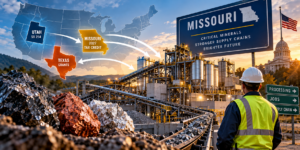
The USA Rare Earth-Serra Verde deal is a blueprint for future M&A. By acquiring producing assets in friendly jurisdictions (Brazil) and linking them to domestic processing (Texas), companies are effectively bypassing the risks associated with the Chinese market. This is particularly vital for defense metals and REE supply chains.
Copper Deficit: The $18B Reality Check
BHP’s investment confirms that the era of “easy copper” is over. Future supply must come from remote, high-altitude, and high-capex projects. The Vicuña district investment is a hedge against the inevitable price spikes expected as global electrification outpaces mine supply.
Lithium Price Forecast 2026
The lithium price forecast for late 2026 remains cautiously optimistic. While the market saw a glut in 2024-2025, the sheer volume of EV battery manufacturing plants coming online in 2026 is expected to absorb excess supply. Projects like Q2 Metals’ Mia Zone are essential for the 2028-2030 window, but short-term price stability will depend on the pace of interest rate cuts and consumer EV adoption rates.

Geopolitical Implications and Infrastructure
The U.S. government’s involvement in the REE sector through offtake agreements and low-interest loans marks a return to industrial policy not seen since the Cold War. The Department of Energy’s “Mine of the Future” initiative is playing a key role in funding these transitions, ensuring that the US-DOE-led mine initiatives provide a safety net for junior and mid-tier miners tackling critical mineral shortages.
For operators on the ground, the message is clear: the most successful projects in 2026 will be those that integrate advanced technology, secure multi-decade offtake agreements with Western allies, and prioritize sustainable resource management. Whether it is copper in the Andes, lithium in Quebec, or rare earths in Brazil, the race for resource supremacy is no longer just about what is in the ground: it is about who controls the path to the end-user.