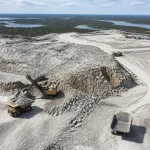
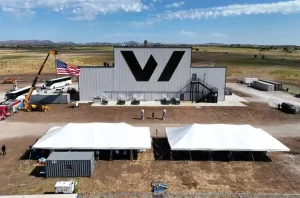
LUSAKA, Zambia : KoBold Metals, the Silicon Valley-backed exploration firm, has officially commenced construction at its Mingomba copper project, signaling a shift in how artificial intelligence is deployed to address the global copper deficit.
The groundbreaking ceremony, held on April 29, 2026, was attended by Zambian President Hakainde Hichilema and U.S. diplomatic officials. The event marks the transition of the $2.3 billion project from an AI-driven exploration success to a massive infrastructure undertaking that aims to produce more than 300,000 tons of copper annually.
Backed by high-profile investors including Bill Gates, Sam Altman, and Jeff Bezos, KoBold Metals is applying data science and machine learning to traditional geological challenges. The Mingomba discovery is being hailed as a proof-of-concept for the firm’s “Google Maps for the Earth’s crust” approach, which identified the high-grade deposit in a fraction of the time typically required by conventional exploration methods.
The Silicon Valley influence on critical minerals
The development of Mingomba represents a unique convergence of Big Tech capital and industrial extraction. KoBold’s investor list includes Breakthrough Energy Ventures (founded by Bill Gates) and Apollo Projects (led by Sam Altman). These figures are increasingly focused on the 2026 copper deficit, recognizing that the transition to electric vehicles and the expansion of AI data centers depend entirely on a stable supply of high-conductivity metals.
More Read

Unlike traditional mining majors that rely heavily on historical mapping and incremental drilling, KoBold utilized its proprietary AI stack to synthesize decades of fragmented geological data. By applying sophisticated algorithms to determine where to drill with surgical precision, the company moved from acquisition in December 2022 to groundbreaking in less than four years.


Mingomba project: Timeline and technical risks
The Mingomba project is situated on the outskirts of Chililabombwe, near the border with the Democratic Republic of Congo (DRC). While the discovery is high-grade, the operational environment presents significant engineering hurdles that will test KoBold’s technological capabilities.
More Read

- Project Depth: The ore body is located approximately 1,700 meters (5,576 feet) below the surface. This depth places Mingomba among the world’s deepest copper mines, requiring substantial investment in ventilation and hoisting infrastructure.
- Water Management: The Copperbelt region is notorious for being one of the wettest mining jurisdictions globally. The Konkola area, where Mingomba sits, requires constant, high-volume water pumping to prevent underground flooding. KoBold will need to implement advanced predictive maintenance and remote monitoring to manage these hydraulic risks.
- Capital Expenditure: The estimated $2.3 billion to $3 billion price tag covers shaft sinking, processing facilities, and a dedicated power grid connection. Engineering studies are slated for completion by early 2027, with full-scale production expected to ramp up by the end of the decade.
Zambia’s 3-million-ton copper target
For the Zambian government, the Mingomba project is the cornerstone of an ambitious policy to more than triple national copper output to 3 million tons per year by the mid-2030s. President Hichilema’s administration has aggressively sought foreign investment to revitalize the mining sector, which remains the backbone of the nation’s economy.
KoBold is developing the mine in partnership with ZCCM Investments Holdings (ZCCM-IH), the state-owned entity that retains a minority stake. The project is also seen as a geopolitical win for the United States, which has been seeking to secure critical mineral supply chains that bypass Chinese-dominated refining corridors.
“This is not just a mine; it is a technology project that extracts minerals,” a KoBold spokesperson noted during the groundbreaking. The company has already hired hundreds of Zambian nationals, ranging from software engineers to underground drillers, emphasizing a commitment to local technology transfer.

Comparative market performance
The Mingomba groundbreaking comes at a time when copper prices are experiencing renewed volatility. While some producers like Capstone Copper have reported record earnings due to production growth, the industry at large is struggling to bring new “greenfield” projects online.
KoBold’s entry into the space represents a disruption of the traditional mining cycle. By shortening the discovery-to-development timeline, the firm hopes to provide a blueprint for how other critical minerals: including lithium and cobalt: can be fast-tracked to meet the demands of the energy transition.
Geopolitical and Economic Implications
The strategic importance of Mingomba extends beyond the balance sheets of its billionaire backers. The project is a central pillar of the Lobito Corridor, a U.S.-backed infrastructure project designed to link the African Copperbelt to the Atlantic port of Lobito in Angola. This rail link is intended to reduce transit times for copper exports and decrease reliance on routes through the DRC and South Africa, which have been plagued by logistical bottlenecks.
Industry analysts suggest that if KoBold successfully navigates the technical challenges of the 1,700-meter depth and the region’s water issues, it will validate AI as the primary tool for the next generation of mineral discovery.

Summary of Mingomba Development Phase
| Category | Detail |
|---|---|
| Location | Mingomba, Zambia (near Chililabombwe) |
| Primary Backers | KoBold Metals, Breakthrough Energy, Apollo Projects |
| Investment | $2.3 Billion – $3.0 Billion |
| Production Target | 300,000+ tons copper per annum |
| Target Depth | ~1,700 Meters |
| Key Partners | ZCCM-IH (Zambia State) |
| Discovery Method | Proprietary AI & Machine Learning Exploration |
By Charles Pitts