By Charles Pitts

**CHANGZHI, Shanxi : ** At least 90 workers are confirmed dead following a massive gas explosion at the Liushenyu Coal Mine in northern China, marking the country’s deadliest mining disaster in more than 15 years. The blast, which occurred late Friday in the coal-rich heartland of Shanxi province, has triggered an international outcry over persistent safety failures in the world’s largest coal-producing nation.
Emergency crews in Qinyuan County continued to search for nine missing miners on Saturday as the scale of the tragedy became clear. Local authorities confirmed that 247 workers were underground when the explosion ripped through the shafts at approximately 19:29 local time. While 201 individuals were successfully evacuated or rescued, more than 100 remain hospitalized, many suffering from acute toxic gas exposure and severe burns.
Chinese President Xi Jinping has issued an “all-out” directive for rescue operations and demanded a prompt, thorough investigation into the cause of the disaster. In a rare move reflecting the severity of the incident, state media reported that several executives from Shanxi Tongzhou Group Liushenyu Coal Industry, the mine’s operator, have already been detained by local police.
The Incident: A Toxic Surge Underground
Preliminary reports from the Shanxi Emergency Management Bureau indicate that a carbon monoxide alarm was triggered shortly before the explosion, suggesting that gas levels had surged beyond safety limits. However, the evacuation protocol appears to have failed or was initiated too late to prevent the catastrophic ignition.
More Read

The Liushenyu Coal Mine was previously identified as a “high gas content” facility, a designation that requires stringent ventilation and monitoring under Chinese law. Despite being listed as a disaster-prone site, the mine remained operational to meet the country’s surging demand for industrial energy.

“This was a preventable tragedy,” said an independent mining news analyst following the rescue efforts. “The discrepancy between the mine’s blueprints and the actual underground layout has significantly hampered the rescue teams. This suggests not just a technical failure, but a fundamental breakdown in regulatory oversight and corporate transparency.”

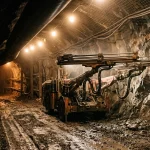
Mine rescuers review tunnel maps under harsh lighting as crews work through hazardous conditions.
More Read

Rescue Challenges and Mapping Discrepancies
Rescuers arriving at the scene on Friday night were met with a chaotic environment. High concentrations of toxic gases and the structural instability of the blast-damaged tunnels forced teams to use advanced breathing apparatus and robotic sensors to navigate the shafts.
The most damning revelation during the initial 24 hours of the operation was the discovery that the mine’s official blueprints did not match the physical reality of the underground tunnels. Unauthorized expansions and “blind alleys” created by undocumented extraction zones trapped miners who might otherwise have found a path to safety.
According to local reports, the rescue effort has involved over 500 emergency personnel, including specialized mine rescue units from neighboring provinces. The focus remains on the nine missing individuals, though officials have privately expressed concerns that the window for finding survivors is rapidly closing given the levels of carbon monoxide detected.
Accountability and Political Fallout
The detention of the mine’s leadership underscores the political sensitivity of the event. In 2026, China has faced increasing pressure to modernize its industrial safety record as part of its broader China critical minerals strategy. This disaster, the deadliest since a 2009 explosion in Heilongjiang that killed 108, threatens to derail the government’s narrative of improved industrial oversight.
President Xi’s public demand for “strict accountability” is expected to lead to a nationwide sweep of coal facilities. Historically, such disasters in China have resulted in the temporary closure of dozens of nearby mines for “safety audits,” which could tighten coal supplies in the short term and impact regional energy prices.
“The central government cannot afford the optics of a return to the high-mortality era of the early 2000s,” noted a Beijing-based industrial consultant. “We expect to see heads roll not just at the corporate level, but within the local safety bureaus that signed off on these inspections.”

Authorities in Shanxi are expected to examine both mine management and local safety oversight.
The Role of Mine Safety Technology 2026
The Liushenyu disaster highlights a widening gap between China’s “showcase” automated mines and its aging legacy pits. While the industry has touted mine safety technology 2026 initiatives: including real-time gas sensors, autonomous haulage, and digital twin mapping: the implementation has been inconsistent.
The failure of the gas alarm system at Liushenyu to trigger an immediate, automated shutdown and evacuation is central to the ongoing investigation. Experts suggest that if the mine had been equipped with modern integrated safety suites, the surge in carbon monoxide would have automatically disabled electrical equipment and sealed off the affected sectors.
“We are seeing a two-speed mining sector in China,” says a report from Skillings Mining Review. “On one hand, you have high-tech facilities that rival the best in Australia or Canada. On the other, you have disaster-prone sites where blueprints are hand-drawn and safety sensors are treated as suggestions rather than hard stops.”
A Decade of Safety Progress Under Threat
Since the mid-2010s, China has successfully reduced the annual death toll in its coal mines from several thousand per year to a few hundred. This was achieved through the forced closure of thousands of small, “illegal” pits and the consolidation of the industry into larger, state-backed groups.
However, the Liushenyu blast serves as a stark reminder that even consolidated groups, like Shanxi Tongzhou, can fall victim to the pressures of production quotas. As the 2026 energy transition continues to place heavy demands on the grid, coal remains the bedrock of Chinese power generation, often at the expense of human safety.

Advanced monitoring technology is increasingly mandated, yet the Liushenyu disaster shows that implementation remains uneven.
Global Implications for the Mining Industry
The disaster is likely to resonate through global mining markets. As China is both the world’s largest producer and consumer of coal, any significant regulatory shift or production halt in Shanxi: the “coal capital” of the country: could influence global energy commodity valuations.
Furthermore, the incident provides a grim case study for safety professionals worldwide. The failure of “as-built” documentation (the blueprints) is a recurring theme in global mining disasters. It underscores the necessity for the industry to move toward live, 3D spatial data that reflects real-time tunnel development.
“Investors and operators are looking at this and realizing that ‘safety on paper’ is no longer enough,” said a representative from a global mining equipment provider. “The 2026 standard for mine safety must include verified, digital-first infrastructure that cannot be faked or bypassed by local operators.”
Looking Ahead: The 2026 Safety Mandate
In the coming weeks, the industry expects the Chinese Ministry of Emergency Management to announce a new set of mandates. These are likely to include:
- Digital Twin Verification: Mandatory 3D mapping of all underground workings, verified by independent third-party drone surveys.
- Automated Gas Interlocks: Requirements for gas sensors to be hard-wired into the mine’s power grid, ensuring an immediate blackout if thresholds are breached.
- Executive Liability: Increased criminal penalties for corporate officers who preside over mines with undocumented expansions.
As the families of the 90 victims in Shanxi begin the process of mourning, the global mining community is reminded that the “cost of coal” is still too often measured in lives. For the survivors and the families of the nine still missing, the search for answers is only just beginning.
For more updates on this developing story and the latest in mining news, subscribe to our daily intelligence briefings.