By Charles Pitts

NEW YORK : Antimony prices shattered all-time records this week, surging past the $65,000-per-tonne threshold as a sudden tightening of export licenses in major producing regions triggered a global supply shock. The rally, which intensified in early June 2026, has left procurement managers in the defense and solar industries scrambling for material, as the critical mineral’s supply chain faces its most severe deficit in modern history.
The current antimony price trend 2026 reflects a “second wave” of volatility that has eclipsed the previous historic highs of 2025. While the market had seen a brief period of price normalization in early spring, the unexpected revocation of several key export permits in China: combined with a production slowdown in Tajikistan: has removed roughly 15,000 tonnes of annual supply from the international spot market almost overnight.
The June 2026 Price Surge: By the Numbers
As of June 8, 2026, spot prices for 99.65% antimony ingot (FOB China) reached $65,250 per tonne, a 12% increase from the previous month. In North American and European markets, where physical premiums remain high due to logistical constraints and “strategic metal” surcharges, prices have touched as high as $32.00 per pound.
For context, this represents a more than 550% increase compared to 2020 averages. The speed of the move has caught market participants off guard, particularly after industry analysts at the start of the year predicted an “adequately supplied” 2026.
More Read

| Period | Antimony Price (USD/Tonne) | Growth (YoY) | Market Status |
|---|---|---|---|
| June 2024 | $12,400 | +18% | Balanced |
| June 2025 | $59,750 | +381% | Acute Deficit |
| January 2026 | $42,000 | -29% | Normalizing |
| June 2026 | $65,250 | +55% | Record High |
The rapid escalation is being driven by a convergence of geopolitical policy shifts and a fundamental lack of new primary supply. Despite high prices in 2025, which incentivized some marginal restarts, the time lag for bringing significant new “greenfield” capacity online has left the critical minerals supply chain 2026 dangerously exposed to single-source disruptions.


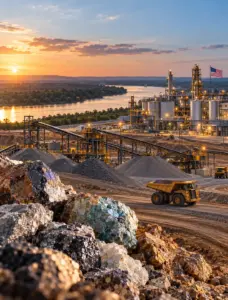
High-grade stibnite ore, the primary source of antimony, has become one of the most sought-after commodities in the global strategic minerals market.
Export Constraints and Geopolitical Volatility
The primary catalyst for the June breakout was the sudden suspension of export quotas by several “Dual-Use” authorities. Under new guidelines, authorities have prioritized domestic strategic stockpiling for defense and high-tech manufacturing, leaving international buyers to bid for a dwindling pool of available tonnage.
More Read

This move follows a similar pattern seen in the rare earths supply chain 2026, where processing bottlenecks and export controls have been used as leverage in broader trade negotiations. For antimony, the impact is more acute because of the extreme concentration of production.
“We are seeing a systemic re-evaluation of what ‘secure supply’ means,” says a senior analyst at a major London-based metal exchange. “In 2024 and 2025, the market hoped that high prices would solve the problem by bringing on new mines in the West. But in June 2026, we are realizing that those projects are still years away from commercial production, while the current supply is being weaponized.”
Strategic Impact: Defense and the Solar Squeeze
The urgency of the current price spike is felt most strongly in two key sectors: defense and renewable energy.
1. The Defense Industry
Antimony is a non-negotiable ingredient in the production of modern ammunition, lead-acid batteries for military hardware, and specialized alloys for night-vision goggles and infrared sensors. The U.S. Defense Logistics Agency (DLA) has intensified its procurement efforts throughout 2026, competing directly with industrial buyers. This “inelastic demand” creates a firm floor for prices, as government contractors are mandated to secure supply regardless of cost.
2. The Solar Glass Squeeze
In the energy transition sector, antimony (as sodium antimonate) acts as a critical glass clarifier for photovoltaic (PV) modules. It improves light transmission, which directly impacts the efficiency of the panels. Despite some efforts to find substitutes, no cost-effective alternative has reached the scale required for the global solar build-out.
With global solar installations on track to hit a record 750 GW in 2026, the demand for high-clarity PV glass is higher than ever. The price surge is now threatening to increase the cost-per-watt of solar modules for the first time in three years, potentially slowing the pace of the energy transition in price-sensitive regions.

The efficiency of large-scale solar arrays is dependent on high-clarity glass, which currently requires sodium antimonate to achieve maximum light transmission.
Supply Chain 2026: The Search for Alternatives
The current crisis has accelerated the search for new supply sources and recycling technologies. In the United States, several projects aimed at domestic extraction are being fast-tracked through the permitting process under “Strategic Priority” status.
However, the industry is also looking toward “secondary” supply. Antimony recycling from lead-acid batteries and flame-retardant plastics is becoming more economically viable at $65,000 per tonne. Furthermore, technology firms are re-evaluating the copper demand AI data centers nexus, as the flame retardants used in data center cabling also consume significant quantities of antimony trioxide.

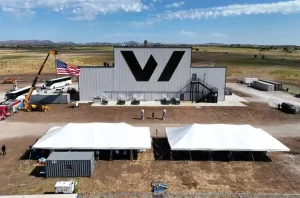
Advanced processing plants are the frontline in the battle to diversify the antimony supply chain away from concentrated production hubs.
Antimony Price Forecast 2026: Base, Bull, and Bear Case
As we move into the second half of 2026, the market outlook remains fraught with uncertainty. The critical minerals 2026 outlook suggests that volatility will remain the dominant theme across the board.
- Base Case: Prices stabilize between $55,000 and $60,000 per tonne as some export licenses are eventually released, but the market remains structurally tight.
- Bull Case ($80,000+): A total ban on antimony exports to Western markets is enacted, or a major production outage occurs in Tajikistan or Russia. This would likely lead to government-mandated rationing of the metal.
- Bear Case ($35,000): A sudden breakthrough in PV glass chemistry that eliminates the need for sodium antimonate, combined with an unexpected surge in secondary recycling output.
Conclusion: A New Normal for Critical Minerals
The June 2026 record highs for antimony are a stark reminder that the energy transition and national security are inextricably linked to the supply chains of “minor” metals. For operators and investors, the lesson of 2026 is clear: market fundamentals are no longer just about supply and demand; they are about policy, permits, and the geography of processing.
Until significant non-Chinese supply comes online: likely not until late 2027 or 2028: the market should expect the antimony price trend 2026 to remain on a hair-trigger.