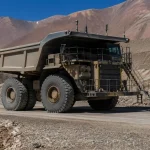
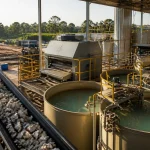
Mine-tailings reprocessing and critical-minerals recovery facility. Image: Skillings Mining Intelligence.

By Charles Pitts
**WASHINGTON : ** The U.S. Department of Energy has selected nine projects for up to $162 million to recover critical minerals from mine waste, tailings and industrial byproducts, adding another federal funding tranche aimed at strengthening the critical minerals supply chain in 2026.
The projects will target materials including scandium, copper, antimony and rare earth elements. The selected participants range from technology developers and processing companies to mining operators with existing pilot-scale facilities.
The initiative is designed to move recovery systems from laboratory and bench-scale development toward pilot and pre-commercial demonstration. DOE said the projects could help produce domestic supplies for energy, defense and advanced manufacturing without relying solely on new greenfield mines.
The funding complements earlier U.S. government commitments totaling more than $1 billion across mining, processing and manufacturing technologies, including programs focused on coal waste, rare earth elements and other domestic feedstocks.

However, the $162 million is not yet a final disbursement. DOE said the selections are subject to award negotiations, and funding amounts may change. The department can also cancel negotiations or rescind a selection before an award is issued.
Nine projects move into two development tracks
DOE’s Office of Critical Minerals and Energy Innovation selected four projects under a bench-scale program and five under a pilot-scale program. The National Energy Technology Laboratory will manage the awards.
| Development track | Selected participants | Expected technology progression | Main supply-chain relevance |
|---|---|---|---|
| Bench-scale facilities | Anactisis, Still Bright, Nusano, SiTration | Technology readiness level 4 or 5 toward level 7 | Advancing laboratory processes toward prototype systems |
| Pilot-scale facilities | Thompson Creek Metals, Felix Gold Alaska Treasure Creek, DISA Technologies, Alcoa USA, Trigg Minerals | Technology readiness level 6 or 7 toward level 7 or 8 | Moving existing pilot systems toward pre-commercial demonstration |
The technology-readiness-level framework is intended to measure progress from laboratory validation to operational systems. DOE’s technology-readiness guidance defines the later stages as demonstration in relevant environments and preparation for commercial deployment.
The four bench-scale projects are:
- Anactisis Inc., based in Pittsburgh, which is developing selective separation and adsorbent technologies for scandium and rare earth elements from industrial waste streams.
- Still Bright Inc., based in Newark, New Jersey, which is advancing a critical-material recovery process from industrial feedstocks.
- Nusano Inc., based in West Valley City, Utah, which is developing recovery processes for critical materials, including rare earth elements.
- SiTration Inc., a Cambridge, Massachusetts-based MIT spinout, which is working on silicon-membrane separation technology to recover copper and other valuable materials from dilute mining and industrial streams.
The pilot-scale selections include:
- Thompson Creek Metals Company USA, headquartered in Langeloth, Pennsylvania, for recovery from existing mine infrastructure and waste streams.
- Felix Gold Alaska Treasure Creek Inc., based in Fairbanks, Alaska, for work on antimony at the Treasure Creek project.
- DISA Technologies Inc., based in Mills, Wyoming, for its high-pressure slurry ablation process to separate mineralized particles from waste material.
- Alcoa USA Corp., headquartered in Pittsburgh, for recovery of critical materials from aluminum-sector industrial streams.
- Trigg Minerals, headquartered in Jersey City, New Jersey, for antimony and tungsten processing in support of a domestic supply chain.
DOE’s announcement provides limited technical detail on several projects. Further information is expected as negotiations progress and project agreements are finalized.
Waste recovery adds supply without starting with a new mine
The program reflects a shift in how governments and companies are evaluating domestic mineral resources. Mine waste, tailings, discarded rock, process residues and industrial byproducts can contain metals that were uneconomic or technically difficult to recover when the original operation was designed.
In some cases, improved separation technology can turn a liability into a secondary feedstock. That may allow operators to use existing roads, power connections, processing facilities and permitted industrial sites rather than building an entirely new mine and concentrator.
The approach does not remove the need for conventional mining. Demand for copper, rare earth elements, antimony and other materials is expected to continue growing as the United States expands grid infrastructure, defense manufacturing, electric equipment and advanced industrial production.
But waste recovery could provide an additional source of material while reducing the amount of new ground disturbance associated with supply expansion. It may also help operators extract value from legacy stockpiles and tailings that remain after a mine has closed or changed its production profile.
For investors and project developers, the key question is whether these processes can produce consistent, saleable products at competitive costs. Feedstock grades in waste streams can be low and variable. Recovery systems must also manage impurities, water use, reagent consumption, energy demand and the cost of transporting large volumes of material.
Antimony and rare earths carry strategic weight
The selected projects cover several commodities with different market characteristics.
Antimony is used in flame retardants, lead-acid batteries, alloys and defense applications. Its supply chain has attracted increased attention because processing capacity is concentrated in a small number of countries. Felix Gold’s Treasure Creek project in Alaska and Trigg Minerals’ antimony and tungsten work could therefore have significance beyond the size of their individual operations.
Rare earth elements are used in permanent magnets, electronics, wind turbines, electric motors and defense systems. Recovering them from industrial feedstocks may help address one of the most difficult parts of the supply chain: separating individual elements and producing consistent, high-purity materials.
Copper presents a different challenge. The metal is widely produced, but demand from power networks, electrification and data infrastructure is increasing. SiTration’s focus on dilute waste streams illustrates the potential value of recovering copper that may be too dispersed for conventional processing.
Scandium is a smaller market but can command strategic importance in advanced aluminum alloys and other specialized applications. Its availability is often linked to byproduct recovery rather than standalone mining.

Membrane filtration and separation equipment used in a critical-minerals recovery setting. Image: Skillings Mining Intelligence.
Circular mining still requires rigorous ESG controls
Recovering minerals from waste is often described as circular mining, but the environmental benefit depends on how each project is designed and operated.
A tailings reprocessing project may reduce the volume or long-term risk of a waste facility. It can also create new water-management requirements, increase traffic and require additional chemical processing. If residues remain after reprocessing, operators must demonstrate that the material can be stored and managed safely.
That makes mining ESG compliance in 2026 a central consideration rather than a secondary benefit. Companies will still need to address permitting, water quality, tailings stability, worker safety, closure planning, community engagement and emissions reporting.
DOE has used community-benefit requirements in earlier critical-minerals programs. Its 2023 funding for projects focused on coal waste and acid mine drainage, for example, required community and labor engagement plans, quality-job commitments and reporting on benefits to affected communities. Those standards provide a reference point for how waste-recovery projects may be evaluated as they move toward construction and operation.
Investors and lenders are also likely to examine whether a project’s environmental claims can be measured. Relevant indicators may include:
- Tonnes of waste removed or reprocessed.
- Quantity and grade of recovered mineral products.
- Water withdrawn, recycled and discharged.
- Energy used per tonne of recovered material.
- Residual waste generated after processing.
- Tailings-risk reduction and closure-cost implications.
- Local employment, procurement and community commitments.
These metrics could become important in technical due diligence and ESG-linked financing. A project that recovers a valuable metal but consumes large amounts of energy or creates a new hazardous residue may not deliver the same environmental outcome as a lower-impact process.
Skillings previously examined related issues in its analysis of mining ESG compliance in 2026, tailings risk and disclosure rules.
Commercial proof remains the next test
The DOE selections provide technical support, but they do not guarantee commercial production. Each project must move through negotiations, engineering work, testing and, in some cases, permitting before the full benefit to domestic supply chains can be assessed.
The most important milestones will include confirmation of final award amounts, feedstock agreements, recovery rates, product specifications and operating costs. Companies will also need to show that their systems can operate continuously rather than only under controlled laboratory conditions.
For mine operators, the program could create a new pathway to monetize historical waste and improve the economics of existing sites. For technology companies, it offers a route to demonstrate systems at a scale that is more relevant to customers and financiers.
For policymakers, the initiative tests whether targeted funding can shorten the gap between promising mineral-recovery research and reliable domestic output.
The projects will not immediately change U.S. import dependence. But if even a portion reaches commercial operation, they could broaden the country’s supply options while linking mineral production to remediation, resource efficiency and industrial reuse.
The DOE’s announcement is available through its Office of Critical Minerals and Energy Innovation. NETL’s earlier work on turning mine waste into critical minerals provides additional context on the technical and environmental challenges involved in developing domestic recovery facilities.
For the mining sector, the central issue is no longer whether waste contains recoverable value. It is whether companies can extract that value safely, consistently and at a cost that supports a durable U.S. supply chain.