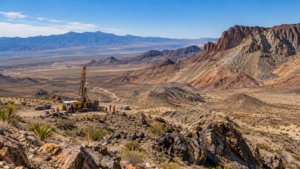
Exploration drilling in Montana’s Stillwater mining district. Image: Skillings-generated editorial image.

Stillwater Critical Minerals has established a maiden indicated resource at its Stillwater West nickel-copper-cobalt-platinum group metals project in Montana and expanded the inferred resource to 805.1 million tonnes, more than tripling the tonnage reported in the company’s previous estimate.
The update gives the Vancouver-based explorer a higher-confidence resource category for the first time, while substantially increasing its reported inventory of metals that include nickel, copper, cobalt, platinum, palladium, gold and rhodium. The company said the estimate is intended to support additional metallurgical testing, engineering work and future economic studies.
The project remains an exploration-stage asset. The reported resources are not mineral reserves, and the company has not yet published an economic study demonstrating that the deposit can be developed profitably.
Maiden indicated resource adds geological confidence
According to the company’s Stillwater West project information, the updated mineral resource estimate includes 29.4 million tonnes in the indicated category at 0.38% total nickel equivalent, using a 0.20% nickel-equivalent cut-off.
More Read

The indicated resource contains approximately:

- 119 million pounds of nickel;
- 59 million pounds of copper;
- 11 million pounds of cobalt; and
- 359,000 ounces of platinum, palladium, gold and rhodium combined.
Stillwater Critical Minerals CEO Michael Rowley said in the company’s release that the first indicated resource and the refinement of the geological model provide a stronger technical foundation for metallurgical studies, engineering and future economic evaluation.
An indicated resource has a higher level of geological confidence than an inferred resource. That distinction matters because mining companies generally require greater geological certainty before completing more advanced mine planning and feasibility work. It does not, however, establish that the material is economically mineable.
More Read

The company’s previous Stillwater West estimate, published in January 2023, was entirely inferred. That estimate outlined 254.8 million tonnes at an average grade of 0.39% nickel equivalent and contained approximately 1.64 billion pounds of nickel, copper and cobalt, according to the company’s technical report page.

Geological core samples prepared for analysis in a Montana exploration setting.
Inferred tonnage more than triples
The updated estimate reports 805.1 million tonnes of inferred material at 0.34% total nickel equivalent at the same 0.20% cut-off.
Stillwater said the inferred inventory includes approximately:
| Metal group | Updated inferred resource | Comparison with 2023 estimate |
|---|---|---|
| Nickel | 3.01 billion lb. | Almost triple |
| Copper | 1.52 billion lb. | More than triple |
| Cobalt | 283 million lb. | More than triple |
| Platinum | 2.28 million oz. | More than double |
| Palladium | 3.97 million oz. | More than double |
| Gold | 864,000 oz. | More than double |
| Rhodium | 310,000 oz. | Increased from 115,000 oz. |
The figures are rounded and represent contained metal in the resource model, not recoverable production. Actual output would depend on mining methods, processing recoveries, dilution, operating costs, permitting and other technical and economic factors.
The company described the increase as a more than doubling of the inferred resource. The comparison with the 2023 estimate shows why the update is also being characterized as a more-than-tripling of inferred tonnage: the estimate increased from 254.8 million tonnes to 805.1 million tonnes.
The grade is lower on a nickel-equivalent basis than the 2023 estimate, which reported an average of 0.39% nickel equivalent. That difference illustrates an important feature of resource expansion: the newer estimate incorporates a much larger volume of material, including lower-grade areas, rather than simply adding higher-grade tonnes.
Drilling and historical data underpin update
The new estimate incorporates 14 drill holes totaling 5,781 metres from the company’s 2023 and 2025 drilling campaigns, according to reporting by The Northern Miner.
The company also included selected historical drill holes after a quality-control review. Mine Technical Services prepared the resource estimate, which uses an open-pit mining assumption for the reported resource model.
The resource covers roughly 10 kilometres of the company’s 32-kilometre property position in the Stillwater Igneous Complex. Stillwater Critical Minerals says the resource is distributed across five deposits, including Chrome Mountain and deposits in the Iron Mountain area.
The company’s project page says the broader land package is adjacent to Sibanye-Stillwater’s operating Stillwater mine and includes a historical database of drilling, geochemistry, geophysics and geological mapping. Those nearby operations provide regional infrastructure and mining context, but mineralization or production at an adjacent property does not establish the economic potential of Stillwater West.

Forest access road and exploration area in Montana’s Stillwater district.
What investors and operators will watch next
The immediate technical question is how much of the large inferred inventory can be converted into indicated material through additional drilling.
Stillwater Critical Minerals said its next work will include metallurgical studies, engineering and mine-planning scenarios. The company is also examining whether higher-grade zones could form an earlier phase of a potential development plan, according to The Northern Miner.
That work will need to address several issues:
Resource conversion
Most of the updated tonnage remains inferred. Inferred resources are considered too uncertain to support detailed economic decisions on their own. More drilling would be required to define the continuity, thickness and grade distribution of the mineralization at a higher confidence level.
The company has not disclosed a feasibility-stage mine plan for Stillwater West. Until that work is completed, the 805.1-million-tonne figure should be treated as a geological inventory rather than a production forecast.
Metallurgical performance
Stillwater West contains a polymetallic sulphide assemblage. The value of the deposit will depend not only on grades in the ground but also on the ability to recover nickel, copper, cobalt and platinum group metals into saleable products.
Future test work will need to establish recoveries, concentrate quality, potential penalty elements and the likely processing route. The company’s reported nickel-equivalent figures are calculated assumptions and do not represent demonstrated plant performance.
Scale and infrastructure
A large resource can create logistical advantages, but it can also require substantial infrastructure. Future studies will need to assess access, power, water, waste management, processing capacity and the practical scale of an operation in a mountainous and forested region.
The project’s proximity to established mining operations is a relevant regional factor. It does not remove the need for project-specific permitting, environmental review, engineering and community engagement.

Metallurgical testing equipment and mineral samples in a laboratory setting.
Commodity-price exposure
The resource contains several metals, which can diversify potential revenue but also increase exposure to multiple markets. Nickel and cobalt prices are affected by battery demand, Indonesian and other supply growth, inventory levels and changes in battery chemistry. Copper demand is tied to electrification, construction and industrial activity.
Platinum group metals face separate demand dynamics from autocatalysts, hydrogen applications, jewellery and industrial uses. A future economic study would need to establish which metals are payable and how changes in price assumptions affect the project’s economics.
Permitting and environmental risk
Stillwater West remains subject to federal, state and local permitting requirements. Exploration-stage claims about strategic importance or proximity to existing operations do not guarantee approval for mine construction.
The project’s location in Montana also places environmental baseline work, water management, reclamation planning and community engagement among the issues that could influence its timeline and development cost.
Resource growth changes the project’s next test
The updated estimate gives Stillwater Critical Minerals a materially larger exploration base and its first indicated resource. It also strengthens the company’s case for spending on metallurgy and engineering rather than focusing solely on early-stage discovery.
The central question is whether the expanded inventory can be converted into a technically workable and economically viable mine plan. That will depend on resource definition, recoveries, infrastructure, permitting and commodity prices.
For now, the 2026 update is best understood as a significant geological milestone, not a declaration of mineable reserves. The next meaningful evidence will come from an updated technical report, additional resource conversion, metallurgical results and a formal economic assessment.
Social snippet: Stillwater Critical Minerals has established a maiden indicated resource at its Stillwater West project in Montana and expanded inferred tonnage to 805.1 million tonnes. The update increases reported nickel, copper, cobalt and PGM inventories, but the project remains at the exploration stage and has no demonstrated economic viability yet.