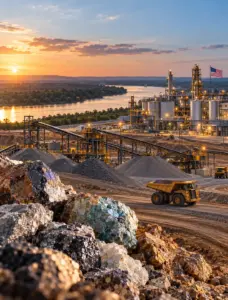
An autonomous ultra-class haul truck operates on a terraced open-pit mine haul road.

Autonomous mining technology 2026 has reached a new scale threshold. Komatsu has commissioned its 1,000th ultra-class autonomous haul truck, while EACON says it has delivered more than 3,000 autonomous mining trucks globally. Tonly has signed an agreement covering 800 autonomous battery-electric trucks in Xinjiang, and Hitachi Construction Machinery has formed a strategic partnership with Pronto to develop open, OEM-agnostic mine automation.
Taken together, these developments show that autonomy is no longer confined to pilot projects at a small number of iron ore operations. It is moving into gold, coal, aggregates and mixed-fleet mining, with competing deployment models emerging around proprietary systems, retrofit platforms and electric haulage.
For mine operators, the key question is changing. The issue is no longer whether autonomous haulage can work. It is how quickly it can be scaled, integrated with existing fleets and aligned with power, workforce and mine-planning requirements.
The 1,000-truck threshold
Komatsu announced on April 21 that it had commissioned its 1,000th ultra-class autonomous haul truck equipped with the FrontRunner Autonomous Haulage System. The milestone truck is a Komatsu 930E-5AT with a 290-metric-tonne payload, deployed at Barrick’s Nevada Gold Mines in the United States.
More Read

The deployment is notable for two reasons. First, it extends Komatsu’s autonomous haulage footprint into gold mining, after years of large-scale adoption in iron ore, copper and other bulk commodities. Second, it demonstrates that autonomy is becoming relevant beyond the largest Australian and South American operations.

According to Komatsu, customers using FrontRunner have collectively moved more than 11.5 billion metric tonnes of material since the system’s commercial introduction in 2008. The company describes the 930E as its most widely deployed autonomous truck model, with more than 500 units operating across customer sites.
FrontRunner is an OEM-specific system, engineered around Komatsu trucks and fleet-management systems. That approach gives operators a tightly integrated hardware and software package, but it can also encourage fleet standardisation around one manufacturer.
More Read

Komatsu’s milestone comes as the industry begins combining autonomous operation with electrification. The company has also demonstrated autonomous operation of an electric-drive truck connected to a dynamic trolley line, highlighting the potential for autonomy to support lower-emissions haulage rather than operating as a standalone productivity tool.

An ultra-class mining truck equipped with telemetry hardware operates in an arid open-pit mine.
EACON brings an OEM-agnostic model to scale
EACON’s reported numbers point to a different path. The company’s website states that it has delivered more than 3,000 autonomous mining trucks globally across more than 40 active projects, with data identified as current in August 2026.
Unlike an OEM-specific platform, EACON’s ORCASTRA system is designed to work across truck brands, payload classes and powertrains. The platform supports diesel, hybrid and battery-electric vehicles, and can be installed on new equipment or retrofitted to existing trucks.
That distinction matters in brownfield mines. Replacing an entire haulage fleet is capital-intensive and may not align with equipment replacement cycles, mine-life assumptions or existing maintenance capability. A retrofit model allows operators to automate selected assets while retaining parts of their current fleet.
EACON’s deployment at Norton Gold Fields in Western Australia illustrates this approach. Working with Thiess and Norton Gold Fields, the company has retrofitted autonomy onto Komatsu HD1500 trucks. Six trucks began day-shift operations without safety drivers at the Havana Pit, providing a test of OEM-agnostic autonomy in a Western Australian gold-mining environment.
The company has also operated large fleets in China, including more than 200 autonomous trucks at the South Open-Pit Coal Mine. Its portfolio spans coal, aggregates, iron ore, copper, gold and zinc, giving EACON exposure to a broader range of mine types than many proprietary systems.
EACON’s scale claim should be read differently from Komatsu’s milestone. Komatsu refers to ultra-class trucks commissioned by an OEM. EACON refers to autonomous trucks delivered through an independent platform, including factory-fitted and retrofit deployments. The figures are strategically important, but they are not directly comparable measures of installed capacity.
Tonly’s 800-truck Xinjiang agreement
The largest individual fleet announcement in the current wave comes from Tonly Heavy Industries. The company has signed an agreement to deliver 800 autonomous “new energy” mining trucks to Xinjiang Hanxiang.
The agreement was announced at a Tonly regional green and intelligent mine development seminar in Ürümqi. Industry coverage identifies the vehicles as autonomous battery-electric wide-body mining trucks, including Tonly’s TLE135 model in the 90-tonne class.
The 800-truck figure is a contracted delivery target, not a confirmed number of trucks already commissioned. That distinction is important for investors, suppliers and mine planners assessing the pace of adoption.
Even so, the agreement signals the scale of China’s autonomous mining market. Large open-pit coal operations have become important proving grounds for electric and autonomous haulage because they offer repetitive haul cycles, controlled road networks and sufficient fleet density to justify centralised dispatch and remote operations.
The Xinjiang project also connects three trends that are increasingly moving together:
- Autonomy, which can reduce exposure to high-risk haulage tasks and stabilise truck cycles.
- Electrification, which can reduce diesel consumption and local emissions when supported by suitable charging infrastructure.
- Fleet-scale digitalisation, including remote monitoring, dispatch optimisation and equipment-health data.

Open-pit mining infrastructure illustrates the scale and logistics required for autonomous fleet deployment.
Hitachi and Pronto target mixed fleets
Hitachi Construction Machinery and Pronto signed a strategic memorandum of understanding in July to develop open, OEM-agnostic mine automation solutions for surface mining.
The partnership is significant because it brings an established mining-equipment OEM into a model traditionally associated with independent autonomy providers. Hitachi contributes mining equipment, customer relationships, digital capabilities and its Wenco fleet-management business. Pronto contributes an autonomy platform designed to retrofit trucks from different manufacturers.
The focus is expected to include autonomous haulage, collision avoidance and wider mobile-equipment automation. The partnership is also aimed at brownfield operations, where mines may need to upgrade existing assets in stages rather than replace a fleet or adopt a single-vendor architecture.
However, the agreement remains a development framework. No joint commercial product, named mine deployment, supported truck list or delivery timetable was announced with the memorandum. Operators should therefore distinguish between Pronto’s existing commercial activity and the future product roadmap implied by the Hitachi partnership.
The direction of travel is nevertheless clear. OEMs are beginning to combine proprietary equipment expertise with independent autonomy platforms, particularly where customers operate mixed fleets or want to preserve procurement flexibility.

Remote operations teams use live equipment and production data to coordinate mine activity.
Autonomous mining technology 2026 deployment tracker
| Company or partnership | Reported scale | Equipment or platform | Deployment status | Strategic significance |
|---|---|---|---|---|
| Komatsu FrontRunner | 1,000 ultra-class trucks commissioned | Komatsu 930E-5AT and other Komatsu electric-drive trucks | Commercial fleet; 1,000th truck deployed at Nevada Gold Mines | Shows OEM-specific autonomy reaching global scale and expanding into gold |
| EACON ORCASTRA | More than 3,000 trucks delivered globally | Multi-OEM, diesel, hybrid and battery-electric trucks | More than 40 active projects, according to EACON | Establishes retrofit and mixed-fleet autonomy as a competing model |
| Tonly and Xinjiang Hanxiang | 800 trucks covered by agreement | Autonomous new-energy wide-body mining trucks | Delivery agreement; commissioning timetable not publicly detailed | Illustrates China’s move toward very large electric-autonomous fleets |
| EACON, Thiess and Norton Gold Fields | Six Komatsu HD1500 trucks in initial autonomous operation | Retrofit OEM-agnostic autonomy | Day-shift operation without safety drivers at Havana Pit | Provides a Western Australia demonstration of mixed-fleet retrofit autonomy |
| Hitachi Construction Machinery and Pronto | No confirmed joint fleet number | Open, OEM-agnostic automation framework | Strategic MoU signed; commercial deployment not yet announced | Could connect a major OEM network with retrofit-based autonomy |
Figures refer to different measures, including commissioned trucks, delivered trucks and contracted units. They should not be treated as a single global fleet total.
What operators should watch next
The next phase of autonomous haulage will be determined less by headline truck counts and more by integration economics.
First, mine operators will assess whether autonomy can operate across mixed fleets without creating additional control-room complexity. Common data standards, fleet-management integration and safety-case requirements will become increasingly important as mines combine equipment from multiple suppliers.
Second, brownfield retrofit economics will influence adoption. The ability to automate an existing truck without extensive structural modification may be especially valuable at mature mines, quarries and operations with shorter remaining lives.
Third, autonomy will increasingly be evaluated alongside powertrain strategy. Electric trucks require charging systems, grid capacity and new maintenance skills. Autonomous electric fleets add another layer of software, communications and operational dependency. The strongest projects will be those that plan these systems together.
Finally, workforce transition will remain central. Removing drivers from haulage does not eliminate the need for skilled personnel. It shifts demand toward remote operations, systems engineering, maintenance, data analysis, safety assurance and site-level change management.
The 1,000-truck Komatsu milestone, EACON’s 3,000-plus deployment figure, Tonly’s 800-truck Xinjiang agreement and the Hitachi-Pronto collaboration point to a more competitive autonomy market. Proprietary OEM systems are scaling, independent platforms are gaining reach, and partnerships are beginning to bridge the two models.
For decision-makers tracking mining technology, the defining question for 2026 is no longer whether autonomous trucks can move material. It is which combination of equipment ownership, software control, powertrain and operating model will deliver the most adaptable fleet over the life of a mine.