
Global lithium demand will more than triple between now and 2050, requiring the equivalent of 134 new mines and more than $100 billion in investment before any contribution from recycling, according to a forecast published today by Benchmark Mineral Intelligence.

The figure translates to roughly one new lithium mine every two months for the next 24 years. Benchmark, a London-based price reporting and research firm, derives that rate by dividing the projected demand growth by an average mine size of 36,000 tonnes of lithium carbonate equivalent per year. The calculation is a benchmark for scale, not a production schedule.
The Demand Side of the Forecast
Benchmark’s base case puts global lithium demand at 2.11 million tonnes LCE in 2026. By 2050, it forecasts demand reaching approximately 7 million tonnes LCE — a rise of 4.8 million tonnes over 24 years. Of the 134 additional mines the firm calculates are needed, 44 are required just to cover demand growth in the final decade, between 2040 and 2050.
Batteries account for 92% of lithium demand in 2026, up from approximately 70% in 2020. Electric vehicles currently drive 55% of total lithium consumption. Benchmark forecasts EVs will account for 76% of demand by 2050 as stationary storage, which has grown explosively in recent years, moderates its rate of expansion.
Cameron Perks, Benchmark’s product director for lithium, noted that stationary storage has grown more than 60% per year for the past two years. He forecasts that pace slowing to around 5% annually through the end of the decade as the initial wave of grid-scale deployments matures.
More Read

The Capital Challenge
The $100 billion figure covers the mined supply gap to 2050 before recycling is factored in. That framing matters. Benchmark separately estimated, in its Capex Briefing, that approximately $64 billion would be needed to meet 2040 lithium demand — a different horizon and a different assumption set, one that credits recycling with meeting a significant share of future demand.

These two numbers describe different things and should not be treated as equivalent. The $100 billion reflects what mines alone must deliver against the 2050 base case. The $64 billion reflects what mines must fund to reach 2040 if recycling performs as Benchmark’s base case expects.
Perks named the core difficulty plainly. The biggest challenge, he said, is sustaining that investment through price cycles, while competing for capital with artificial intelligence, defence and the wider energy transition.
More Read

That framing connects directly to the structural tension in mining finance that Skillings has tracked across recent months. Capital is not scarce in absolute terms. It is competing across more high-priority categories than at any previous point in the energy transition, and lithium’s history of sharp price cycles makes it a difficult story to tell to capital allocators during periods of oversupply.
The Upside Scenario
Benchmark’s upside case, driven by more aggressive EV and energy storage policy across major economies, sees lithium demand approaching 9 million tonnes LCE by 2050. In that scenario, the firm estimates the equivalent of approximately 180 new mines would be required and that total investment would exceed $150 billion. Perks noted that even the base-case investment figure could prove conservative depending on where those mines are built, given that cost structures differ materially by jurisdiction.
The Regional Shift
The 134-mine requirement lands unequally across the world’s lithium-producing regions. Benchmark’s forecast describes a significant redistribution of mined supply share over the next quarter century.
Australia is the largest producer of mined lithium in 2026, accounting for 29% of global mined supply. That share falls to 20% by 2050 in Benchmark’s base case, even with large brownfield expansions such as Pilbara Minerals’ P2000 project factored in for a start around 2030.
Perks described the Australian position directly. Many of Australia’s mines will be depleting by 2050, he said. Price volatility has made financiers hesitant and the regulatory burden is growing. He added that it is not too late, but if Australia does not back growth, other regions will take that share.
China’s share, by contrast, remains relatively stable at around 25% through to 2050, supported by continued investment in domestic resources and an emphasis on battery supply chain control.
North America faces the most significant production ramp implied by the forecast. The region currently accounts for just 1.7% of global mined lithium supply. Benchmark forecasts that rising to 13% by 2050 as North American battery manufacturing expands its domestic supply base. North America’s share of cell-manufacturing demand is expected to grow from 6% to 12% over the same period.
Europe’s position is structurally similar but more constrained. The region accounts for less than 1% of mined supply despite driving 7% of cell-manufacturing demand. Benchmark forecasts Europe reaching 5.5% of mined supply by 2050 — still short of its 8% share of cell demand. Perks acknowledged the challenge: many of Europe’s and North America’s largest and most promising projects require novel technology or face environmental and community concerns. Those factors create significant delays and mean mines built in those regions cost more.
The Recycling Variable
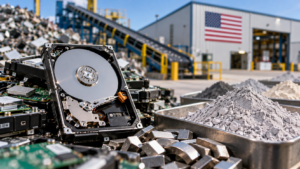
Recycling is the largest single factor that could reduce the number of new mines the industry needs to build. Benchmark’s base case forecasts recycled material accounting for almost half of lithium supply by 2050. That is a substantial assumption, and the firm is explicit about what it depends on.
Perks noted that recycling is limited by how quickly batteries reach end of life. A battery that goes into an EV today does not return to the recycling stream for a decade or more. Recycling also needs to compete with mines on cost — an assumption that is reasonable over the long term but is not guaranteed.
Every tonne that recycling does not deliver, he said, has to come from a mine.
The 134-mine figure represents the gap before recycling makes its contribution. The degree to which recycling performs as Benchmark expects will determine whether the real number of new mines required is closer to that figure, higher or lower.
What the Numbers Mean for the Industry
Benchmark’s forecast is not a prediction that 134 mines will be built. It is a statement of what demand requires. The gap between what the industry needs and what it builds is determined by capital availability, permitting timelines, project economics at the time of investment decision and the performance of recycling at scale.
Several of those variables are moving in different directions at once. Capital has grown more available for lithium projects over the past twelve months as prices recovered. Permitting timelines remain long in most Western jurisdictions. Project economics have improved at current price levels but remain sensitive to the kind of price compression that cleared the market in 2023 and 2024.
The pace implied by Benchmark’s base case — one new mine every two months — is achievable in aggregate across the global industry only if investment decisions are made consistently through periods of lower prices as well as higher ones. That consistency has not characterised the lithium market historically.
What the Industry Should Watch
Capital commitment through the current price cycle. Lithium prices recovered through 2025 and into 2026. Investment decisions made in the current cycle will determine whether the project pipeline grows enough to address the supply gap Benchmark describes. Monitoring final investment decisions over the next 18 to 24 months will indicate whether the capital is following the demand story.
Australia’s brownfield expansion timeline. Australia’s share is forecast to decline from 29% to 20% of global mined supply. Whether that decline reflects depletion of existing resources, investment hesitance or regulatory friction will have different implications. Projects that receive financing and permitting in the next two years will help clarify which factor dominates.
North America’s 1.7% to 13% trajectory. North American mined lithium supply needs to increase roughly eightfold relative to its current share of global output. Tracking which projects receive final investment decisions, on what timelines and under what financing structures will indicate whether that trajectory is achievable inside 24 years.
Recycling ramp-up. Almost half of 2050 lithium supply, in Benchmark’s base case, needs to come from recycled batteries. The commercial conditions for that — battery volume reaching end of life, recycling costs falling below mine production costs, and processing infrastructure scaling — need to be in place well before 2050. Progress in the recycling industry over the next five years will indicate whether that trajectory is on track.
The upside scenario triggers. Benchmark’s upside case, at approximately 9 million tonnes and 180 mines, would be realised if government EV and storage policies drive demand beyond the base case. Following policy developments in the European Union, the United States and China — where vehicle electrification targets and storage mandates are set — will indicate which scenario the market is tracking toward.
A Structural Test, Not a Quarterly Problem
The 134-mine requirement is a generational challenge, not a quarterly one. The question is not whether the industry can build 134 mines. It is whether the capital, the policy environment, the permitting systems and the recycling industry can perform consistently enough, over a 24-year period, to prevent demand from running ahead of supply.
Price cycles will create false signals in both directions. During periods of oversupply, the required investment looks excessive. During periods of deficit, the insufficient investment becomes visible. The pattern repeats.
What Benchmark’s forecast adds is a scale reference that transcends any individual cycle. One new mine every two months, for 24 years, before recycling. That is the structural rate the industry needs to sustain if demand follows the base case. Whether it does will depend less on the next quarterly price move than on whether mining capital, mining policy and mining regulation all stay directionally aligned for two and a half decades.
Sources
Benchmark Mineral Intelligence — South America Mined Lithium Supply to Grow 77% by 2040 (October 21, 2026)
Mining.com — Lithium’s $100B Question: Who Will Build 134 New Mines?