MP Materials Delivers GM’s First Non-Chinese Rare Earth Magnets, Five Years Ahead of Pentagon’s Original Timeline
America’s only fully integrated rare earth producer has begun shipping permanent magnets to General Motors from Fort Worth, Texas — completing a domestic mine-to-magnet supply chain that didn’t exist five years ago.
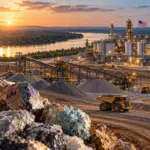
Somewhere in Fort Worth, Texas, a magnet that started as ore pulled from the California desert is about to enter an American-made electric vehicle. No Chinese refinery touched it. No Chinese processing plant handled it. No Chinese magnet factory shaped it. That is not how this supply chain has operated for the better part of three decades — but it is how it operates now.
MP Materials has begun delivering rare earth magnets to General Motors from its Independence facility in Fort Worth. With those deliveries, the first fully domestic mine-to-magnet supply chain in the United States is no longer theoretical. It is running.
Commercial shipments are set to begin at small volumes in the fourth quarter of 2026. GM signed on as MP’s foundational automotive customer in December 2021 — making this arrival point roughly three years faster than the original development timeline.
This is not a proof of concept. It is a functioning supply chain.
How This Actually Came Together
Back in December 2021, GM and MP signed a binding agreement to build a fully domestic rare earth magnet supply chain together. Under the deal, GM committed to sourcing rare earth materials, alloys, and finished NdFeB permanent magnets from MP’s California-to-Texas operation. Those magnets are destined for Ultium Platform electric motors — the drivetrain used in the Cadillac LYRIQ, Chevrolet Silverado EV, and GMC Hummer EV.
“We are building a resilient and sustainable EV manufacturing value chain in North America, from raw materials to cell manufacturing to electric drive motors and beyond.”
— Shilpan Amin, Vice President of Global Purchasing and Supply Chain, General Motors
MP backed the partnership with a $700 million capital commitment of its own. Its Independence facility in Fort Worth — the physical anchor of the GM deal — began producing neodymium-iron-boron magnets in December 2025. By August 2026, initial deliveries had reached GM for automotive-grade certification testing. Regular commercial production is expected before year-end.
James Litinsky, MP’s founder, chairman, and CEO, was candid in investor calls about where the real difficulty lay. Building the supply chain was not the technical challenge — finding a customer willing to commit before Washington had written a single cheque was. GM took that step in 2021. The Pentagon arrived four years later. That sequence matters enormously.
“Restoring the full rare earth supply chain to the United States at scale would not be possible without U.S. manufacturers like GM recognizing the strategic consequence and acting with conviction. We are proud to welcome GM as the foundational automotive customer for our new magnetics facility.”
— James Litinsky, Founder, Chairman & CEO, MP Materials
Why GM Signed Before the Pentagon Did
GM’s 2021 commitment came when MP’s magnet plant existed only on paper. Litinsky has said that anchor customers are what generate conviction in capital-intensive supply chains. Without GM’s early commitment, the development timeline would have looked very different — closer to eight years than five.
By the time Washington committed capital, MP had already broken ground, secured construction financing, and started moving toward commercial production. That track record gave the government a credible partner rather than a speculative one. The equity stake that followed was a strategic investment, not a rescue.
What the Pentagon’s Investment Actually Covers
On July 10, 2025, the Department of Defense formalised the most direct government stake in a private rare earth producer in modern US history. A $400 million investment in MP Materials via convertible preferred stock gave the Pentagon approximately a 15% diluted ownership position — making it the company’s largest single shareholder.
Beyond equity, the agreement also included a $150 million loan for expanding heavy rare earth separation capability at Mountain Pass in California. A 10-year purchase commitment locked in a floor price of $110 per kilogram for neodymium-praseodymium oxide, the core input for high-performance permanent magnets. Board observation rights and a warrant for additional common stock gave the DoD a direct line into MP’s strategic planning.
Construction financing of $1 billion came separately, through a credit line from JPMorgan and Goldman Sachs.
One distinction worth drawing clearly: the Pentagon’s $400 million did not fund the GM magnets. MP financed the Independence facility entirely through its own $700 million commitment. Government capital was directed toward a separate, larger plant described below.
The 10X Plant: What Comes Next
A second Texas magnet facility — known as 10X — is where the Defense Department’s equity stake is most directly pointed. Construction is underway on a 120-acre campus in Northlake, Texas. Designed to produce approximately 10,000 metric tonnes of rare earth magnets annually, it will be more than three times the size of the current Independence facility’s 3,000-tonne capacity target.
Commissioning at 10X is expected around 2028. Once running at full capacity, it will push MP Materials’ total annual magnet output to roughly 10,000 metric tonnes, covering every step from extraction through finished components on US soil. Under the 10-year offtake arrangement, 100% of the new facility’s output is committed to the Pentagon.
More than 1,500 jobs are projected at the Northlake campus. State and local incentives total approximately $200 million. MP broke ground on the site in 2026.
The Numbers Behind the Magnets
Independence facility capacity: 3,000 tonnes of NdFeB magnets per year at full output
GM annual contract volume: ~1,000 tonnes — enough for Ultium Platform EV motors (192 magnets per large motor; 128 per smaller motor)
NdPr oxide output: 1,757 tonnes in H1 2026, vs ~2,600 tonnes for all of 2025
10X target: ~10,000 tonnes per year, commissioning expected 2028
Production is accelerating upstream. MP Materials produced 1,757 tonnes of NdPr oxide in the first half of 2026 alone — nearly matching full-year 2025 output. The DoD’s price floor removed the commercial uncertainty that had previously constrained how aggressively the company could ramp.
Worth noting: MP stopped selling rare earth concentrate to China in July 2025. Before that decision, Mountain Pass ore was shipped to China for processing, then re-entered global supply chains. That arrangement made the US nominally a producer while functioning as a raw material supplier to the country it now works to move away from.
Why Vertical Integration Is the Core of This Story
MP describes itself, accurately, as the only fully vertically integrated rare earth producer in the United States. No other American company currently mines, processes, refines, alloys, and manufactures finished rare earth magnets within a single operational structure.
Litinsky has stated that no entity outside China handles the full supply chain under one roof at commercial scale. That is not a branding claim — it is a supply chain reality with direct national security implications. China imposed temporary rare earth export restrictions in October 2025. Companies relying on partial integration elsewhere in the chain had no guarantee of continuity. Full domestic integration removes that risk entirely.
Beyond GM, MP serves Apple and US aerospace and defence contractors. Cross-sector demand across automotive, consumer electronics, and national security gives the company a breadth few critical minerals producers currently match.
Why This Milestone Took Decades — and Why It Matters Now
China’s control over rare earth processing and magnet manufacturing has compounded since the early 1990s. Deng Xiaoping’s oft-cited observation — that the Middle East has oil and China has rare earths — captured a strategic intent that took decades to fully materialise. What followed was a steady consolidation of processing capacity, manufacturing expertise, and supply chain infrastructure that left the rest of the world broadly dependent on Chinese output.
China still controls an estimated 94% of global permanent magnet production. Fort Worth deliveries will not move that figure in any material way. What those deliveries do is establish a credible, functioning alternative — for the first time in decades — running entirely outside Chinese influence, from a California mine through a Texas factory to a Detroit automaker.
That structural break is the milestone. Volume and stock price are secondary. The chain now exists and works.
Bottom Line
MP Materials is now doing in practice what US rare earth policy has been trying to do in theory for twenty years. A domestic mine feeds a domestic refinery, which feeds a domestic magnet plant, with a major American automaker taking delivery and the Pentagon holding equity.
Commercial production is underway. Deliveries to GM are real. Whether the broader strategy scales now depends on the 10X facility hitting its 2028 commissioning target.
Among all the mine-to-magnet projects announced or underway in the United States — USA Rare Earth, Vulcan Elements, and others — MP Materials remains the only one that has threaded the entire needle. Everything else is still building toward where MP stands today.
Source note: Key facts in this article are drawn from MP Materials SEC filings (Form 8-K, December 2021; Form 10-K, FY2024), MP Materials Q1 2025 and Q3 2025 earnings calls, the GM-MP Materials joint press release (April 2022) filed with the SEC, Department of Defense public announcements (July 2025), and corporate investor updates. The 247 Wall St. article dated October 5, 2026 identified this as a news story; all facts have been independently sourced and verified from primary materials.
Content on Skillings Mining Review is for informational purposes only and does not constitute investment advice.