By Penny Langford

The rare earth magnet industry is crossing a 300,000-tonne benchmark, but the headline needs careful interpretation. The figure is best understood as a milestone in the rapid expansion of commercial neodymium-iron-boron (NdFeB) manufacturing, rather than a complete measure of global capacity across every magnet type and accounting basis.
The distinction matters because available industry estimates now place China’s sintered NdFeB capacity at roughly 380,000 tonnes in 2025, with capacity approaching 400,000 tonnes in 2026. Global permanent-magnet demand is also expanding quickly, driven by electric vehicles, wind turbines, industrial motors, automation and defense systems.
The broader supply chain remains highly concentrated. The International Energy Agency estimates that China accounted for around 60% of mined magnet rare earths, 91% of refined output and 94% of sintered permanent-magnet production in 2024.
That leaves mining companies, magnet producers, original equipment manufacturers and policymakers facing a central question: does rising capacity improve resilience, or does it deepen dependence on one dominant manufacturing base?
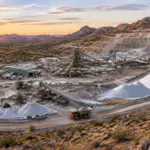
The 300,000-tonne milestone requires a definition
Rare earth supply-chain statistics often combine different products and accounting methods. A tonne of rare-earth oxide is not equivalent to a tonne of finished magnet material. Likewise, capacity can refer to:

- Rare-earth oxide or metal content
- Magnet alloy and powder
- Sintered NdFeB magnets
- Bonded magnets
- Total permanent-magnet output
- Nameplate capacity or actual production
The 300,000-tonne benchmark is therefore useful, but only when linked to a specific product category.
Industry estimates indicate that China produced approximately 300,000 tonnes of NdFeB magnets in 2024, while 2025 output may have reached 340,000–350,000 tonnes. Installed Chinese sintered NdFeB capacity was estimated at approximately 380,000 tonnes in 2025, rising toward 450,000 tonnes by 2027.

On a straight-line basis, that points to capacity of about 415,000 tonnes in 2026. The estimate is an interpolation, not an official single-year forecast, but it illustrates why a 300,000-tonne global capacity figure would be too low if it includes China’s full NdFeB industry.
The more accurate conclusion is that 300,000 tonnes marks a historic production threshold within the global rare earth magnet market, while current total capacity is likely materially higher.
China still controls the value-added stages
The rare earth supply chain becomes more concentrated as material moves from mine to finished product.
| Supply-chain stage | China’s approximate share | Strategic significance |
|---|---|---|
| Mining of magnet rare earths | 60% | Large resource base, but not a monopoly |
| Separation and refining | 91% | Major bottleneck for Nd, Pr, Dy and Tb |
| Sintered permanent magnets | 94% | Highest-value and most concentrated stage |
| China’s share of magnet-REE demand | 57% | Domestic manufacturing remains the main demand centre |
Sources: International Energy Agency; U.S. Department of Energy. Shares refer primarily to 2024 data and magnet-related rare earths.
The IEA’s figures show why new mines outside China do not automatically create independent supply. A project may produce concentrate in Australia, the United States, Brazil or Africa, yet still depend on overseas facilities for separation, metal refining, alloy production or magnet manufacturing.
The U.S. Department of Energy has described the NdFeB supply chain as four linked stages: raw-material production, oxide separation and metal refining, alloy-making and magnet manufacturing, followed by downstream use and recycling. Weakness at any stage can interrupt deliveries to automakers, turbine manufacturers or industrial-equipment producers.

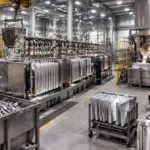
Rare-earth alloying and powder-handling equipment at a magnet manufacturing facility.
Demand is moving beyond electric vehicles
Electric vehicles remain an important source of magnet demand, but they are not the only growth market.
NdFeB magnets are used in:
- Electric and hybrid vehicle traction motors
- Direct-drive wind turbines
- Industrial motors and pumps
- Robotics and autonomous equipment
- Data-center cooling systems
- Hard disk drives and electronics
- Aerospace and defense systems
- Power tools and electric bicycles
The DOE’s earlier high-growth scenario projected global NdFeB demand of approximately 387,000 tonnes by 2030, compared with about 119,000 tonnes in 2020. That forecast was built on strong growth in offshore wind, electric vehicles and other applications.
More recent industry estimates place current demand significantly higher than the 2020 baseline. One market estimate put global rare-earth permanent-magnet demand at approximately 385,000 tonnes in 2025. Applying the DOE’s estimated 8.7% annual growth rate for permanent magnets through 2030 would imply demand of more than 410,000 tonnes in 2026.
These figures are not directly comparable because the sources use different definitions. They nevertheless point to the same operational reality: capacity expansion is occurring in a market where demand growth can absorb new output quickly.
Heavy rare earths remain the sharper constraint
Not all magnets have the same material requirements.
Standard NdFeB magnets rely mainly on neodymium and praseodymium. High-temperature grades used in vehicle traction motors, wind generators and other demanding applications can also require dysprosium or terbium. These heavy rare earths improve resistance to demagnetization but are more difficult to source and process outside China.
Manufacturers are responding through:
- Grain-boundary diffusion
- Lower-heavy-rare-earth magnet designs
- Improved grain control
- Reduced machining losses
- Alternative motor architectures
- Greater use of recycled magnet feedstock
These technologies can reduce material intensity, but they do not remove the need for refined metal and specialized manufacturing expertise.
China’s export-control regime has added another layer of risk. Licensing requirements affecting dysprosium, terbium, yttrium and other controlled materials can delay shipments even when buyers have secured formal approvals. Recent industry reporting has also highlighted cases in which suppliers delayed or declined shipments because of end-user, compliance or resale concerns.
That means the commercial risk is not limited to physical capacity. Buyers must also consider licensing timelines, customs inspections, documentation requirements and the willingness of suppliers to complete transactions.
Ex-China capacity is growing, but from a small base
The United States, Europe, Japan, South Korea and Australia are developing new projects across the mine-to-magnet chain. Planned capacity includes separation plants, alloy operations, recycling facilities and finished-magnet factories.
However, the scale remains limited compared with China.
The IEA has estimated that announced projects outside China for metals, alloys and finished magnets total roughly 18,000 tonnes on a rare-earth-content basis. That number cannot be directly compared with finished-magnet tonnes, but it illustrates the size gap between new diversified projects and China’s existing manufacturing system.
In the United States, USA Rare Earth is targeting initial Stillwater production of hundreds of tonnes per year, with additional capacity planned at its Blacksburg facility. Other projects involving MP Materials, VAC, Noveon, eVAC and additional producers could lift U.S. finished-magnet capacity materially by the end of the decade.
South Korea’s Evolution Metals & Technologies is also expanding its magnet operations, with a target of more than 10,000 tonnes per year across sintered and bonded products.
The issue for investors and policymakers is execution. Announced capacity is not the same as operating capacity. Projects must still secure financing, permitting, skilled labor, qualified customers, power, feedstock and process reliability.

Critical-mineral logistics infrastructure linking processing facilities with downstream manufacturers.
Recycling can improve resilience, but will not close the gap alone
Recycling is becoming a more important part of rare earth supply-chain strategy.
Manufacturing scrap, or swarf, is already recycled in many magnet-producing regions. End-of-life recycling remains less developed because magnets are embedded in motors, hard drives, electronics and other products that require dismantling and sorting.
The most promising approaches include:
- Hydrogen processing to recover magnet powder
- Direct magnet-to-magnet recycling
- Hydrometallurgical recovery of rare earth oxides
- Automated sorting and dismantling
- Recovery of dysprosium and terbium from high-temperature grades
Recycling can reduce mining intensity, lower waste and provide a domestic source of feedstock. It is particularly valuable for manufacturers seeking greater control over material origin.
But recycling volumes will grow gradually because many products containing magnets have long operating lives. New recycling capacity will supplement primary production rather than replace the need for new mines and separation plants in the near term.

Automated equipment separating end-of-life magnet components for recovery and reuse.
Base, bull and bear cases for the supply chain
| Scenario | Capacity and demand outlook | Main drivers | Principal risks |
|---|---|---|---|
| Base case | Global magnet capacity continues expanding above the 300,000-tonne benchmark, while China remains dominant through the decade | EVs, industrial automation, wind power and gradual ex-China build-out | Licensing delays, weak project economics and continued refining concentration |
| Bull case | New ex-China plants commission on schedule and recycling gains commercial scale | Government support, long-term offtake agreements, faster permitting and technology improvements | Higher costs may still limit market share |
| Bear case | Capacity exists on paper but output lags as projects face delays and demand outpaces qualified supply | Export restrictions, financing gaps, feedstock shortages and technical ramp-up problems | Magnet shortages, price volatility and production interruptions for OEMs |
For mining companies, the strongest strategic position may belong to projects that offer more than a rare earth resource. Integrated separation, metal refining, alloy production, recycling and secured offtake can reduce exposure to midstream bottlenecks.
For manufacturers, supply-chain resilience will depend on qualifying multiple magnet grades and suppliers before disruption occurs. Redesigning a traction motor or wind generator after a supply interruption is considerably more difficult than qualifying alternatives in advance.
What the 300,000-tonne threshold means
The rare earth magnet market has already moved beyond the era when supply-chain risk could be measured only by mine production. The critical contest is now taking place in refining, alloy production, sintering, coating, recycling and logistics.
The 300,000-tonne milestone is significant because it shows how quickly magnet manufacturing has scaled. But it should not be treated as a complete measure of global capacity. Current evidence suggests that China alone has moved above that level in both output and installed sintered NdFeB capacity.
The more consequential benchmark is whether alternative producers can build enough qualified capacity to compete across the full chain. Until then, a larger global magnet market may still operate with a narrow geographic center of gravity.
For operators, investors and policymakers tracking critical minerals, autonomous tech, electric vehicles and energy-transition infrastructure, the key indicator is not simply tonnes produced. It is how many tonnes can be separated, refined, converted into qualified magnets and delivered without geopolitical interruption.
LinkedIn snippet
Rare earth magnet capacity has crossed the 300,000-tonne benchmark, but the bigger story is supply-chain concentration. China still accounts for roughly 91% of refined magnet rare earths and 94% of sintered permanent-magnet production. Our analysis examines what the milestone means for EVs, wind power, automation, recycling and ex-China capacity.
X snippet
Rare earth magnet capacity is moving beyond 300,000 tonnes, but China still dominates refining and finished NdFeB production. The next supply-chain test is not mining alone ; it is separation, alloying, qualified magnet output and recycling.