
When the Trump administration issued an executive order in April 2025 calling for accelerated development of seabed mineral resources, it identified three distinct geographic areas as targets. That three-part framing was not rhetorical. Each area operates under a different legal regime, involves different government agencies and international actors, and faces its own obstacles before mining could begin.

Understanding the difference between those three areas is the starting point for evaluating any seabed mining announcement, permit application or investment claim that originates from US policy. The legal landscape shapes what can move forward, how quickly and at what political cost.
Coalter Lathrop, director of Sovereign Geographic, a law firm and cartography consultancy, has set out the most precise public analysis of that landscape to date. This article draws on that analysis to explain the three areas and what each one means for mining in practice.
What the Seabed Contains
Before the jurisdictional question, the mineral question. The US Geological Survey’s critical minerals list runs to 60 entries. Of those, 43 occur within the marine environment of the US continental shelf. All 60 occur on US land territory, but most are not currently mined or processed within the United States.
Six Deposit Types
The seabed concentrates critical minerals in six distinct deposit types, each with a different mineral profile, depth range and geographic distribution.

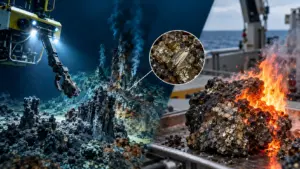
Polymetallic nodules sit on the ocean floor at depths of 4,000 to 7,000 metres. These potato-shaped rocks contain manganese, cobalt, copper, nickel, titanium and trace rare earth elements. The richest concentrations are in the Pacific and Indian Oceans, particularly in the Clarion-Clipperton Zone.

Polymetallic sulfides, also called seafloor massive sulfides, form around hydrothermal vents along mid-ocean spreading ridges. Their depth range is 100 to 7,000 metres. They contain copper, zinc, lead and silver.
Cobalt-rich ferromanganese crusts accumulate on hard volcanic rock on seamounts and ridges at 400 to 5,000 metres. They contain cobalt, manganese, nickel, platinum and trace rare earth elements.
More Read

Rare earth element-rich muds are embedded in the ocean floor subsoil. Known occurrences sit at water depths of 3,000 to 6,000 metres in the Pacific and Indian Oceans.
Phosphorites occur along continental shelves and seamounts at depths below 1,000 metres. They contain phosphate, uranium and trace rare earth elements.
Marine placers are heavy mineral sands in nearshore marine environments at depths below 200 metres. They contain titanium, tin, platinum, silver and trace rare earth elements.
These deposit types are not interchangeable. Rare earth elements feed into permanent magnets. Copper goes into electrical wiring. Nickel, manganese and cobalt go into batteries. Their processing requirements and end uses differ substantially. That differentiation matters when evaluating the strategic case for any specific seabed mining programme.
The First Area: US Jurisdiction
The US continental shelf covers approximately 11 million square kilometres of seabed. It extends up to and beyond 200 nautical miles from US territory. That territory includes the continental United States, Alaska, Hawaii, American Samoa, Guam, the Northern Mariana Islands and US Minor Outlying Islands. One million of those 11 million square kilometres constitutes the extended continental shelf, lying beyond 200 nautical miles.
In this area, the United States holds exclusive jurisdiction and sovereign rights over the mineral resources on the seabed and in the subsoil. All six deposit types are known to exist within it.
The Outer Continental Shelf Lands Act governs the use of non-living natural resources in this zone. The Bureau of Ocean Energy Management — now under the newly formed Marine Minerals Administration at the Department of the Interior — is the administrative and leasing agency. The National Oceanic and Atmospheric Administration serves as the primary marine scientific research agency for these resources.
Mining decisions here are subject to domestic political and legal processes. Public international law has limited direct application. It applies where activities might interfere with other nations’ high seas freedoms — navigation and cable-laying — or where environmental harms spread beyond the US continental shelf.
Domestic Friction Points
Two concrete situations illustrate where the domestic process is currently generating friction. Conservation and community groups brought a legal challenge in US District Court to block a BOEM seabed mineral lease sale surrounding American Samoa. That sale is set for November 2026. Separately, an unsolicited application to lease phosphorites and heavy mineral sands off the Virginia coast generated nearly 77,000 public comments before BOEM as of July 2026.
Each situation is moving through domestic legal channels. Each could delay or reshape the lease process. Neither requires international adjudication — and that absence of international oversight is the defining characteristic of this first area.
The Second Area: Other Countries’ Jurisdiction
Approximately 150 other coastal states exercise the same exclusive jurisdiction and sovereign rights over their own continental shelves that the United States exercises over its own. Each country determines whether, when, where, how and by whom its seabed resources are developed. Its national laws and government agencies make those decisions.
The United States has no jurisdiction or sovereign rights in these areas. US companies can operate there, typically through foreign subsidiaries. At the intergovernmental level, Washington has signed non-binding cooperation agreements with Japan and the Cook Islands. NOAA can also partner with coastal states to conduct marine scientific research within their zones.
Mining in this second area depends entirely on the political and legal environment in each individual country. Several recent decisions show how variable that environment is.
Norway was on the verge of opening its inaugural seabed minerals licensing round in December 2025. Following a national election, it reversed course and announced a pause through 2029. Papua New Guinea signed a declaration calling for a region-wide moratorium on seabed mining in 2023. Four other Pacific island nations joined it. The decision followed the 2019 failure of PNG’s Solwara 1 seafloor massive sulfide project. The Cook Islands issued three five-year exploration licences and has continued to consider exploitation, though domestic opposition exists. Japan collected rare earth element-rich muds from its seabed in February 2026. It plans to return for a mining trial in 2027.
US companies and government agencies can engage with these jurisdictions. What they cannot do is move faster than the political and regulatory systems in each host country allow.
The Third Area: Beyond National Jurisdiction
The legal landscape changes substantially in seabed areas beyond the limits of coastal state jurisdiction. This is where the most consequential and contested questions currently sit.
Approximately half of the planet’s ocean floor lies beyond national jurisdiction. The United Nations Convention on the Law of the Sea calls this zone “the Area.” UNCLOS designates the Area and its resources as the common heritage of mankind. It establishes the International Seabed Authority to organise, carry out and control exploration and exploitation of those resources on behalf of humanity as a whole.
One hundred seventy-one states and the European Union are parties to UNCLOS. The United States, uniquely among major industrialised nations, is not.
The ISA has issued 32 exploration contracts with 22 separate contractors. Each contractor is formally sponsored by a state party to the convention. The ISA has developed exploration regulations for polymetallic nodules, seafloor massive sulfides and cobalt-rich crusts. It has not developed regulations for rare earth element-rich muds or phosphorites. It has not entered into any exploitation contracts. Exploitation regulations remain under development.
The US Unilateral Approach
In April 2025, the United States announced its intention to issue seabed mineral exploration licences and commercial recovery permits in areas beyond national jurisdiction. It did so acting under its own 1980 Deep Seabed Hard Mineral Resources Act. NOAA is the permitting agency under that statute.
Four days after the executive order, The Metals Company USA applied for two DSHMRA exploration licences and one commercial recovery permit. These were the first licence applications under the Act since 1984. The commercial recovery permit application was the first ever filed. As of October 2026, six exploration licence applications and one commercial recovery permit application had been made public. More are in the pipeline. The Metals Company anticipates NOAA will issue its commercial recovery permit before the end of 2027. Legal challenges could push that date later.
Two Legal Questions
That approach raises two questions of international law. Lathrop identifies both as unresolved and likely to be tested in court.
The first is whether the United States would violate its international legal obligations by authorising or undertaking unilateral seabed mining in the Area. The US is not a party to UNCLOS and is not bound by its treaty obligations. Whether parallel rules of customary international law apply is contested. Some legal scholars conclude the US would breach customary law obligations. Others argue it would not. No international court can compel the United States on this question. It has not consented to their jurisdiction.
The second question concerns the obligations of UNCLOS parties when a non-party undertakes unilateral mining. Parties to the convention must ensure their own nationals and entities those nationals effectively control do not participate in unauthorised mining activities in the Area. They must also refuse to recognise any claim, acquisition or exercise of rights over minerals recovered from the Area outside the convention framework. Anti-alienation obligations restrict transfers of ownership of such minerals. If states implement these obligations fully, they would substantially isolate and disable US unilateral mining activities.
These questions are likely to come before international courts and tribunals. Forty-six states have already called for a pause or moratorium on seabed mining in the Area. Where their legal obligations ultimately intersect with US commercial activities in the Area will be determined across Kingston, Hamburg, Washington and 171 national capitals — simultaneously, and without a clear resolution timeline.
The Commercial Reality Underneath the Legal Framework
The legal complexity is real. It does not exist in isolation from commercial practicality.
Lathrop notes that without significant government intervention, the commercial viability of deep-sea mining at scale is in question. The interventions required include commodity price floors, offtake agreements, grants and loan guarantees. Some observers have described deep-sea mining as a multi-billion-dollar solution to problems that do not exist. They point to land-based alternatives and the pace at which recycling and shifting battery chemistries could reduce pressure on seabed resources.
That assessment may prove too dismissive as critical minerals supply chains tighten. It may also prove accurate if land-based supply expands sufficiently. The legal framework does not answer that question. It determines where and under whose authority any commercially viable projects would be permitted to proceed.
What the Industry Should Watch
The BOEM lease sales in November and December 2026. BOEM’s upcoming sales for American Samoa and the Northern Mariana Islands are the first concrete test of whether the first area can generate actual mineral leases in the face of legal challenges. The outcome of the District Court challenge to the American Samoa sale will indicate how durable domestic permitting will be.
NOAA’s processing of The Metals Company’s permit application. A commercial recovery permit issued under the DSHMRA before the end of 2027 would be the first in the statute’s 46-year history. It would be the clearest test of whether the US can operationalise unilateral mining in the Area under domestic law.
ISA exploitation regulations. The ISA has been working on exploitation regulations without finalising them. The pace and outcome of that process will determine whether the multilateral regulatory framework reaches completion before unilateral US activities begin.
UNCLOS party responses. Whether and how UNCLOS parties implement their treaty obligations will shape the commercial ecosystem for deep-sea mining. Banking, insurance, offtake contracts and equipment supply could all be affected if US companies proceed outside the ISA framework. A formal advisory opinion from the ITLOS Seabed Disputes Chamber or a contentious case between states could clarify those obligations.
Environmental litigation across all three areas. Legal challenges have already emerged in the first area. Further challenges are likely in the third area if commercial recovery moves forward. The pace of litigation relative to the pace of permitting will determine real-world timelines.
Three Areas, Three Timelines
The executive order that launched the current US push described seabed minerals as vital to national security and economic prosperity. That framing is accurate for some minerals in some deposit types. Whether the legal framework supports that ambition at the administration’s intended pace is a separate question. It has a different answer for each of the three geographic areas.
In US jurisdictional waters, mining can proceed under domestic law subject to domestic legal challenges. In partner countries’ waters, mining can proceed subject to each country’s political and legal environment. The Area beyond national jurisdiction offers two routes — the ISA framework if exploitation regulations are finalised, or the US unilateral path under domestic law with contested international legal consequences attached.
None of those paths is fast. None is without risk. Understanding which path applies to which project is the essential first step in evaluating any deep-sea mining investment or policy claim.
Sources
Coalter Lathrop — United States Seabed Mineral Activities: Understanding the Legal Landscape, Just Security, October 22, 2026
Executive Order 14225 — Unleashing America’s Offshore Critical Minerals and Resources, April 2025 — whitehouse.gov
BOEM Seabed Mineral Lease Sales — boem.gov
NOAA Deep Seabed Hard Mineral Resources Act — fisheries.noaa.gov
ISA Contract List — isa.org.jm