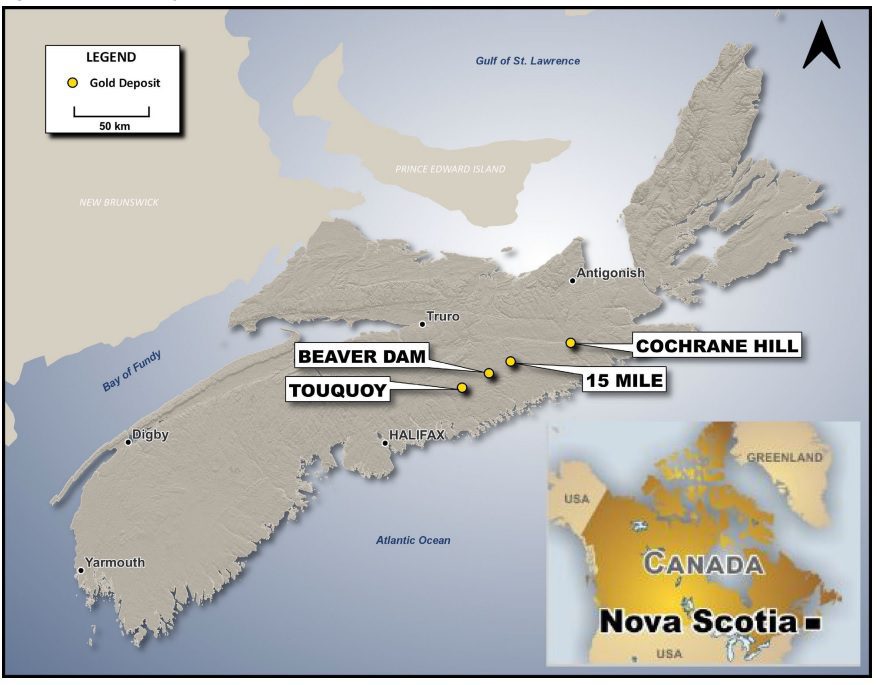

St Barbara gold (ASX:SBM) revealed the pre-feasibility study (PFS) results for its wholly-owned 15 Mile Gold project in Nova Scotia, situated in the mineral-rich terrains of Western Australia. As Santa Barbara is an Australian company, the study was conducted according to Australian standards.
Gold Mining Investment Australia: Financial Analysis of the St Barbara Gold Project
The study is based on total mineral resources of nearly 840,000 ounces of gold and Mineral Reserves of 618,000 ounces of gold. Under the current mine plan, the company is able to plan for an 11-year mine life, producing an average of 55,000 to 60,000 ounces of gold per year at an average all-in sustaining cost of $992 per ounce.
Based on a life-of-mine gold price of US$1,700, the 5% after-tax NPV is estimated at CAD$174 million, giving a capex to NPV ratio of almost exactly 1:1 given the initial capital expenditure of CAD$182 million.
Sustainable Gold Mining: At the Heart of St Barbara’s Operations
The PFS details an impressive Net Present Value (NPV) of AUD 1.2 billion, calculated at an 8% discount rate, and an alluring Internal Rate of Return (IRR) of 29%. These figures, set against a backdrop of fluctuating market conditions, not only bolster confidence in the project’s robustness but also signify potential windfalls for both the company and its shareholders.

Projected to span a life of 12 years, the mine anticipates an average gold production volume of 300,000 ounces per annum. The operational forecast is complemented by an all-in sustaining cost (AISC) of AUD 1,050 per ounce, a competitive figure that positions 15 Mile Project favourably in the global gold market.

Assuming a gold price of US$1,900 per ounce over the life of the mine, the after-tax NPV increases from 5% to C$289 million, which also increases the IRR from 20.3% to a more respectable 26.6% as the payback period increases from 4.3 years shortened to 3.4 years.
“The financial anatomy of the project is as robust as it is promising,” commented a St Barbara spokesperson. “An initial capital expenditure of AUD 450 million and a calculated sustaining capital of AUD 150 million over the mine’s life is an investment that we believe will yield substantial returns.”

However, the report extends beyond mere numbers. St Barbara reaffirms its commitment to environmental stewardship and social responsibility. The company pledges to minimize its ecological footprint, engage constructively with local communities, and adhere to the highest standards of sustainable mining—a move that industry experts and environmentalists might find commendable amidst the growing clamour for climate-conscious business practices.

Gold Production Forecast Australia: What the Future Holds for the 15 Mile Gold Project
The pre-feasibility study also outlines the next strategic steps, including a definitive feasibility study (DFS) and continued exploration activities aimed at expanding the resource base—a clear indication of St Barbara’s assertive yet meticulous approach.
Despite the project’s bright prospects, St Barbara remains cognizant of potential risks—fluctuating gold prices, operational challenges, and regulatory shifts. Yet, the opportunities, as detailed in the report, are significant and include resource expansion, mining method optimization, and technological innovations.
As the Strong 15 Mile Project transitions to subsequent phases, it carries the aspirations of a company, the anticipation of its stakeholders, and the watchful eyes of the global mining community. It’s a bold stride forward for St Barbara, and indeed, a golden chapter awaiting narration.
While this pre-feasibility study is definitely not stellar, the results are quite robust and the relatively low initial investment cost may be attractive to Santa Barbara. NPV calculations are based on 618,000 ounces of gold in mineral reserves. Therefore, if the company is able to convert some of its resources into reserves, it can extend the mine life, which will also have a positive impact on NPV. The impact is relatively small because the discount rate also plays an important role.