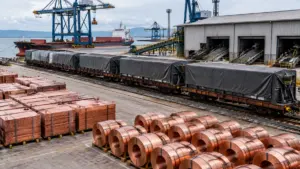
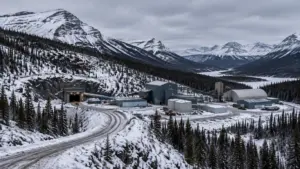
Uranium processing infrastructure and sealed handling equipment in a modern industrial facility.

The uranium market is entering a more politically divided phase. Spot prices are holding near $90 per pound, while the reported long-term price has reached about $96 per pound: an 18-year high. At the same time, Kazatomprom, the world’s largest uranium producer, is asking shareholders to approve proposed supply contracts with Chinese and Rosatom-linked buyers.
The vote is scheduled for October 7. Contract volumes, pricing and delivery schedules have not been disclosed, but the decision could determine how much Kazakh uranium remains available to Western utilities outside existing commitments.
The supply question is complicated by a sharp increase in Kazatomprom’s production costs. The company’s attributable C1 cash cost rose 37% year over year to $24.48 per pound in the first half, according to reporting from Crux Investor and The Deep Dive.
The combination of high prices, rising input costs and strategically allocated supply is reshaping the market ahead of a period of continued nuclear fuel procurement.

Uranium prices are signaling a tighter contracting market
The uranium market has two important reference points: the spot price for near-term material and long-term contract prices negotiated between producers and utilities.

TradeTech’s weekly uranium indicator places spot near $90 per pound. Its methodology considers completed transactions, pending transactions, firm bids and offers, and stated willingness to buy or sell. The indicator does not represent the price of uranium delivered under older long-term contracts.
The reported long-term price near $96 per pound is therefore significant. It suggests that utilities seeking security of supply are willing to pay a premium over the immediate spot market. Long-term contracting also allows buyers to reduce exposure to future shortages, transportation disruptions, enrichment constraints and geopolitical restrictions.

A reported 18-year high in the long-term price does not mean every utility is paying $96 per pound. Contract prices vary according to delivery dates, escalation clauses, flexibility, origin, credit terms and whether the agreement is with a primary producer or a secondary supplier. It does, however, indicate that the market is placing a higher value on dependable future supply.
Kazatomprom’s first-half results show the contrast between realized prices and current benchmarks. The company reported an average realized uranium price of $67.88 per pound, while the average weekly spot price during the period was reported at $85.98 per pound. That gap reflects the lag between older contracts and current market conditions.
The October 7 vote could redirect uncommitted material
Kazatomprom has proposed a spot-term uranium concentrate contract with China’s State Nuclear Uranium Resource Development Company and a separate supply agreement with Uranium One Group JSC, a Rosatom-linked company.
According to reporting based on the company’s shareholder notice, material under the Chinese contract would be delivered to Alashankou, while uranium under the Russian transaction would be delivered to the Siberian Chemical Plant. The notice does not disclose contract volumes, duration or delivery schedules.
Shareholders can submit absentee ballots before the vote, with results expected on October 7. The immediate market question is not simply whether the contracts are approved. It is how much production they would commit and over what period.
Kazakhstan supplied approximately 28% of uranium delivered to U.S. utilities in 2025, according to the Crux analysis. That makes Kazakh supply strategically important even if the proposed contracts do not directly involve Western buyers.
If meaningful volumes are directed to Chinese and Russian counterparties, Western utilities may face a smaller pool of uncommitted material. The effect could be especially important for buyers seeking new contracts rather than relying on legacy agreements negotiated at lower prices.
The decision also illustrates how uranium is increasingly being treated as a strategic commodity. State-linked buyers may place greater weight on fuel security and geopolitical alignment than on short-term price optimization. That can change the competitive dynamics for commercial utilities and independent producers.

An in-situ recovery wellfield reflects the infrastructure behind Kazakhstan’s uranium production base.
Kazatomprom’s cost inflation raises the supply-floor question
Kazatomprom remains one of the uranium industry’s lowest-cost producers, but its cost base has moved higher.
The company reported a 37% year-over-year increase in attributable C1 cash costs to $24.48 per pound. All-in sustaining cash costs rose 25% to $38.45 per pound. Full-year guidance was raised to approximately $25.50–$27.00 per pound for C1 costs and $39.00–$40.50 per pound for all-in sustaining costs.
Management has attributed the increase to several factors:
- Kazakhstan’s mineral extraction tax increased from 9% to 12.4%.
- Sulfuric acid prices rose significantly.
- The Kazakh tenge strengthened against the U.S. dollar.
- Input and operating costs increased across the production system.
Sulfuric acid is particularly important for uranium operations using in-situ recovery, or ISR. The method circulates a leaching solution through an ore body and relies on chemical reagents to recover uranium.
The planned commissioning of Kazatomprom’s TQZ sulfuric acid plant has also reportedly been delayed from the first quarter of 2027 to a window between the third quarter of 2027 and the first quarter of 2028. A longer reliance on external acid supplies could keep cost pressure elevated.
At current prices, Kazatomprom retains a substantial margin over reported C1 and all-in sustaining costs. But the relevance of the increase is broader than the company’s own profitability. If the lowest-cost major producer faces higher taxes, reagents and currency costs, new supply elsewhere may require materially higher prices to move forward.
Uranium market scenario framework
The following framework is intended to distinguish market drivers from forecasts. It is not a price target.
| Scenario | Main conditions | Likely market effect | Key indicators |
|---|---|---|---|
| Bear case | Vote is approved but contracts commit limited volumes; new production and secondary supply increase; reactor demand growth slows | Spot and long-term prices soften from current levels | Rising inventories, delayed utility contracting, faster project restarts |
| Base case | Contracts are approved with meaningful but undisclosed volumes; Western buyers continue replacing legacy contracts; costs remain elevated | Long-term prices remain around the mid-$90s, with spot near or below term levels | October vote outcome, utility tenders, Kazatomprom cost guidance |
| Bull case | Large eastward commitments reduce Western availability; acid and tax costs rise further; project delays persist | Spot tightens and long-term prices move above current high levels | Contract volumes, declining uncommitted supply, higher conversion and enrichment costs |
The base case depends on continued utility contracting rather than a sudden spike in reactor demand. Nuclear generation growth, fleet life extensions and new reactor construction all support longer-term uranium consumption, but the market’s near-term sensitivity is primarily about procurement timing.
Western supply cannot respond immediately
Potential supply from the United States, Canada and other jurisdictions could reduce dependence on Kazakh material, but new production remains constrained by permitting, infrastructure and development timelines.
Existing processing capacity can help. The White Mesa Mill in Utah provides an established conventional uranium processing route, while other U.S. projects are pursuing mine restarts and in-situ recovery development. Canada’s Athabasca Basin also contains significant exploration potential and established uranium infrastructure.
However, a resource is not the same as delivered fuel. A project must move through technical studies, permitting, financing, construction, commissioning and ramp-up. Even permitted projects may face delays when reagent supply, processing capacity or skilled labor is limited.
That timing gap matters because utility procurement often extends years into the future. Buyers seeking contracts for the late 2020s and early 2030s cannot assume that every announced project will be producing on schedule.

Secure handling and packaging infrastructure are part of the nuclear fuel supply chain.
What operators, utilities and policymakers should watch
The October vote is the clearest near-term catalyst, but several follow-up disclosures will matter more than the approval itself.
First, contract volume and duration. Without those details, the market cannot estimate how much Kazakh supply would be unavailable to other buyers.
Second, delivery geography. Contracts routed through Chinese or Russian infrastructure may deepen regional segmentation in the uranium trade, particularly if sanctions, export controls or logistics constraints affect future transactions.
Third, Kazatomprom’s cost trajectory. The 37% C1 increase shows that uranium prices are not the only variable affecting supply. Tax policy, sulfuric acid availability and currency movements could influence production economics.
Fourth, Western contracting activity. New utility tenders, particularly those covering deliveries from 2030 onward, would confirm whether buyers are acting on concerns about future availability.
Finally, secondary supply. Government inventories, trader-held material, commercial stockpiles and recycled fuel can temporarily ease market tightness. Their availability is difficult to measure and should not be treated as equivalent to dependable primary production.
Bottom line
The uranium market is not facing a single supply story. It is facing a combination of higher long-term prices, limited contracting transparency, rising producer costs and a growing role for state-linked buyers.
The reported $96 per pound long-term price and spot near $90 indicate that buyers are placing a premium on future availability. Kazatomprom’s October 7 shareholder vote could reinforce that premium if the proposed China and Rosatom-linked contracts commit substantial volumes.
At the same time, the 37% increase in C1 costs shows why new supply may not arrive quickly even when prices are attractive. Western utilities may need to compete for a narrower pool of uncommitted uranium while waiting for projects in North America and elsewhere to complete the development cycle.
The result is a market where contract allocation, delivery timing and geopolitical alignment may matter as much as the headline spot price.
LinkedIn snippet
Uranium spot prices are near $90/lb, while reported long-term prices have reached about $96/lb: an 18-year high. Kazatomprom’s October 7 shareholder vote on China and Rosatom-linked contracts could determine how much Kazakh supply remains available to Western utilities. The company’s C1 costs have also risen 37% year over year. Our scenario framework examines what operators, utilities and policymakers should watch next.
X snippet
Uranium’s next test is allocation, not just price. Spot is near $90/lb, long-term pricing is reported around $96/lb, and Kazatomprom’s Oct. 7 vote could redirect supply toward Chinese and Rosatom-linked buyers. C1 costs are up 37% YoY. Our base/bull/bear framework explains the risks.