The Patagonia Mountains in southern Arizona, where South32’s Hermosa project has completed federal permitting under FAST-41.

South32’s Hermosa project has become the first mining development to complete the federal permitting process under FAST-41, giving U.S. mining companies a concrete example of how coordinated environmental review may work in practice.
The U.S. Forest Service approved South32 Hermosa Inc.’s exploration and Mine Plan of Operations for the project in southern Arizona, the agency said. The decision clears the way for work to begin in the Patagonia Mountains and completes the first Forest Service critical-minerals project designated under Title 41 of the Fixing America’s Surface Transportation Act.
The approval arrived as the House passed the Protecting Domestic Mining Act of 2025, a bill that would permanently place mining and mineral processing within FAST-41’s statutory coverage. Together, the developments mark a significant change in the permitting framework for U.S. mining: but they do not remove environmental review, agency decision-making, or project execution risks.
Hermosa becomes FAST-41’s first mining test case
South32’s Hermosa project is a proposed zinc and manganese mining and processing operation in Santa Cruz County, about 55 miles south of Tucson. The project includes the Clark deposit, which the Forest Service describes as an advanced domestic source of battery-grade manganese.
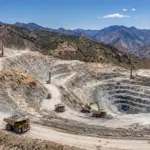
The Federal Permitting Improvement Steering Council said the project represents a planned investment of $3.3 billion and could become the largest investment in southern Arizona’s history. South32 expects the operation to produce up to five federally designated critical minerals, including zinc, silver, and manganese.

The project has strategic importance beyond its location. The Forest Service said the United States remains fully reliant on foreign sources for manganese, while China produces more than 95% of battery-grade manganese globally. The agency also said Clark is the only advanced U.S. project that has demonstrated through pilot testing that battery-grade manganese can be produced from a domestic ore source.

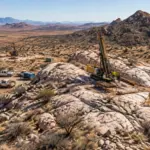
Underground mining infrastructure is central to the Hermosa project’s small-footprint development plan.
The Forest Service’s approval followed the project’s environmental review and final decision under the National Environmental Policy Act. South32 had previously received a Final Record of Decision for the project’s federal infrastructure in July.
The Forest Service approval states that the agency and its cooperating partners met FAST-41 and NEPA timelines through coordination among the Forest Service, the U.S. Department of Agriculture, the Permitting Council, and other federal agencies.
The Permitting Council separately described Hermosa as the first mining project to receive FAST-41 coverage and complete federal permitting under the program. South32 Hermosa President Pat Risner said the process provided greater predictability and transparency while maintaining public engagement and Tribal consultation.
Hermosa timeline: from dashboard posting to approval
The Federal Permitting Dashboard provides the clearest public record of the project’s permitting status. It lists the Forest Service as the lead agency and shows the project as complete.
| Milestone | Status or timing | Significance |
|---|---|---|
| Dashboard project posting | May 5, 2023 | Hermosa entered the public FAST-41 permitting framework |
| Environmental review and agency coordination | 2023–2026 | Federal reviews were managed through a coordinated timetable |
| Final Record of Decision | July 2026 | Completed the principal NEPA decision for federal project infrastructure |
| Forest Service approval | September 2, 2026 | Approved the exploration and Mine Plan of Operations |
| Dashboard status | Complete | Federal environmental review and permitting listed as completed |
The Hermosa Permitting Dashboard records the project’s environmental review and permitting as complete on September 2. It also identifies the Department of the Interior’s Fish and Wildlife Service as another agency with actions or authorizations connected to the project.
That distinction matters for operators. FAST-41 does not mean that a project receives one universal permit or bypasses agency authority. It creates a framework for coordinating federal actions, publishing a permitting timetable, identifying responsible agencies, and improving visibility when schedules change.
The Forest Service approval is therefore both an authorization for Hermosa and a test of whether that coordination model can be applied consistently to more complex mining developments.
What the Protecting Domestic Mining Act would change
The House passed H.R. 1501, the Protecting Domestic Mining Act of 2025, on September 2. The bill was introduced by Representative Jefferson Shreve and passed by a reported vote of 218–201.
The House Natural Resources Committee said the legislation would expedite environmental review for mining infrastructure projects under FAST-41.
The bill text on Congress.gov would make two central changes:
- Codify mining and mineral processing as covered project sectors under FAST-41.
- Prevent the Permitting Council from finalizing or enforcing a 2023 proposed rule that would have limited mining coverage to critical-mineral projects.
The first change would move mining and mineral processing from an administrative policy question into the statute. That could give operators greater confidence that the sector will remain eligible for coordinated federal review across different administrations.
The second change would prevent FAST-41 eligibility from being narrowed to only minerals included on the federal critical-minerals list. Under the House-passed language, a qualifying project involving other mined commodities or mineral-processing activities could also seek coverage.
The bill has not, however, become law. It would still require Senate action and presidential approval. Until then, operators must assess FAST-41 eligibility under existing law, regulations, and Permitting Council procedures.
What FAST-41 does: and does not: guarantee
For mining companies, the practical value of FAST-41 is schedule management rather than an automatic approval.
Covered projects can receive:
- A comprehensive permitting timetable.
- A designated lead agency.
- Interagency coordination through the Permitting Council.
- Public visibility through the Federal Permitting Dashboard.
- A structured process for identifying delays, extensions, and agency responsibilities.
- Greater coordination of environmental reviews and federal authorizations.
The framework can reduce the risk that agencies work sequentially without a shared schedule. It can also make it easier for lenders, joint-venture partners, contractors, and local governments to track the regulatory path of a project.
But FAST-41 does not eliminate NEPA, public participation, Tribal consultation, species protections, water authorizations, or other legal requirements. It also cannot resolve every state, county, land-access, infrastructure, financing, or community issue facing a mine.
The Hermosa process illustrates this balance. South32’s project underwent environmental review, public engagement, and consultation before the Forest Service issued its final authorization. The benefit of FAST-41 was the coordination and transparency surrounding those steps: not the removal of the steps themselves.

Interagency coordination and published schedules are central features of the FAST-41 framework.
Implications for mining operators
The House bill and the Hermosa approval create several practical signals for companies developing U.S. mines and processing facilities.
1. Permitting strategy must begin earlier
Operators should evaluate FAST-41 eligibility during project definition, not after completing feasibility work. Early engagement with the prospective lead agency can help determine whether the project meets coverage criteria and which federal actions should be included in the schedule.
For integrated developments, the analysis should cover mines, concentrators, refineries, tailings facilities, power systems, roads, water infrastructure, and processing plants. The House-passed bill’s inclusion of mineral processing would make that full-chain approach more important if the legislation becomes law.
2. A dashboard timetable becomes a management tool
A published schedule can support internal project controls. Companies will need to align engineering, baseline environmental studies, land access, public consultation, and financial assurance with the federal timetable.
A schedule visible to agencies and stakeholders can also increase accountability. Delays may become easier to identify, but they will also become harder to explain if the project sponsor has not delivered the information required for an agency decision.
3. Community and Tribal engagement remain material
FAST-41 does not replace local credibility with federal coordination. Hermosa’s approval followed extensive public engagement and Tribal consultation, according to South32 and the Permitting Council.
Operators should therefore treat consultation, water management, land disturbance, cultural resources, and reclamation planning as schedule-critical workstreams. A faster federal process can expose weaknesses in these areas rather than make them disappear.
4. Project economics may benefit from greater timing certainty
Permitting uncertainty affects construction contracts, financing, offtake negotiations, workforce planning, and equipment procurement. A reliable timetable can improve the quality of project modeling even when it does not change commodity-price assumptions.
That may be particularly important for critical-minerals projects competing for strategic capital, government support, and long-term customer commitments. However, schedule certainty should not be confused with economic viability. Metallurgy, capital costs, operating costs, infrastructure availability, and market conditions remain decisive.

Processing infrastructure will be increasingly important as FAST-41 coverage expands beyond mine development.
The next test is scale
Hermosa is now a reference project for the U.S. mining sector, but one completed project does not establish a universal permitting timeline. Future tests will include projects with more complex federal land issues, larger water demands, multiple processing stages, cross-border supply-chain links, or substantial state and local opposition.
The House-passed Protecting Domestic Mining Act would broaden the potential pool further by making mining and mineral processing explicit FAST-41 sectors. That could benefit projects involving copper, lithium, nickel, gold, silver, graphite, rare earths, and other commodities covered by the critical minerals and battery metals coverage at Skillings.
The measure’s progress should be watched alongside broader permitting developments and project-level implementation. Skillings’ earlier analysis of mining permits reform and the FAST-41 effect provides additional context on the policy shift.
For operators, the immediate lesson is narrow but important: FAST-41 can improve federal coordination and schedule transparency, but it rewards projects that arrive with strong technical documentation, credible environmental planning, and sustained stakeholder engagement.
Hermosa has completed the first major test. The question for the rest of the U.S. critical-minerals supply chain is whether that model can be repeated without sacrificing the review standards that determine whether a project can operate for decades.
Shareable takeaways
LinkedIn:
South32’s Hermosa project is the first U.S. mine to complete federal permitting under FAST-41. The House-passed Protecting Domestic Mining Act would expand the framework to all mining and mineral processing projects; but FAST-41 improves coordination and schedule certainty, not automatic approval. Our analysis examines the timeline and what operators should prepare for next.
X:
South32’s Hermosa is the first mining project to complete federal permitting under FAST-41. The House-passed Protecting Domestic Mining Act would codify coverage for all mining and mineral processing. The key shift: coordinated schedules and transparency: not a waiver of NEPA or other permits.