Autonomous haulage is moving from isolated pilots toward larger, mixed-powertrain fleets.

Autonomous mining technology is entering a more consequential phase. The question is no longer whether a truck can navigate a haul road without a driver, but whether mines can scale autonomous and electric operations across entire production systems.
EACON says its autonomous haulage platform is now deployed on more than 3,500 mining trucks globally, including more than 1,500 battery-electric units. That would make battery-electric trucks approximately 42% of its autonomous fleet and the largest single powertrain category in its reported deployment base.
The shift is significant for copper, gold, iron ore, coal and other operations facing rising labour costs, safety requirements and pressure to reduce diesel consumption. It also changes the investment case for autonomy. Mines must now evaluate charging systems, road design, fleet software, power availability, emergency response and workforce capabilities alongside the trucks themselves.
The broader market is moving in the same direction. EACON has introduced a cabless, bidirectional electric truck; Epiroc is extending autonomous haulage from underground workings to surface roads; Volvo is offering autonomy as a managed transport service; and SANY has shipped its first autonomous electric mining trucks to South America.

Deployment data points to a broader fleet transition
EACON’s reported numbers provide one of the clearest indicators of scale in autonomous mining. The company says its system has accumulated more than 150 million autonomous kilometres across more than 40 projects and multiple commodities.

Its fleet is not exclusively electric. The company describes a mixed portfolio of battery-electric, diesel hybrid-electric and methanol hybrid trucks. That mix reflects the practical constraints facing mine operators: grid capacity, charging infrastructure, haul profiles, climate, payload requirements and the availability of suitable replacement equipment.
| Deployment or system | Reported data | Operational significance |
|---|---|---|
| EACON autonomous fleet | More than 3,500 trucks | Indicates deployment beyond pilot-scale operations |
| EACON battery-electric autonomous trucks | More than 1,500 units | Approximately 42% of the reported fleet |
| EACON autonomous operating distance | More than 150 million km | Provides a large operating base for software and safety refinement |
| EACON project footprint | More than 40 projects | Covers coal, iron ore, copper, gold and zinc |
| EACON AT150 | 136-tonne payload | Combines battery-electric drive, autonomy and bidirectional operation |
| Volvo Autona / earth | More than 1 million tonnes hauled at Brønnøy Kalk | Demonstrates commercial autonomous haulage in a quarry environment |
| SANY autonomous fleet | More than 300 trucks as of July 2026 | More than 13 million km of reported operation |
| SANY South American shipment | SKT110Ei pure-electric autonomous trucks | First autonomous mining truck project announced by SANY in the region |
The EACON fleet figures are company-reported and should be read as deployment data rather than an independently audited industry census. Even so, the reported ratio is useful because it shows how autonomy and electrification are increasingly being planned together.

EACON’s AT150 changes the truck architecture
The EACON AT150 illustrates how autonomy can affect the design of the vehicle itself.
Developed by EACON with Inner Mongolia North Hauler and State Power Investment Corporation, the AT150 is a 136-tonne-payload, cabless and bidirectional battery-electric mining truck. It was deployed at an SPIC mine in northern China.
Conventional haul trucks are designed around a fixed cab, a forward-facing operator and turning movements that often require U-turns or switchbacks. The AT150 removes that assumption. Its front and rear are functionally interchangeable, allowing the truck to approach a loading or dumping location in one direction and leave in the other.
That architecture could be valuable in constrained pits, narrow haulage corridors and areas where turning space is limited. It may also reduce non-productive travel and simplify traffic flows around loading and dumping points.
The truck combines all-wheel steering, electric drive, a 900-volt electrical system and charging of up to 3.4 megawatts, according to EACON. The company also says its dispatch system can account for battery state of charge, production tasks, charger availability and fleet demand when assigning work.
For mine planners, the implication is important: autonomy is no longer only a software layer added to an existing truck. In some cases, vehicle architecture, road geometry and production sequencing can be designed together.
Epiroc extends autonomy across the underground-to-surface route

Underground automation depends on reliable perception where satellite positioning is unavailable.
Epiroc’s Deep Automation work addresses a different challenge: maintaining autonomous operation when a haul cycle crosses between underground workings and the surface.
As reported in industry coverage of Epiroc’s 3D LiDAR system, the technology uses 3D LiDAR as a primary reference for localisation, mapping and obstacle detection. That is important because GPS-based positioning is unreliable or unavailable underground.
The system can create continuous three-dimensional point-cloud maps of tunnels, ramps and surface roads. It uses those maps to identify road edges, berms, vehicles, personnel, loose rock and other obstacles. The objective is to remove the manual handover that can occur when a truck reaches a portal or surface operating area.
This has direct consequences for mine design and operating discipline. Underground-to-surface autonomy requires:
- Consistent road geometry and clearly defined edges.
- Controlled interactions between autonomous and manually operated equipment.
- Reliable communication through ramps, portals and surface zones.
- Strong procedures for personnel entry, emergency stopping and maintenance.
- Regular updating of digital maps as headings, stopes and haul routes change.
The operational value comes from treating the haul cycle as one connected process rather than a series of separate automation zones. That could reduce delays at transition points, but only if the mine’s infrastructure and traffic rules are designed to support the system.
Volvo packages autonomy as a transport service

Fleet control rooms become central to autonomous production management.
Volvo Autonomous Solutions is taking a different commercial approach through Autona / earth, an end-to-end autonomous haulage system for mines and quarries.
The offering includes autonomous Volvo FH trucks, the Volvo Virtual Driver, fleet management, site infrastructure, operations and maintenance. It is structured as a transport-as-a-service model in which customers pay according to the goods transported while Volvo manages more of the autonomous operating system.
That model could lower the adoption barrier for operators that do not want to build an autonomy organisation internally. It also changes how performance is evaluated. Rather than buying trucks and software separately, the mine is assessing a managed material movement service with targets for availability, tonnes moved, cycle consistency and cost per tonne.
Volvo says seven autonomous trucks at Norway’s Brønnøy Kalk quarry have hauled more than one million tonnes. The operation includes steep gradients, tunnels, harsh weather and 24-hour autonomous activity.
For operators, the model raises several commercial questions:
- Which party carries responsibility for uptime and production shortfalls?
- How are changes in mine layout handled contractually?
- What data remains with the mine, and what is managed by the service provider?
- How does the service compare with owning and maintaining an autonomous fleet?
- Can the system integrate with existing fleet-management and mine-management platforms?
Autonomy-as-a-service may be particularly relevant to quarries, mid-sized mines and brownfield operations where a full internal deployment team would be difficult to justify.
SANY takes electric autonomy to South America
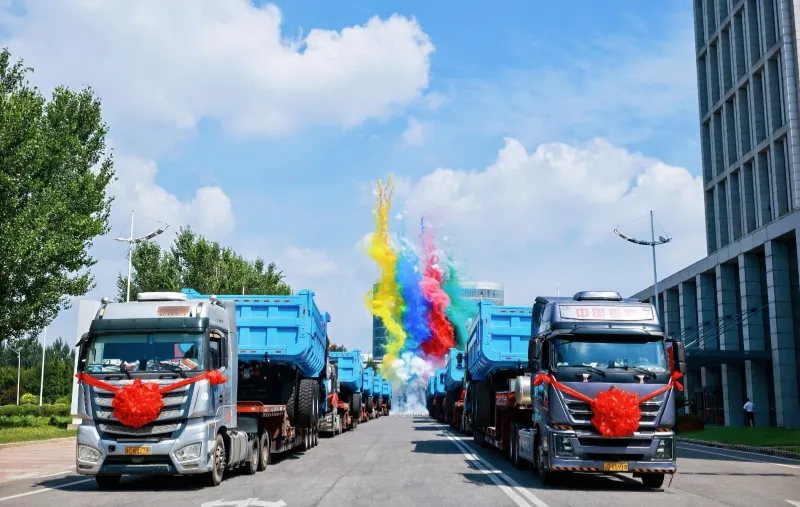
SANY announced its first South American autonomous mining truck shipment in August 2026.
SANY said it shipped its first batch of SKT110Ei pure-electric autonomous mining trucks to South America on Aug. 12. The company’s announcement described the project as its first autonomous mining truck deployment in Latin America.
The shipment includes autonomous trucks, an intelligent dispatching system and lifecycle operations and maintenance services. SANY said the customer-specific package also integrates roadside infrastructure, cloud-based dispatching and localised support.
The move matters beyond the individual shipment. South American mines are important producers of copper, iron ore, gold and other critical minerals, but operations often face long distances, challenging terrain and uneven access to technical labour. Electric autonomous haulage could reduce diesel dependence while improving consistency in repetitive transport cycles.
SANY reported that more than 300 autonomous mining trucks had been deployed globally as of July 2026, with more than 13 million kilometres of operation and over 41 million cubic metres of earth and rock transported.
What mine operators should evaluate
The deployment data suggests that autonomous electric haulage is becoming a fleet-planning issue rather than a technology demonstration. The main operational implications are fivefold.
1. Charging becomes part of production planning
A battery-electric autonomous fleet requires chargers, substations, cable routes, energy management and contingency capacity. Charging windows must be integrated with loading, hauling and maintenance schedules. A truck that is technically autonomous but unavailable because of charger queues will not improve production.
2. Mixed fleets will remain common
The EACON figures show why mines should expect mixed powertrains for some time. Diesel hybrids, methanol hybrids and battery-electric trucks may operate in the same autonomous operations zone. Dispatch systems must account for different acceleration, braking, refuelling and charging characteristics.
3. Road quality becomes a technology requirement
Autonomy depends on predictable road geometry, stable berms, accurate mapping and controlled traffic. Poor road maintenance can increase braking, reduce cycle consistency and create perception challenges. Haul road engineering is therefore part of the autonomy business case.
4. Safety responsibilities move rather than disappear
Removing drivers from trucks can reduce exposure to high-risk areas, but it creates new requirements around high-voltage systems, battery incidents, remote intervention, communications failure and mixed traffic. Safety cases must cover normal operation, degraded modes and recovery procedures.
5. Workforce planning becomes more technical
Autonomous mines still need people, but the roles change. Demand may grow for control-room operators, electrical technicians, network specialists, data analysts, software engineers and maintenance teams trained to work with drive-by-wire systems.
The next benchmark is integrated performance
The strongest deployments will not be judged by whether individual trucks can drive autonomously. They will be judged by system-level performance: tonnes moved, energy consumed, availability, incident rates, maintenance intervals and cost per tonne.
EACON’s reported electric fleet, Epiroc’s underground-to-surface automation, Volvo’s managed transport model and SANY’s South American expansion point to different routes toward that outcome. None removes the need for careful site assessment. Each mine still has its own geology, traffic pattern, power constraints, climate and production schedule.
But the direction is clear. Electric autonomy is moving from a narrow equipment category into the design of the mining operation itself. For companies developing copper, lithium, nickel, gold, silver and other critical-mineral projects, autonomous haulage will increasingly be evaluated alongside mine plans, power systems and processing capacity: not as a separate technology experiment.
Shareable social snippets
LinkedIn:
Autonomous mining is moving beyond pilot projects. EACON reports more than 1,500 battery-electric autonomous trucks in a global fleet of more than 3,500, while Epiroc, Volvo and SANY are extending autonomy across underground routes, managed haulage services and South American operations. The next challenge is integrating charging, roads, dispatch and workforce planning into one production system.
X:
Electric autonomy is scaling in mining. EACON reports 1,500+ battery-electric autonomous trucks in a 3,500+ fleet. Epiroc is linking underground and surface haulage, Volvo is offering autonomy as a service, and SANY has shipped its first autonomous electric trucks to South America.