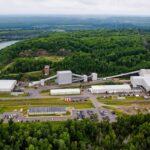
Guyana’s interior landscape near the proposed Eagle Mountain gold project.

By Mo Shine | Mining
Mako Mining has signed a mineral agreement with the Government of Guyana for its Eagle Mountain gold project in Region Eight, establishing a 10-year framework for the project’s legal, fiscal and operating conditions.
The agreement marks a key development milestone for the advanced-stage open-pit project, which Mako is targeting for construction in the third quarter of 2027 and first production by the end of 2028, subject to permitting and other approvals.
Eagle Mountain is located in west-central Guyana, about 200 kilometers south-southwest of Georgetown and approximately 8 kilometers from Mahdia in the Potaro-Siparuni region. Mako holds a 100% interest through its Guyanese subsidiary, Stronghold Guyana Inc.

The agreement was signed with the Cooperative Republic of Guyana and the Guyana Geology and Mines Commission under the country’s Mining Act. It covers the stability of mining and prospecting licences, project authorizations and fiscal terms for an initial 10-year period.

The framework can be renewed or renegotiated after the initial term, according to details released about the agreement.
Permitting remains the next major milestone
Mako is continuing work on the environmental and regulatory approvals required to advance Eagle Mountain toward construction.
More Read

The company submitted an Environmental and Social Impact Assessment to the Guyana Environmental Protection Agency in March. The public comment period ended in June, and Mako expects to file a final version incorporating stakeholder feedback in the fourth quarter.
A permitting decision is expected to follow the final submission.
The timing leaves the company with a series of permitting, engineering, financing and construction decisions to complete before the targeted 2027 construction start. The mineral agreement provides greater certainty around the project’s operating and fiscal framework, but it does not replace the environmental approvals or other authorizations required before development can begin.
Mako President Steve Parsons said the agreement would help advance and de-risk the project by providing greater certainty around key legal and fiscal terms. He also pointed to commitments relating to employment, training, environmental stewardship and community development.
Under the agreement, Mako is expected to prioritize Guyanese labor, goods and services where available. The company will also make annual contributions to community development, environmental programs and social initiatives.
Those contributions are expected to begin within 24 months of the mining licence being granted or within 12 months of production starting, whichever occurs first.

Exploration and technical work will support the project’s final design and permitting process.
Eagle Mountain resource and production plan
Mako’s Eagle Mountain project profile identifies the project as an advanced-development, preliminary economic assessment-stage asset covering approximately 5,050 hectares.
The proposed operation is a conventional open-pit mine supported by processing facilities, waste storage and tailings management infrastructure. The project area includes an exploration camp, power-generation equipment, access roads and nearby water sources.
The company’s current resource base includes:
| Resource category | Gold resource | Average grade | Status |
|---|---|---|---|
| Indicated | Approximately 1.2 million ounces | 1.18 grams per tonne | Higher-confidence resource category |
| Inferred | Approximately 582,000 ounces | 0.98 grams per tonne | Lower-confidence resource category |
| Planned production | Approximately 66,500 ounces per year | : | Targeted over a 15-year open-pit mine plan |
The indicated and inferred figures are mineral resources, not mineral reserves. They do not by themselves demonstrate economic viability, and the inferred portion carries a lower level of geological confidence than the indicated resource.
Mako’s development concept is based on a shallow open-pit operation and a 15-year mine life. The planned annual production rate is approximately 66,500 ounces of gold.
The company’s project materials describe the deposit as a series of shallowly dipping shear zones hosted in granodiorite. The geology and proposed mine design are expected to support phased development, subject to further engineering and regulatory work.
The project’s proximity to Mahdia could also provide access to an existing mining workforce and basic services. Road access from Georgetown and an airstrip near Mahdia are among the infrastructure features identified in project documentation.

Road access and local infrastructure will be important to Eagle Mountain’s construction planning.
Stability framework covers project economics
Mineral agreements in Guyana are designed to provide a degree of predictability for large-scale mining projects while setting out obligations to the state and local communities.
For Eagle Mountain, the agreement covers the legal and fiscal terms that will apply during the initial 10-year period. It also includes provisions relating to royalties, taxes, government undertakings and the prioritization of Guyanese labor, supplies and services.
The stability provisions matter because the project is still several years from planned production. A more defined fiscal framework can help the company and potential financing partners assess capital requirements, operating costs and project returns over the construction and operating periods.
However, the agreement does not remove the project’s exposure to construction costs, gold prices, permitting conditions, financing requirements or operational performance.
Mako will also need to finalize the mine plan, complete detailed engineering and secure the capital required to move from an advanced development project to construction.
The company’s earlier project studies indicated that the proposed operation could be developed in phases. Those studies were prepared before the current mineral agreement and remain subject to updates as engineering, permitting and market conditions evolve.
Guyana’s mining sector continues to expand
Eagle Mountain is being advanced as Guyana seeks to build on its established gold-mining industry and attract additional investment into minerals development.
The country has experienced growing interest from international mining companies, particularly in gold and other mineral commodities. The sector provides employment and economic activity outside the coastal population centers, while also increasing scrutiny of environmental management, local participation and infrastructure requirements.
For Mako, Eagle Mountain would provide a second operating jurisdiction alongside its San Albino gold mine in Nicaragua. The company has previously said that its mine-building and operating experience at San Albino could support the development of the Guyana project.
The project’s location near Mahdia places it in an active mining district, but the surrounding terrain and rainforest environment will require careful planning for roads, water management, power supply, waste storage and tailings facilities.
The final ESIA will be important in defining how those issues are addressed. It is expected to incorporate feedback received during the public consultation process and provide regulators with updated information on potential environmental and social effects.

Final project design and environmental approvals will determine the path to construction.
Timeline and key risks
Mako’s current timeline places the final ESIA submission in the fourth quarter, construction in the third quarter of 2027 and first production by the end of 2028.
That schedule leaves a relatively short period between the planned construction start and production target for an open-pit project requiring processing infrastructure, waste facilities, access improvements and supporting services.
The main milestones are:
- Final ESIA: Expected in the fourth quarter
- Permitting decision: Expected after the final ESIA review
- Construction: Targeted for the third quarter of 2027
- First production: Targeted by the end of 2028
- Planned mine life: Approximately 15 years
- Planned annual production: Approximately 66,500 ounces of gold
The key risks include delays in environmental approvals, changes to project costs, financing availability, construction execution, infrastructure development and variations in gold prices.
The resource estimate also requires careful interpretation. The project has approximately 1.2 million ounces of indicated gold and 582,000 ounces of inferred gold, but additional technical work would be needed before those resources could support a definitive mine plan or reserve statement.
Mako’s agreement with Guyana therefore provides an important foundation, but the next stage will depend on the quality of the final environmental assessment and the company’s ability to convert the project’s resource base into a permitted, financed and buildable operation.
For ongoing coverage of gold mining news, project timelines and resource development, follow Skillings Mining Intelligence. Additional background on the sector is available in our analysis of gold mining reserves, costs and project timelines.
Sources: Mako Mining’s Eagle Mountain project page; Mining Technology’s report on the mineral agreement; Eagle Mountain environmental assessment documents.