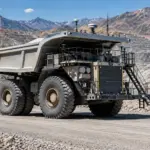
Industrial facilities are central to the U.S. effort to rebuild a secure tungsten supply chain.

By Penny Langford
PORTLAND, Maine : The U.S. government has committed up to $2 billion to a tungsten stockpile agreement with Elmet Technologies, pairing a long-term Defense Logistics Agency contract with a separate $450 million investment intended to expand mining, processing and manufacturing capacity.
The agreement is designed to address a central weakness in the U.S. critical-minerals supply chain: Washington is seeking to rebuild strategic inventories while domestic industry still relies heavily on imported tungsten feedstock and the country has no active commercial tungsten mine.
Elmet said Sept. 14 that its subsidiary, Elmet Technologies, had received an indefinite delivery/indefinite quantity contract from DLA Strategic Materials. The contract has a ceiling of up to $2 billion and includes a guaranteed funded commitment of $150 million.

It covers the supply of tungsten ores, concentrates and sodium tungstate for the U.S. National Defense Stockpile. The base ordering period runs through Aug. 30, 2031, with a two-year extension option that could extend the agreement through Aug. 30, 2033, according to Elmet’s announcement.

The contract’s headline value is a ceiling rather than an immediate purchase. The $150 million minimum is the funded commitment currently identified by the company.
Stockpile deliveries will wait for new supply
Elmet said it will not immediately divert material into the stockpile. Deliveries will begin only after additional supply is secured through mining investments, offtake agreements and processing expansions.

That sequencing is intended to prevent government procurement from reducing the material available to existing U.S. manufacturers. Tungsten is used in cemented carbide cutting and wear-resistant tools, specialty steels, electrical components, aerospace systems, defense equipment and other industrial applications.
The company said deliveries will be phased in with DLA as new production and processing capacity becomes available from its approved supplier network. The network includes Blue Moon Metals’ Springer Tungsten Complex in Nevada, EQ Resources’ Mt. Carbine operation in Australia and the Barruecopardo mine in Spain.
The arrangement therefore goes beyond a conventional stockpile purchase. It links government inventory building to the creation of new upstream and midstream capacity.

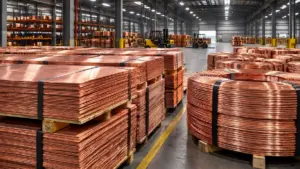
Tungsten oxide and metal powder processing depend on specialized industrial capacity.
$450 million investment targets U.S. capacity
Separately, the U.S. Department of War has agreed to invest $450 million in The Elmet Group, the company said. The investment will begin with a $200 million drawdown at closing, followed by additional drawdowns.
The government will receive redeemable preferred equity, warrants representing up to 19.9% of Elmet’s common stock on a post-transaction basis, and the right to appoint one independent director and one nonvoting board observer, according to the company.
Elmet said more than $165 million of the investment is expected to go toward its U.S. operations in Lewiston, Maine; Coldwater, Michigan; and Euclid, Ohio. Those facilities manufacture or process tungsten, molybdenum and related advanced materials and components.
The company also plans to allocate about $150 million to the Springer Tungsten Complex in Nevada through a proposed majority-owned joint venture with Blue Moon Metals and EQ Resources. The project is intended to restart and expand ammonium paratungstate conversion capacity.
Elmet is also establishing Elmet Refining & Trading, a division intended to coordinate tungsten sourcing, refining and material delivery across the company’s supplier network.
The company described the investment and DLA agreement as part of a broader “Tungsten Resiliency Framework.” The objective is to create a more integrated supply chain linking mine production, concentrate, chemical conversion, metal powders and finished components.
U.S. remains dependent on foreign supply
The urgency is reflected in government data.
The U.S. Geological Survey’s 2026 tungsten summary says tungsten has not been mined commercially in the United States since 2015. The agency also reports that U.S. net import reliance was greater than 50% in the latest period covered by its summary.
China accounted for 26% of U.S. imports of tungsten ores, concentrates and other forms between 2021 and 2024, followed by Germany at 14%, Bolivia at 8% and Vietnam at 8%, according to the USGS.
The agency estimates that roughly 60% of U.S. tungsten consumption is used in cemented carbide parts for cutting and wear-resistant applications. Those products are essential to construction, metalworking, mining and oil and gas drilling, meaning tungsten supply disruptions can affect industrial production well beyond the defense sector.
The USGS also listed potential fiscal 2025 acquisitions of 2,041 metric tons of tungsten for the government stockpile, with no potential disposals listed.
That figure is separate from the current Elmet contract, but it illustrates the scale of the government’s acquisition planning.
| Supply-chain indicator | Reported figure |
|---|---|
| Elmet DLA contract ceiling | Up to $2 billion |
| Guaranteed funded commitment | $150 million |
| Separate government investment in Elmet | $450 million |
| Potential USGS fiscal 2025 tungsten acquisitions | 2,041 metric tons |
| U.S. commercial tungsten mining | None since 2015 |
| Share of U.S. tungsten imports from China, 2021–24 | 26% |
Earlier DLA planning shows the material challenge
The Elmet award follows earlier DLA planning for the National Defense Stockpile.
A DLA Strategic Materials sources-sought notice on SAM.gov sought information on the potential acquisition of 1,715 metric tons of tungsten ores and concentrates. The notice identified Hammond Depot in Indiana, Hawthorne Depot in Nevada and Scotia Depot in New York as potential delivery locations.
The notice was a request for information, not a contract award. It nonetheless showed that the government was evaluating a large-scale purchase of primary tungsten material before the Elmet agreement was announced.
The distinction matters because stockpile policy depends on more than the volume of material purchased. The government must also establish where the tungsten was mined, processed and converted, particularly as restrictions on covered-country supply chains become more stringent.
2027 sourcing rules raise the stakes
Under DFARS 252.225-7052, restrictions taking effect Jan. 1, 2027, will apply to tungsten supply chains connected to China, Russia, Iran or North Korea.
The rule covers tungsten ore or feedstock, including recycled material, as well as tungsten metal powder, tungsten heavy alloy and finished or semifinished components containing tungsten heavy alloy.
That means processing or remelting material in a noncovered country will not necessarily eliminate the need to establish its original provenance. Contractors will need greater visibility into the chain from ore and feedstock through powder, alloy and final component production.
The timing increases pressure on the U.S. government and defense contractors to secure traceable supplies from domestic and allied sources. It also raises the value of projects that can provide both feedstock and documented processing capacity.

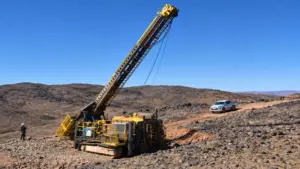
Strategic stockpiles require secure storage and reliable logistics as well as material supply.
Supply-chain execution will determine the outcome
The immediate test for the Elmet agreement is whether the company and its partners can bring new capacity online without creating shortages for existing customers.
The government investment provides capital support, while the DLA contract offers a potential long-term customer. But the contract ceiling does not guarantee that the full $2 billion will be spent, and several parts of the proposed network still depend on project development, financing, permitting, mine restart plans and processing performance.
The Springer project is one example. Elmet said it plans to support the Nevada complex and expand ammonium paratungstate conversion, but that work must translate into qualified production before it can support stockpile deliveries.
The same applies to overseas sources in Australia and Spain. Allied supply can reduce exposure to China, but it still requires transport, quality control, commercial agreements and clear origin documentation.
The deal also highlights the importance of processing. As Skillings has reported, diversified mining does not automatically create a diversified supply chain when refining and conversion remain concentrated.
For tungsten, the U.S. challenge is particularly acute because domestic mine production has stopped while industrial users continue to depend on the metal’s unusual combination of hardness, density and heat resistance.

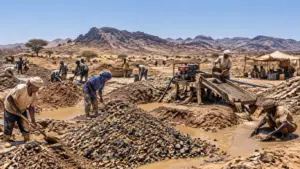
Ore concentrate is the starting point for a traceable tungsten supply chain.
The Elmet agreement offers Washington a way to combine stockpiling with industrial policy. Its success will depend less on the contract’s headline value than on whether it produces additional tonnes, new conversion capacity and verifiable supply routes before the 2027 sourcing restrictions take effect.
For mining companies, processors and defense manufacturers, the message is clear: access to tungsten will increasingly depend on the full chain from mine to finished component, not simply on the location of the final factory.