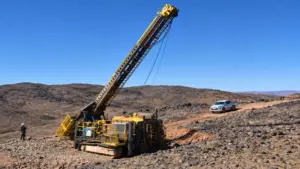
Construction activity begins at USA Rare Earth’s planned rare-earth metal and magnet manufacturing complex in Blacksburg, South Carolina.

USA Rare Earth has broken ground on a $1.2 billion rare-earth metal and permanent magnet manufacturing complex in Blacksburg, South Carolina, advancing the company’s plan to connect upstream mineral resources with downstream production in the United States.
The facility at Bailey Industrial Park in Cherokee County is designed to produce up to 6,400 metric tons per year of sintered neodymium-iron-boron (NdFeB) magnets and 5,000 metric tons per year of strip-cast rare-earth metal and alloy, according to company announcements. Commissioning is targeted for 2028.
The project is one of the largest planned investments in the U.S. rare-earth supply chain. It is also a test of whether domestic producers can build capacity across the full chain : from mining and separation to metalmaking, alloy production and finished magnets : rather than focusing on extraction alone.
South Carolina facility combines metals and magnet production
USA Rare Earth expects the Blacksburg complex to include about 800,000 square feet of manufacturing space on a site of approximately 124 acres. The project is expected to create roughly 490 high-skilled manufacturing jobs, according to the company and South Carolina officials.

The site will combine two stages of the rare-earth value chain:

- Strip-cast metal and alloy production, with planned initial capacity of 5,000 metric tons per year.
- Sintered NdFeB magnet manufacturing, with planned capacity of 6,400 metric tons per year.
NdFeB magnets are used where high magnetic strength and compact size are required. Applications include electric motors, wind turbines, defense systems, aerospace equipment, industrial automation, medical devices and data-center hardware.
The company’s announcement does not mean the facility is already producing material. Engineering and procurement work must be completed, construction must progress, and the plant’s equipment will need to be commissioned and qualified for customers before commercial output can begin.

USA Rare Earth’s groundbreaking announcement describes the South Carolina project as the centerpiece of its planned mine-to-magnet supply chain.

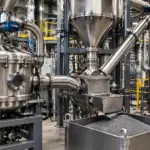
Automated equipment inside a rare-earth magnet manufacturing line.
The project’s role in the mine-to-magnet strategy
The South Carolina plant is being developed alongside USA Rare Earth’s Round Top project in West Texas and an existing magnet manufacturing operation in Stillwater, Oklahoma.
The intended chain is:
- Mining and mineral processing at Round Top in Texas
- Separation and refining of rare-earth materials
- Metal and alloy production
- NdFeB magnet manufacturing in Oklahoma and South Carolina
- Supply to industrial, automotive, defense and energy-transition customers
Round Top, located in Hudspeth County near Sierra Blanca, has not yet entered commercial production. USA Rare Earth is targeting commercial mining in 2028, but the schedule remains subject to feasibility work, financing, permitting and construction.
Company materials describe Round Top as containing 15 of the 17 rare-earth elements, including heavy rare earths such as dysprosium, terbium and yttrium. Those elements are important in high-performance magnets because they can improve resistance to heat and maintain magnetic performance in demanding applications.
The deposit’s development therefore matters to the South Carolina project, but it does not automatically guarantee that the plant will receive Round Top material when it starts up. Until the Texas mine and associated processing facilities are operating, USA Rare Earth will need to rely on other sources of metal and alloy feedstock.
That distinction is important for investors and industrial customers. A domestic magnet factory can reduce exposure to imported finished magnets while remaining dependent on imported oxides, metals, alloys, equipment or chemical inputs.
Stillwater provides an operating base
USA Rare Earth commissioned its first commercial magnet production line at Stillwater, Oklahoma, in March 2026, according to company disclosures and industry reporting.
The Oklahoma facility gives the company an operating base while the larger South Carolina project is built. Stillwater is also expected to form part of the company’s broader U.S. magnet manufacturing network.
Before Round Top reaches commercial production, Stillwater’s feedstock comes from third-party suppliers, including materials associated with USA Rare Earth subsidiary Less Common Metals in the United Kingdom. The company’s longer-term objective is to replace more of that external supply with internally controlled material from its own integrated chain.
The South Carolina plant would expand that domestic footprint substantially. Together with Stillwater, the company has discussed a long-term U.S. magnet manufacturing capacity of roughly 10,000 metric tons per year, although the timing and final scale of any expansion remain dependent on execution and market demand.

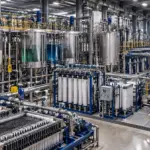
Processing equipment used for rare-earth metal and alloy production.
Federal support underscores critical-minerals significance
The project is moving forward as governments seek to reduce exposure to China’s dominance in rare-earth separation, metalmaking and magnet production.
USA Rare Earth has announced agreements for up to $1.6 billion in federal support connected to its integrated heavy rare-earth mining, metal and magnet supply chain. The package includes approximately $277 million in direct funding and up to $1.3 billion in senior secured loan capacity, according to company disclosures and reporting by Reuters.
The funding is intended to support multiple parts of the company’s platform, including Round Top, processing operations and the Stillwater and Blacksburg manufacturing facilities. It does not represent a direct subsidy limited only to the South Carolina plant.
The policy rationale is tied to supply-chain concentration. The International Energy Agency has identified China as the dominant producer and processor of many rare-earth materials, particularly those used in permanent magnets.
Skillings’ analysis of critical-minerals refining concentration highlights the wider problem: expanding mine supply does not necessarily create a secure industrial supply chain if refining and metalmaking remain concentrated elsewhere.
The same issue applies to rare-earth magnets. A country may have access to mineral resources but still lack the separation plants, alloy technology, qualified manufacturing lines and customer approvals needed to produce finished components at scale.
Execution risks remain across the chain
The South Carolina groundbreaking is a significant construction milestone, but several risks remain before USA Rare Earth can deliver a fully integrated mine-to-magnet system.
Round Top development
The Texas project still needs to advance through feasibility, financing, permitting and construction. USA Rare Earth has targeted commercial production in 2028, broadly aligning the mine schedule with the planned commissioning of the South Carolina plant.
That creates a narrow execution window. If Round Top is delayed, the South Carolina plant may begin operations using third-party feedstock for longer than planned.
Technical qualification
Producing rare-earth metal is not the same as producing magnet-grade alloy, and producing alloy is not the same as producing magnets that meet the specifications of automotive, aerospace or defense customers.
Manufacturers must qualify chemical composition, magnetic performance, dimensional tolerances, coating systems and reliability. These processes can take time, particularly for customers with strict certification requirements.
Cost competitiveness
New supply chains outside China typically face higher costs for labor, energy, equipment, financing and compliance. Government support can help close that gap, but long-term commercial success will depend on securing customers willing to pay for supply security or on achieving sufficient operating efficiency to compete with established producers.
Feedstock and technology
A mine-to-magnet strategy is only as integrated as its weakest link. The company will need reliable access to separation capacity, chemical inputs, metalmaking equipment and specialized technical expertise. Restrictions on rare-earth processing technology could also affect projects that rely on overseas equipment or know-how.

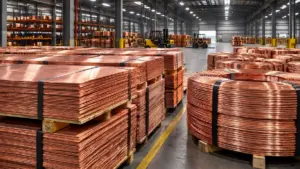
Industrial infrastructure supporting mineral processing and advanced manufacturing.
What the project means for U.S. rare-earth supply
If completed as planned, the Blacksburg facility would add substantial U.S. capacity for both rare-earth alloys and finished NdFeB magnets.
Its strategic importance is greater than the number of jobs or the size of the building. The plant is intended to link several stages that are often separated geographically and commercially. That could give USA Rare Earth greater control over material traceability, product qualification and customer supply, while reducing reliance on imported finished magnets.
The project will not eliminate U.S. exposure to global rare-earth markets. Nor will it resolve the supply-chain challenge on its own. The United States will still need additional mines, separation plants, recyclers, magnet producers and specialized equipment suppliers to create a broader industrial base.
Still, the groundbreaking marks a shift from policy announcements to physical construction. The next milestones will be site development, equipment installation, qualification of the production lines and progress at Round Top.
For operators, investors and policymakers, the central question is whether those projects advance together. A South Carolina magnet factory can strengthen domestic supply, but the full mine-to-magnet case depends on the company’s ability to deliver the upstream resource and the intermediate processing capacity required to keep the plant supplied.
Sources: USA Rare Earth, Reuters on the South Carolina investment, and USA Rare Earth company information.