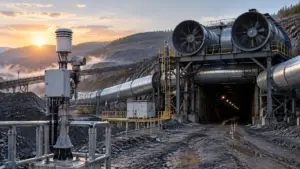
Modern critical minerals refining and separation facility.

By Penny Langford
The world is adding mines, but the refining system that turns ore into usable industrial material is becoming more concentrated.
In 2024, the three largest refining countries accounted for an average 86% of refined output across six key energy minerals: copper, lithium, nickel, cobalt, graphite and rare earths, according to the International Energy Agency’s Global Critical Minerals Outlook 2025. The comparable figure was about 82% in 2020.
The statistic is significant because refining is the point at which raw mineral supply becomes battery chemicals, cathode materials, purified graphite, separated rare earths and other products that manufacturers can actually use.

It also shows why new mines alone will not resolve critical-mineral supply-chain risk. A country may secure access to ore but remain dependent on a small number of overseas processing hubs.

What the 86% figure measures
The 86% figure is an average share for the top three refining nations across six minerals. It is not the share held by one country, nor does it mean that every mineral has the same concentration profile.
The underlying pattern is nevertheless clear: processing capacity is concentrated in fewer jurisdictions than mining capacity, and much of the additional refined supply created in recent years has come from the dominant producer in each market.
| Indicator | Level | Why it matters |
|---|---|---|
| Top three countries’ average share of refining | 86% in 2024 | Midstream processing is highly concentrated |
| Top three countries’ average share of refining | About 82% in 2020 | Concentration increased over four years |
| Top three countries’ average share of mining | 77% in 2024 | Mining is more geographically distributed than refining |
| Share of refined supply growth from the largest supplier in each market | About 90% between 2020 and 2024 | New capacity did not generally diversify the market |
| Projected top-three share of refined supply by 2035 | About 82% under current policies | Announced projects imply only gradual diversification |
The gap between mining and refining is the central issue. Mining is visible through permits, production figures and new discoveries. Refining is less visible, but it often determines whether material can enter a battery, magnet, power grid or defense supply chain.

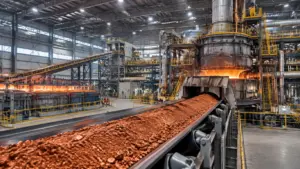
Hydrometallurgical equipment inside a mineral processing facility.
Concentration varies by mineral
The six-mineral average conceals important differences.
Indonesia has become the main driver of nickel-processing growth, supported by a rapid expansion of nickel pig iron, matte and intermediate products for the stainless steel and battery sectors. China remains the dominant processor across several other supply chains, including cobalt, graphite and rare earths.
The IEA has described China as the leading refiner for 19 of 20 energy-related minerals in its broader analysis, with an average share of roughly 70%. Its position is particularly strong in the midstream stages that connect mines to manufacturers.
Graphite and rare earths illustrate the risk most clearly. China controls a very large share of graphite purification and rare earth separation, as well as downstream magnet production. In lithium, China is a major converter of mined and brine-based feedstock into battery-grade chemicals, even when the original material comes from Australia, Chile or elsewhere.
Copper is a different case. Its refining market is also concentrated, but the risks are shaped more by smelter capacity, treatment charges, energy costs, concentrate availability and project delays. The same principle applies: mine output does not automatically equal secure refined supply.
For operators, the practical question is therefore not only where a deposit is located. It is also:
- Where will the material be concentrated, separated or converted?
- Which country controls the required technology?
- Can the product meet customer specifications outside the dominant processing hub?
- Is there a credible alternative if export rules or shipping routes change?
Why concentration creates supply-chain risk
A concentrated refining system can create vulnerability even when the market is not experiencing an outright shortage.
The first risk is policy exposure. Export licensing, customs restrictions, sanctions and industrial-policy measures can affect supply without a formal embargo. A permit delay or change in end-user rules may be enough to disrupt manufacturers operating with limited inventory.
The second is operational concentration. A refinery outage, power disruption, environmental shutdown or shipping interruption can affect global availability if alternative facilities are scarce.
The third is qualification risk. Manufacturers cannot always switch suppliers immediately. Battery chemicals, purified graphite, rare earth oxides and magnet materials must meet technical specifications, and replacement suppliers may require lengthy testing and approval.
The fourth is pricing asymmetry. Material with secure non-dominant-country provenance can trade at a premium because buyers are paying for delivery certainty, traceability and compliance: not only for the mineral itself.
This helps explain why supply-chain diversification can remain economically difficult even when governments identify it as a strategic priority.
Policy responses are moving downstream
Governments in the United States, European Union, Australia, Canada and Japan are responding with a mix of subsidies, trade rules, strategic partnerships and permitting reform.
The EU’s Critical Raw Materials Act sets 2030 benchmarks for domestic extraction, processing and recycling. It also aims to ensure that no more than 65% of the EU’s annual consumption of a strategic raw material at a relevant processing stage comes from a single non-EU country.
The United States is using tax incentives, project finance, defense procurement and restrictions on supply from entities of concern to encourage alternative sources. The policy focus is expanding from mines to conversion plants, separation facilities, battery materials and recycling.
Australia and other resource-producing countries are seeking to retain more value domestically rather than exporting untreated or lightly processed material. Kenya’s effort to attract support for domestic critical-minerals processing, covered in Skillings’ analysis of its U.S.-backed processing push, reflects this broader shift.
These measures are changing project economics, but they do not eliminate the underlying challenges. Refining facilities require reliable power, water, transport, chemical inputs, skilled labor, environmental approvals and long-term customers. They are also expensive to build and often struggle to compete with established producers during periods of low commodity prices.

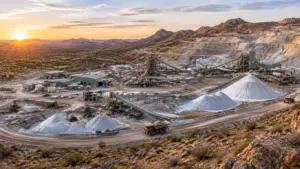
Processing infrastructure connected to transport and export logistics.
The investor question: capacity or capacity with customers?
For investors, the 86% figure shifts attention from geological potential to commercial execution.
A mining project may control a valuable resource but still face a weak valuation if it lacks a credible route into refining. Conversely, a smaller processing project may become strategically important if it is located in a lower-risk jurisdiction and has a qualified customer base.
The most relevant projects are likely to be those that combine several characteristics:
- A secure feedstock agreement with mines or intermediate producers.
- Proven processing technology rather than an untested flowsheet.
- Access to affordable, reliable energy and infrastructure.
- Government support that is contractually defined, not merely announced.
- Binding or advanced offtake agreements with manufacturers.
- Traceability and compliance systems that satisfy U.S., EU and customer requirements.
- A realistic path to scale beyond demonstration production.
Capital costs in diversified regions are often higher than in the dominant producing country. The IEA has estimated that mining and refining projects in alternative jurisdictions can carry capital costs roughly 50% higher in some cases.
That does not make them commercially unattractive. It means their returns may depend on policy support, premium pricing, long-term contracts or strategic investors willing to value resilience alongside immediate cost.
The investment risk is that governments may announce diversification faster than projects can reach commercial production. A permitted refinery is not the same as an operating refinery, and a pilot plant is not the same as a qualified supplier.
Base, bull and bear cases
| Scenario | Market and policy outcome | Investor implication |
|---|---|---|
| Bull case | Public finance, permitting reform and offtake agreements accelerate non-dominant-country refining and recycling. | Strategic processors reach scale, secure premiums and reduce reliance on a single supplier. |
| Base case | New projects come online gradually, but dominant refiners retain most market share through the next decade. | Selective opportunities emerge, but execution, cost inflation and policy dependence remain central risks. |
| Bear case | Export controls broaden, alternative projects face delays and weak prices undermine investment. | Supply disruptions and price premiums increase, while unfinished projects struggle to secure financing. |
The base case remains the most consistent with current evidence. The IEA expects the average share of the top three refined-material suppliers to decline only modestly, to about 82% by 2035 under current policies.
That would represent some diversification, but not a structural break from the present system.
What decision-makers should monitor
The headline number should be used as a starting point, not a complete risk assessment. Operators, policymakers and investors should monitor:
- Refining capacity by mineral and country, rather than mine production alone.
- Treatment charges and conversion margins.
- Export licensing timelines and customs enforcement.
- The proportion of supply covered by qualified alternative suppliers.
- Power, water and chemical-input availability at new refineries.
- Recycled material collection and processing capacity.
- The share of projects with firm offtake agreements.
- Technology and equipment dependence on incumbent processing hubs.
The broader lesson is that critical-minerals security is increasingly a midstream and downstream challenge.

Control-room operators monitoring refining processes.
Refining is becoming a strategic asset
The 86% concentration figure does not mean that diversification is impossible. It shows that diversification is difficult, capital-intensive and slower than many policy timelines imply.
The next phase of the critical-minerals race will be decided by the ability to build processing networks that are commercially viable, technically qualified and resilient across jurisdictions. Mines remain essential, but their value increasingly depends on whether the material can move through a secure refining chain.
For investors, the most important distinction may be between a project that promises tonnes in the ground and one that can deliver qualified material to a customer.
For policymakers, the test is whether industrial strategy supports the entire chain: from extraction and concentration to refining, recycling and manufacturing.
And for mining companies, the 86% figure is a reminder that supply security is not created at the pit alone. It is created at the refinery.
Related reading: Critical minerals supply chains and the limits of diversification
Social snippets
LinkedIn:
The top three refining countries accounted for an average 86% of refined output across six key energy minerals in 2024, according to the IEA. The figure highlights a central supply-chain risk: new mines do not automatically create secure supply. Refining capacity, qualification, infrastructure and policy support will determine which projects become commercially strategic.
X:
Critical-minerals refining concentration reached 86% across six key energy minerals in 2024. Mining is more geographically distributed than processing, leaving lithium, nickel, graphite, cobalt, rare earths and copper exposed to midstream disruption, export controls and costly diversification.