By Penny Langford

Copper’s 2026 outlook is being reshaped by a market signal that is easy to miss in the headline price: spot treatment charges have fallen to around negative $70 per tonne in parts of the concentrate market, according to S&P Global Market Intelligence.
A negative treatment charge means smelters are effectively paying miners for copper concentrate rather than charging them to process it. The milestone does not mean every annual contract has turned negative, but it is a clear indication that available concentrate is insufficient for the world’s growing smelting capacity.
That tension is central to the copper price forecast for 2026. The market can show near-balanced refined supply on paper while remaining exceptionally tight at the concentrate stage. For miners, the shift improves pricing power. For smelters, it threatens margins and raises the risk of production cuts, maintenance deferrals or greater reliance on by-product revenue.
Why negative treatment charges matter
Copper concentrate is the partially processed material produced at mines. Smelters convert it into blister copper or anodes before refineries produce cathode.

Treatment charges (TCs) are normally deducted from the value of the concentrate to compensate the smelter for processing it. Refining charges (RCs) are additional deductions based on the amount of refined copper produced. The combined TC/RC structure is negotiated between miners and smelters and varies by contract, quality and market conditions.

When concentrate is abundant, smelters can demand higher charges. When concentrate is scarce, smelters compete for feedstock and charges fall.
The current market is at the extreme end of that cycle. S&P Global’s reported spot charge of approximately -$70/t represents a powerful signal that smelters are competing aggressively for units. It also shows why the copper market cannot be assessed solely through exchange inventories or refined production figures.


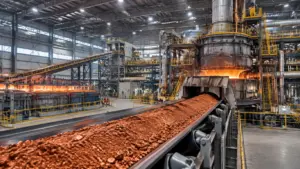
Freshly cast copper anodes in a smelter casting area.
The distinction between spot and benchmark charges is important. A negative spot assessment does not automatically mean that all miners are receiving a premium under long-term contracts. Annual benchmark negotiations typically reflect a broader mix of supply, contract terms and quality adjustments.
Even so, spot charges influence negotiations. If concentrate remains scarce, future benchmark terms are likely to remain historically low, leaving miners with a larger share of the copper price and reducing the cushion available to smelters.
Copper price forecast: a market divided between tight supply and demand risk
Market forecasts for 2026 have moved higher as supply disruptions and concentrate shortages became more apparent. A Reuters analyst poll placed the median 2026 copper price forecast near $11,975 per tonne, while other institutional estimates cluster broadly between $11,000/t and $13,500/t.
J.P. Morgan Global Research has published a quarterly forecast path of approximately $13,500/t in the second quarter, $13,000/t in the third quarter and $12,500/t in the fourth quarter. Its analysis also identifies a medium-term support zone around $11,100–$11,200/t if macroeconomic risks intensify.
The range reflects two competing forces:
- Structural supply tightness: Mine disruptions, declining grades and delayed projects are limiting concentrate availability.
- Cyclical demand risk: Copper consumption remains exposed to construction, manufacturing, Chinese industrial activity, interest rates and global growth.
This creates a market in which the physical supply chain can remain tight even if prices experience sharp corrections.
The refined market may look balanced, but concentrates are not
The International Copper Study Group has projected relatively modest growth in mine production compared with refined output and consumption. Search data cited in market research points to 2026 mine-production growth of around 1.6%, refined-production growth of approximately 0.4% and refined-usage growth near 1.6%.
That combination would leave the refined market with only a small projected surplus of roughly 96,000 tonnes against global usage of approximately 28.7 million tonnes.
A surplus of that size is not necessarily comfortable. It represents less than half of 1% of annual consumption, leaving little room for mine disruptions, smelter outages, shipping delays or stronger-than-expected demand.
More importantly, refined balances do not show whether the right material is available in the right location. A smelter may have capacity, power and labor but still lack suitable concentrate. That is the supply-chain problem reflected in negative treatment charges.

Operators monitor process conditions inside a modern metals facility.
What is driving the concentrate shortage?
Several factors are reinforcing one another.
Mine disruptions and project delays
Major mines are operating in an environment of aging infrastructure, lower ore grades, water constraints and permitting delays. New projects remain difficult to build quickly because they require substantial capital, long environmental reviews and supporting infrastructure.
High copper prices improve project economics, but they do not remove the time required to develop a mine. A greenfield operation can take many years to move from discovery to commercial production.
Smelter capacity growth
Smelting capacity has expanded faster than mine supply in several regions, particularly in China. New and upgraded furnaces require consistent feedstock. When concentrate growth fails to match capacity additions, smelters are forced to compete for a smaller pool of material.
That competition drives down TCs and RCs. It can also encourage smelters to accept lower margins to maintain utilization, especially when shutting down would create technical or financial costs.
By-product and acid economics
Smelters do not rely only on treatment and refining charges. Revenue from sulfuric acid, gold, silver and other by-products can help offset weak copper-processing economics.
However, by-product markets also introduce additional risks. Sulfuric acid availability is important for some copper-mining and leaching operations, while weaker by-product prices can leave smelters more exposed to low TCs.
Company and investor takeaways
The collapse in smelter fees creates different outcomes across the copper value chain.
Copper miners
Producers with high-grade concentrate, reliable logistics and strong recoveries are in a favorable negotiating position. Lower TC/RC deductions allow more of the contained copper value to flow back to the mine.
The benefit is not unlimited. Miners still face royalties, freight, penalties for impurities and the risk that higher copper prices encourage substitution or demand destruction. But the direction of pricing power is clear: scarcity at the concentrate stage favors producers.
Smelters and refiners
Smelters face the most direct pressure. Low charges reduce revenue per tonne of concentrate, while power, labor, maintenance and environmental-compliance costs continue to rise.
Facilities with efficient technology, strong by-product credits or integrated mining assets are better positioned. Independent smelters with high operating costs may face margin compression if negative spot charges persist.
Equipment and technology providers
Extended concentrate tightness increases the value of technologies that improve recovery rates, energy efficiency and plant availability. Automated process control, predictive maintenance and advanced mineral sorting can help operators produce more copper from the same material.
Skillings has previously examined how autonomous mining faces a network problem. In copper processing, the equivalent issue is not only automation hardware but also the quality and reliability of the data connecting mine, concentrator, smelter and refinery operations.
Investors and analysts
The most useful indicators are likely to be physical-market signals rather than copper prices alone:
- Spot and benchmark TC/RC assessments
- Concentrate shipment volumes
- Smelter utilization and maintenance announcements
- Mine-production guidance
- Exchange inventories and warehouse cancellations
- Regional copper premiums
- Chinese imports and manufacturing activity
- Scrap availability and substitution trends
The combination of rising copper prices and falling treatment charges is particularly important. It suggests the market is not simply responding to speculative demand; it is also paying for access to scarce raw material.
Copper price scenarios for 2026
The following framework is analytical rather than an investment recommendation.
| Scenario | Copper price range | Treatment-charge outlook | Main assumptions |
|---|---|---|---|
| Bear case | $10,500–$11,200/t | Spot charges recover from extreme lows | Global growth slows, Chinese demand weakens, mine supply improves and smelter capacity growth moderates |
| Base case | $11,500–$12,500/t | Benchmark charges remain historically low | Concentrate remains tight, refined inventories stay limited and grid demand offsets weaker construction |
| Bull case | $13,000–$14,000/t | Spot charges remain negative or near zero | Further mine disruptions, delayed projects, resilient electrification demand and rising competition for concentrate |
Bear case
The bear case would require more than a temporary price pullback. It would likely involve weaker Chinese industrial demand, a stronger U.S. dollar, higher interest rates or a broad slowdown in manufacturing.
In that environment, scrap flows could increase and consumers could reduce primary copper purchases. Treatment charges would recover as smelters gained bargaining power, although the recovery could be limited if excess refining capacity remained in place.
Base case
The base case assumes a tight but functioning market. Mine supply grows modestly, but not enough to create a significant concentrate surplus. Grid investment, electrification and data-center construction support demand, while property and traditional construction remain uneven.
Under this scenario, copper averages in the low-$12,000s, while TC/RCs remain depressed. Smelters continue operating, but margins stay under pressure and contract negotiations remain contentious.
Bull case
The bull case would combine another major mine disruption with strong demand from power infrastructure, electric vehicles and data centers.
If concentrate availability deteriorates further, spot charges could remain negative and refined copper prices could move toward the mid-$13,000s or higher. The risk would be greatest in regions that depend heavily on imported concentrate or lack readily available exchange stocks.
The central market question
The new low in smelter fees is not a standalone price signal. It is a measure of how the copper market is functioning beneath the headline futures curve.
A market with low or negative spot treatment charges is telling producers, smelters and consumers that the bottleneck is concentrate. That bottleneck can support copper prices even when economic growth is uneven, but it can also expose the industry to abrupt volatility.
For miners, the immediate implication is stronger concentrate pricing power. For smelters, it is a warning that capacity alone is not an advantage without secure feedstock. For investors and policymakers, the data point underscores the difficulty of expanding refined output without developing new mines and improving recovery from existing operations.
The 2026 copper outlook therefore depends on two linked questions: how quickly new concentrate supply can arrive, and whether demand from grids, electrification and digital infrastructure can withstand higher prices.
Until those questions are answered, negative smelter fees remain one of the clearest indicators that the copper market is tighter than its refined-balance figures suggest.
For related analysis, see Skillings’ coverage of the copper price outlook and tariff risk, copper inventories and Chilean supply and critical-minerals refining concentration.
Social snippets
LinkedIn:
Copper smelter treatment charges have fallen to around -$70 per tonne in parts of the spot concentrate market, according to S&P Global Market Intelligence. The milestone points to a deeper supply-chain problem: refining capacity is expanding faster than mine supply. Our 2026 copper forecast examines what negative fees mean for miners, smelters and market risk.
X:
Copper’s 2026 story is not only about price. Spot treatment charges near -$70/t show smelters competing for scarce concentrate. That favors miners but pressures refiners. Base, bull and bear cases explained in our latest analysis.