By Penny Langford

The U.S. Department of War is committing $450 million to The Elmet Group and has awarded its subsidiary a separate contract worth up to $2 billion to supply tungsten to the National Defense Stockpile, in the latest effort to reduce American dependence on China for a defense-critical metal.
The investment will be made through redeemable preferred equity, warrants that could give the department up to a 19.9% stake in Elmet’s common stock and governance rights, including a board seat and a nonvoting board observer, according to the Department of War announcement and Elmet’s investor release.
About $200 million is expected to be drawn at closing, with additional funding to follow. The capital is intended to expand domestic tungsten manufacturing, secure long-term access to raw materials and support mining and processing capacity in the United States and allied supply chains.
The Defense Logistics Agency contract, meanwhile, has a guaranteed funded minimum of $150 million and a ceiling of $2 billion. It covers tungsten ores, concentrates and sodium tungstate for DLA Strategic Materials and the National Defense Stockpile.

Two agreements target different parts of the supply chain
The arrangements give Elmet both capital and a potential long-term customer for future production.

| Arrangement | Scale | Main terms | Strategic purpose |
|---|---|---|---|
| Department of War investment | $450 million | Redeemable preferred equity, warrants for up to 19.9% of common stock, board seat and observer | Expand U.S. tungsten mining, processing and manufacturing |
| DLA IDIQ contract | Up to $2 billion | $150 million guaranteed minimum; supply of ores, concentrates and sodium tungstate | Rebuild the National Defense Stockpile |
| Springer investment | $150 million-$175 million | Mine, mill and APT plant investment involving Elmet, Blue Moon Metals and EQ Resources | Establish an integrated Nevada tungsten supply chain |
The DLA agreement is an indefinite delivery/indefinite quantity contract, meaning the agency can issue orders over time rather than purchase the full ceiling immediately. The base ordering period runs through August 2031, with an option to extend through August 2033.
Elmet has said it does not plan to begin stockpile deliveries until additional mining and processing capacity is operational. That approach is designed to prevent government purchases from diverting material from existing U.S. manufacturers.
The distinction is important. A $2 billion contract ceiling represents potential purchasing authority, not $2 billion in immediate revenue. The guaranteed minimum provides a firmer demand signal, while future orders will depend on production, qualification and stockpile requirements.
Tungsten is a defense and industrial bottleneck
Tungsten is used in armor, armor-piercing munitions, high-temperature alloys, aerospace systems and precision cutting tools. Its high density, hardness and melting point make it difficult to replace in several military and industrial applications.
China accounts for roughly 80% of global tungsten supply and dominates important processing stages. That concentration has become a growing concern for Western governments as export controls, trade restrictions and strategic stockpiling move closer to the center of critical-minerals policy.
The U.S. government’s investment in Elmet is therefore aimed at more than increasing mine output. It is designed to support a chain that extends from ore and concentrate through chemical processing, metal production and finished components.
That downstream focus reflects a broader problem in critical minerals. As Skillings previously reported, the top three refining countries accounted for an average 86% of refined output across six major energy minerals in 2024, compared with 77% for mining. Diversifying mine supply without adding processing capacity leaves manufacturers exposed to the same bottleneck.

Tungsten concentrate and quality-control equipment at a processing facility.
Funding will support U.S. facilities and Nevada development
More than $165 million of the Department of War investment is expected to support Elmet facilities in Lewiston, Maine; Coldwater, Michigan; and Euclid, Ohio. Those operations produce and process tungsten, molybdenum and other advanced materials.
About $150 million is expected to support the Springer Tungsten Complex in Nevada, according to the company and related project disclosures. Springer is being advanced through a partnership involving Blue Moon Metals, Elmet and Australia-based EQ Resources.
The broader Springer package is valued at between $150 million and $175 million, including committed project investment and standby funding. Blue Moon is expected to retain ownership of the mine and mill, while Elmet would lead investment in an ammonium paratungstate, or APT, plant joint venture.
The proposed APT facility is designed to process tungsten concentrate into a higher-value chemical intermediate used to manufacture tungsten metal and components. Under the announced structure, Elmet would hold 70% of the APT joint venture, Blue Moon 20% and EQ Resources 10%.
Springer has a historic open-pit and underground mining operation, a 1,200-ton-per-day mill and an APT plant designed for an initial capacity of up to 4,000 tonnes per year. The mine and mill are targeted for a restart in the fourth quarter of 2027, while the APT plant is expected to begin operations in the second half of 2028, subject to project execution and remaining approvals.
Nevada regulators approved the transfer of key water pollution control and reclamation permits to Blue Moon in August. The state also approved the reclamation bond and a notice of construction for the tailings storage facility, allowing redevelopment work to proceed.

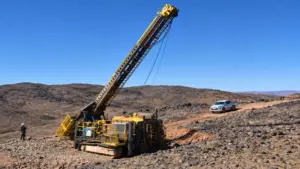
The Springer Tungsten Complex area in Nevada, where mine, mill and processing redevelopment is planned.
Allied supply is also expanding
The Elmet announcement comes alongside a separate move by Almonty Industries and Rwanda to build a Western-aligned tungsten supply chain in Africa.
Under a binding agreement announced Monday, the Rwandan government will receive a 25% stake in Almonty Rwanda Pty Ltd, while Almonty will hold 75%. Rwanda’s contribution includes the Shyorongi tungsten exploration concession, covering about 32 square kilometers in the Rulindo district, and a mineral processing license for a mobile tailings unit.
The venture plans to acquire ore, pre-concentrate and panning tailings from Rwandan mining license holders, including small-scale operators. Material could be sold, upgraded or exported while the partners develop a centralized collection and processing facility.
Reuters reported that the partnership is backed by a U.S. economic framework, although the U.S. government is not providing direct funding. The arrangement gives Rwanda an equity position in the venture rather than limiting its role to that of a concession holder or regulator.
Together, the U.S.-Elmet and Almonty-Rwanda agreements show how governments and companies are pursuing a network of alternative tungsten suppliers rather than relying on a single replacement source.
Execution remains the key risk
The agreements strengthen the commercial case for new tungsten capacity, but they do not eliminate the practical challenges.
Elmet must expand or qualify processing equipment, secure feedstock and meet defense standards. The Springer project must move from permitting and redevelopment into construction, commissioning and reliable production. In Rwanda, the partnership must integrate material from existing operators while developing a new processing platform.
The companies also face the economics of producing outside China. Alternative supply chains often have higher labor, energy, compliance and capital costs. Government investment and strategic offtake can help close that gap, but they do not remove construction risk, permitting risk or operating risk.
The National Defense Stockpile contract may provide long-term demand visibility, but the value of the contract will depend on orders placed and material delivered. The same applies to the $450 million investment: its strategic effect will be measured by new capacity, not only by the size of the government’s financial commitment.
For U.S. manufacturers, the immediate benefit is a clearer path toward domestic access to tungsten concentrates, sodium tungstate, APT and finished products. For policymakers, the agreements offer a model for using public capital, procurement and governance rights to rebuild a supply chain that private markets have not developed at the required pace.
For investors and mining companies, the message is broader. Critical-minerals security is increasingly being built around integrated systems that combine mines, refineries, stockpiles and industrial customers. The Elmet agreements place tungsten firmly within that model, with defense demand helping underwrite a supply chain intended to operate beyond China’s dominant position.

Tungsten alloy materials and precision equipment used in advanced industrial manufacturing.
LinkedIn: The U.S. Department of War is investing $450 million in The Elmet Group while a separate DLA contract could provide up to $2 billion for tungsten supplied to the National Defense Stockpile. The deals target mining, processing and manufacturing capacity across a supply chain dominated by China. The Springer Tungsten Complex in Nevada and an Almonty-Rwanda partnership add to the emerging Western-aligned network.
X: The U.S. is committing $450M to Elmet and awarding a DLA tungsten contract worth up to $2B. The deals target domestic mining, APT processing and defense manufacturing as Washington seeks to reduce reliance on China, which supplies roughly 80% of global tungsten.