The race for critical minerals is accelerating. So, according to governance experts, is the risk of repeating the mistakes that defined an earlier generation of resource extraction.

That was the central tension at the IGF’s 22nd Annual General Meeting, held October 12 to 14 at the Palais des Nations in Geneva. The forum convened government officials, international organisations, mining companies and civil society under the theme “Trust in an Interdependent World: Advancing Inclusion and Resilience in Mineral Value Chains.”
The timing reflects the pressure. Prices for base minerals jumped by roughly a third between early 2026 and September, according to the IEA’s Global Critical Minerals Outlook 2026. Strategic minor minerals more than doubled over the same period. Major powers are competing openly for supply agreements. Producing countries are navigating that pressure from a historically weak position.
Speed Is Becoming a Governance Problem
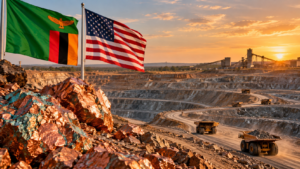
The United States proposed a $2 billion health aid package to Zambia earlier this year, initially tying it to access to the country’s minerals. Washington eventually dropped that condition before signing an agreement. A separate minerals deal is still under negotiation.
The episode illustrated a broader pattern. Alex Malden, policy manager and anti-corruption lead at the Extractives Industry Transparency Initiative, told delegates that the pace of dealmaking is now itself a risk. Agreements often involve a small number of parties. Environmental and social impact assessments are frequently bypassed. Community conflicts in affected areas are not always considered.
More Read

That speed is not neutral. It shapes who benefits from an agreement and who does not.

The Value Gap Has Not Closed
The structural problem facing resource-rich countries is not new. Africa produces a significant share of the world’s critical minerals. Yet it captures a disproportionately small fraction of the value those minerals generate.
UNCTAD data presented at the meeting illustrates the gap directly. Africa accounts for 12% of global mineral exports but captures only 4% of the value embedded in supply chains.
More Read

The IEA adds a further concern. Despite projections that demand for certain minerals will triple by 2030, the agency does not expect major diversification in global mineral supply chains. In other words, production geography may shift without necessarily shifting where value accumulates.
Developing countries’ own interests in the minerals race are often obscured by the competing positions of the United States and China. Both powers are seeking access to minerals required for data centres, artificial intelligence infrastructure, military hardware and the energy transition. The priorities of the countries that hold those minerals in the ground are not always part of that conversation.
Legislation Has Expanded. Enforcement Remains Uneven.
Over the past 25 years, the number of countries with mining legislation requiring benefit-sharing has grown from fewer than 20 to more than 100, according to Brendan Schwartz, executive director of Sustainable Development Strategies Group. That shift moved community benefits from voluntary commitments to legal obligations, typically through royalty-sharing arrangements and national or local development funds.
Tools exist to support that legislation. The African Mining Legislation Atlas compiles mining codes and regulations from 53 African countries on a single platform, allowing governments to compare frameworks and learn from peers. Senegal’s National Geological Survey used that kind of benchmarking when updating its own legislation, though its director general, Rokhaya Samba Diene, noted that legal transplants rarely work without adjustment. What functions in one country requires interpretation before it can serve another.
The African Union went a step further last year by adopting the African Green Mineral Strategy. The strategy prioritises developing domestic processing capacity, building human and technical capabilities, and integrating mining into broader industrial goals in batteries, electric vehicles and renewable energy.
Diene characterised the underlying shift plainly: more and more states are refusing to simply export raw materials.
The National Strategic Project Exemption Is a Growing Risk
These legislative gains are now under pressure from a different direction.
Schwartz observed that mining rules are being set aside in a growing number of jurisdictions, from Canada to Indonesia, through the creation of a category of “national strategic project.” Once a project receives that designation, many of the standard governance requirements no longer apply.
The implication is significant. Two decades of work to embed benefit-sharing, environmental review and community consultation into law can be suspended by executive designation. The legal architecture remains in place. The protections it was designed to provide do not.
Gold Shows What Repeating Past Mistakes Looks Like
Gold has long illustrated how mineral wealth can fail to translate into development. Peru, the world’s fifth-largest gold producer and third-largest copper producer, lost nearly $32 billion over three decades in productivity and capital losses attributable to conflicts between mining operations and Indigenous communities.
Informal and unregulated production has grown by 30% over the past decade. Illegal gold now accounts for approximately 20% of global production, diverting revenue away from governments and removing those operations from any regulatory framework.
Standards-setting bodies are feeling the pressure. The London Bullion Market Association is currently facing a London court case brought by families of two Tanzanian artisanal miners shot at a gold mine where one of its members sourced gold. The association denies the charges. Its sustainability director, Nirali Shah, acknowledged at the forum that the supply chains the LBMA members operate in are becoming more complex. Standards and expectations can only reach so far when sourcing conditions are not controlled directly.
Cobalt Has Demonstrated That Critical Minerals Can Inherit These Problems
The issues that characterised older gold supply chains have since appeared in newer critical mineral supply chains. Cobalt is the clearest example.
More than 70% of global cobalt supply comes from the Democratic Republic of the Congo. Extraction there has been associated with widespread deforestation, water and soil contamination, community displacement and the use of child labour in informal operations. These are not new observations. They have been documented consistently for years.
The DRC also announced export quotas on cobalt earlier this year, which the IEA identified as the direct cause of a new cobalt supply gap. Production and governance conditions in a single country are thus capable of reshaping global supply in ways that no amount of demand forecasting can fully account for.
Geneva-Based Traders Are Already Positioning
The commercial response to the minerals race is already underway among firms headquartered near the forum’s venue.
Mercuria and Glencore, both with Geneva or Zug operations, each committed $500 million to help secure US access to critical minerals. Trafigura is developing a gold-sourcing programme in Venezuela targeted at US markets.
These commitments reflect where the commercial momentum is. They also illustrate the broader dynamic that governance experts at the IGF were describing: capital is moving quickly toward supply security, and the institutional frameworks designed to protect producing communities are not moving at the same pace.
What Policymakers and Investors Should Watch
The IGF meeting identified several dimensions that will determine whether the current minerals race delivers different outcomes than previous commodity cycles.
Deal structure and scrutiny: Bilateral agreements concluded rapidly between a small number of parties carry elevated risks of overlooking environmental and social obligations. The terms of the still-pending Zambia minerals deal will serve as an early test case.
Processing and value retention: Countries that succeed in building domestic refining capacity, as Indonesia has done with nickel through export restrictions, change their position in the supply chain. Those that continue to export raw material do not.
Legislative durability: Benefit-sharing laws that can be suspended through national-strategic-project designations offer weaker protection than they appear to on paper. The frequency with which that designation is applied will matter.
Informal production: Illegal mining represents a persistent diversion of revenue and a governance failure. Gold’s trajectory suggests that critical minerals can follow the same path as informal production expands.
Community conflicts: Peru’s documented losses show that unresolved community disputes translate directly into capital losses and production disruptions. Companies and governments that treat consultation as a procedural requirement rather than a substantive obligation are accepting a financial risk, not just a reputational one.
A Speed Problem That Experience Should Have Solved
The minerals required for energy transition and digital infrastructure are genuinely important. The urgency is real.
However, urgency does not suspend the conditions under which mineral extraction creates lasting value for producing countries. The historical record is clear enough. Africa’s position in global mineral supply chains, Peru’s accumulated losses and cobalt’s documented governance failures all reflect what happens when extraction outpaces accountability.
Schwartz framed the central challenge at the forum directly. The pressure to move faster, he said, is leaving less room for the community benefits that determine whether a project is sustainable over time. That tradeoff, he argued, is not going to work.
The governance architecture for critical minerals exists. The question the IGF’s 22nd Annual General Meeting ultimately posed is whether the pace at which deals are now being concluded will give it any room to function.
Sources: