Race Against Time: Divers Retrieve Body in Search for Trapped Miners in India’s ‘Rat Hole’ Coal Mine
Rescue teams in northeastern India are working around the clock to save at least eight miners trapped in a flooded coal mine, as the body of one miner was recovered on Tuesday. The dramatic operation underscores the perils of rat hole mining, a dangerous and often illegal practice prevalent in the region.

The miners became trapped on Monday after water from an abandoned adjacent mine flooded their work site in the Umrangso area of Dima Hasao district, approximately 125 miles from Guwahati, the capital of Assam. Efforts to locate and save the miners face significant challenges due to the mine’s precarious conditions and narrow, unstructured shafts, characteristics typical of rat hole mining operations.
Related News
- Global Coal Demand Hits Record in 2024, Set to Plateau Amid Renewable Energy Surge
- Mining Boom Fuels Employment in Sierra Leone, but Gender Gaps Persist
- Biden Administration Grants Permit for Perpetua Resources Stibnite Project in Idaho
- Biden Offshore Drilling Ban: A Last-Ditch Effort to Cement U.S. Coastal Protections
Desperate Rescue Efforts Amid ‘Rat Hole’ Mining Hazards
Local government officials confirmed the grim discovery of the first victim. “Army deep divers have found and retrieved one body from the flooded mine,” said Kaushik Rai, a minister overseeing the rescue operation. “The divers will go into the mine again to continue their search operations.”
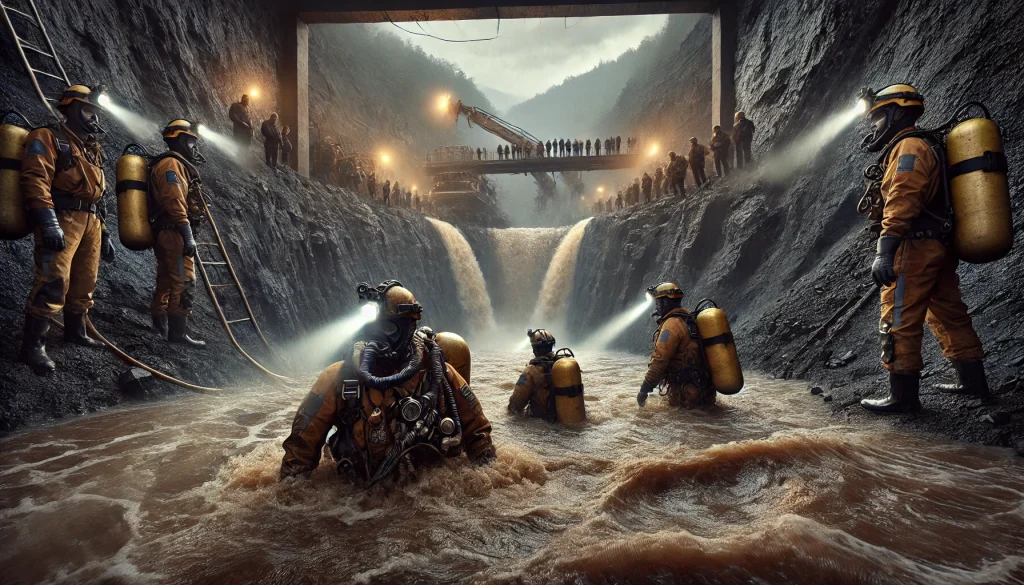
The operation involves teams from the Indian Army, National Disaster Response Force (NDRF), and local authorities. Specialized divers are navigating the submerged labyrinth of tunnels, typical of rat hole mining, using minimal visibility and battling strong water currents.
Authorities have not disclosed the identity of the recovered miner and fear that the chances of survival for the remaining trapped workers diminish with each passing hour. However, rescuers remain determined. “We are doing everything in our power to save lives,” Rai said.
The Dangers of ‘Rat Hole Mining’
The incident highlights the longstanding dangers of rat hole mining, a practice involving narrow, unregulated tunnels often carved deep into the earth. These tunnels—too small for machinery—require miners to crawl inside, relying on rudimentary tools to extract coal.

Though officially banned in several Indian states, including Meghalaya and Assam, rat hole mining persists due to high demand for coal and a lack of viable economic alternatives in impoverished communities.
Mining in the Umrangso area, located near the Kopili River, has long been contentious. Environmental activists have raised concerns about unregulated rat hole mining weakening geological structures and increasing the risk of water ingress. Monday’s flooding appears to have occurred after water breached from an abandoned mine nearby, raising questions about oversight and safety standards.
Grieving Families and Mounting Questions
As rescue efforts unfold, families of the trapped miners are gathering near the site, desperate for news. “My brother went to work every day to feed his children,” said Raju Singh, whose sibling is among the missing. “We are praying for a miracle, but no one is telling us if they are alive.”
The tragedy has sparked outrage among local activists and lawmakers who accuse mining operators of negligence. “This is the result of profit-driven exploitation without any regard for human lives or the environment,” said Debashish Dutta, a local activist. “Authorities must ensure accountability and enforce the mining ban strictly.”
Government officials have promised a thorough investigation. Assam Chief Minister Himanta Biswa Sarma tweeted, “We will ensure justice for the families of the miners and strengthen measures to prevent such incidents in the future.”
International Focus on the Hazards of Rat Hole Mining
The incident has renewed global scrutiny on mining safety, particularly in developing countries where regulations are often poorly enforced. The International Labour Organization (ILO) has previously flagged India’s informal mining sector, including rat hole mining, as one of the most hazardous in the world, citing frequent collapses, flooding, and health risks for miners.
Experts argue that without significant reforms, accidents like the one in Umrangso will remain a tragic fixture. “Illegal mining thrives because it feeds into the formal economy,” said Dr. Anirban Roy, an environmental policy researcher. “The government must address both demand and the socio-economic conditions that drive workers into these perilous jobs.”
The Path Forward: Addressing Rat Hole Mining Risks
As search operations continue, the focus is on recovering the remaining miners and ensuring accountability. But the tragedy has laid bare systemic flaws in India’s mining sector that require urgent attention. From inadequate enforcement of bans to the absence of alternative livelihoods for miners, the road to reform is fraught with challenges.
For the families of the trapped miners, however, the priority remains clear: bringing their loved ones home, alive or dead. The risks of rat hole mining have once again cast a shadow on the lives of workers and the region’s vulnerable communities.