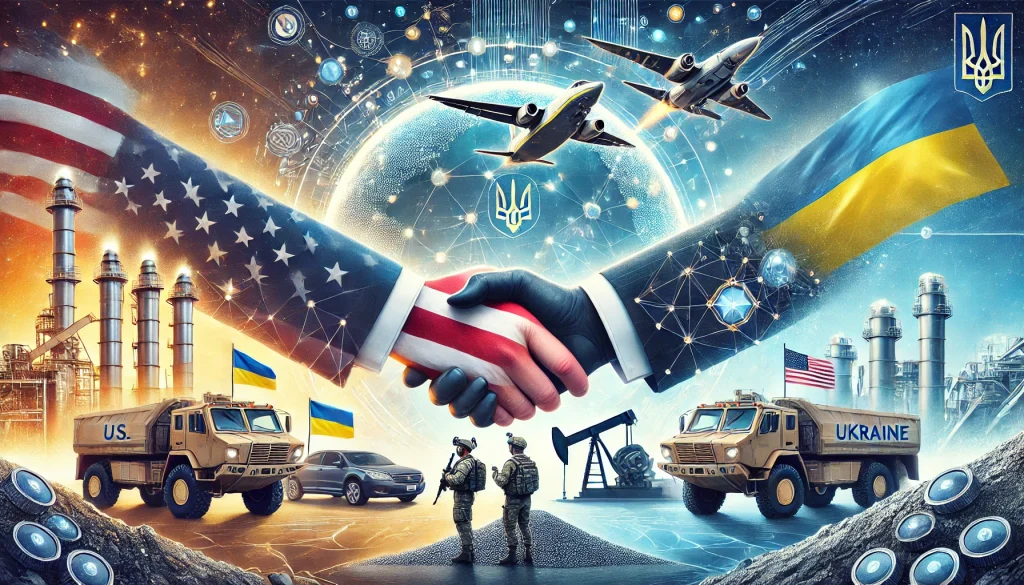
Recently, President Donald Trump initiated access to Ukraine’s critical minerals in exchange for U.S. military support in its war with Russia. Attracting strategic investors to develop critical minerals was also a key measure of the Victory Plan, presented by Ukrainian President Volodymyr Zelensky.

Key Minerals for a Mutually Beneficial Agreement
The critical raw materials industry—essential for battery production and modern technology manufacturing—is one of the fastest-growing sectors. Ukraine has the potential to integrate into international and regional value chains, helping to diversify and reduce global supply risks.
Ukraine possesses 23 of the 50 strategic materials identified by the U.S. as critical and 26 of the 34 materials recognized by the EU as essential. Notably, Ukraine holds strong competitive positions in five key minerals:
- Titanium
- Graphite
- Lithium
- Beryllium
- Rare Earth Elements (REEs)
Currently, these minerals are only partially developed in Ukraine and are rarely used for producing metal alloys and finished goods. There are 30 issued licenses for mineral development, and the government holds over 30 unlicensed deposits and approximately 400 promising occurrences. Ukraine also manages several key industrial assets, with the capacity to produce metal titanium, aluminum, silicon, germanium, and gallium.
Titanium and Beryllium – Essential for Aerospace and Defense
Titanium
Titanium is critical for aerospace, defense, chemical industries, and pigment fabrication.
- Ukraine holds the largest titanium reserves in Europe and ranks among the top five globally for titanium rutile reserves. It could meet U.S. and EU titanium demand for over 25 years.
- The global titanium supply chain is heavily reliant on China and Russia, both of which dominate production and processing, particularly in the metal value chain.
- If Russia were to impose an export ban on metallic titanium, it would severely impact aerospace giants like Boeing and Airbus, as well as the broader defense sector.
Ukraine has extensive experience in titanium mining and processing, particularly in slag and sponge production, but lacks melting capacity. It has several untapped deposits, including Stremyhorodske, the world’s largest hard-rock ilmenite deposit, comparable to Norway’s Tellnes and Canada’s Lac Tio.

To expand its titanium industry, Ukraine invites foreign investors to:
- Develop its domestic titanium sector.
- Construct new melting and fabrication facilities.
- Establish non-metallic titanium product manufacturing, such as white pigment, using existing industrial sites in Zhytomyr and Dnipropetrovsk.
Beryllium
Only a few countries mine and process beryllium, a crucial material for aerospace and defense.
- Ukraine has an explored Perzhansk beryllium deposit, with a development license granted to a private Ukrainian investor in 2019.
- The deposit contains 13.9 Kt of beryllium oxide reserves, enough to supply over 20 years of global production.
Lithium and Graphite – Powering the Energy Storage Revolution
Lithium
The demand for lithium-ion batteries is expected to grow exponentially over the next decade. However, 90% of the battery supply chain, including lithium processing, is controlled by China.
- While Ukraine’s lithium reserves are small on a global scale, they account for one-third of Europe’s proven lithium deposits, making Ukraine a potentially vital supplier of lithium carbonate and hydroxide for the European battery industry.
- Lithium mining has not yet begun in Ukraine. There are three explored deposits—one licensed, one promising, and two located in Russian-occupied territories.
- Initial investments needed for mining and production range from $150 million to $350 million per project.
Graphite
Ukraine can support battery factories by supplying natural graphite concentrate, which can be refined into active anode material for battery cells.
- Ukraine has six known graphite deposits, one of which is operated by the Australian public company Volt Resources. Its products are supplied to countries worldwide, including the U.S.
- Three more graphite licenses were issued in 2019 and 2021 to Ukrainian BGV Group and Turkish Onur Group.
- Estimated investment required for modernization and new fabrication facilities for high-purity spherical graphite production: $650 million.
Rare and Rare Earth Metals – Critical for Semiconductors
Tantalum, Niobium, and REEs
The extraction of tantalum, niobium, and rare earth elements (REEs) is tied to developing:
- The Novopoltava phosphate deposit.
- The Azov rare earth deposit (both currently under Russian control).
- Several other promising occurrences.
Additionally, Ukraine is working on technologies to extract REEs from ilmenite ores, including waste produced by seven operating mining and beneficiation enterprises.
Germanium
Ukraine has significant germanium reserves, found in gas, hard coal, brown coal, and coal ash from electricity generation. It is also present in:
- Lead-zinc production waste.
- Metallurgical slags.
- Carbonaceous clays.
Historically, coking coal served as a germanium source in Ukraine. Extraction was conducted at coke chemical plants, with processing at the Zaporizhzhia Titanium Magnesium Plant, which produced purified germanium tetrachloride and optical monocrystalline germanium lenses.
Gallium and Silicon
- Gallium production could be revived at the Mykolaiv alumina plant, using aluminum bauxite from the Visokopil deposit in Dnipropetrovsk.
- High-quality quartz sands from the Glukhiv quarry (Sumy region) could be used to establish crystalline silicon production.
- In Soviet times, 80% of the USSR’s silicon production capacity was concentrated in Ukraine, particularly at the Zaporizhzhia semiconductor and aluminum plants.
Ukraine’s vast critical mineral reserves—particularly titanium, graphite, rare earths, lithium, and beryllium—position the country as a valuable player in joint supply chains with NATO and OECD countries. These resources enable Ukraine to integrate into modern high-tech production cycles.
However, developing these resources requires significant capital investment and advanced technologies. Currently, only private foreign companies can provide the necessary funding and expertise. To attract investment, the Ukrainian government is working to establish a strong regulatory environment.
Key achievements include:
- Acquisitions by venture investors from Australia (Volt Resources), Turkey (Onur Group), and Azerbaijan (NEQSOL Holding).
- Intergovernmental agreements, including Ukraine’s Facility Program with the EU.
A strategic partnership with the U.S. is particularly promising. Strengthening U.S.-Ukraine collaboration in critical minerals is a logical and necessary step for Ukraine to accelerate its development in high-tech and innovative sectors.