Global Mining Services Leader Faces Challenges in Achieving Net-Zero Emissions
Thiess, a global mining services company, has reaffirmed its commitment to fleet decarbonization with a strategic focus on abatement over offsets. In its recently released 2024 Sustainability Report, Thiess acknowledges that while progress has been made, the company is unlikely to achieve its net-zero Scope 1 and Scope 2 emissions target by the end of 2025. The delay in low-emissions technology and the prioritization of direct emissions reduction strategies are cited as key factors.

Thiess’ Approach to Fleet Decarbonization
Executive Chair and CEO Michael Wright highlighted the difficulties of reducing emissions in mining operations, stating:
“While we continue to make progress on our decarbonization strategy, our current estimations indicate our target to be at net zero Scope 1 and 2 emissions by the end of 2025 will not be met, largely due to the delay in anticipated low-emissions technology and our strategic decision to prioritize abatement over offsets.”
Despite the setbacks, Thiess is actively exploring alternative solutions to achieve fleet decarbonization, working closely with partners, clients, and technology providers. The company is investing in transitional and interim technologies, including hybrid vehicles, renewable energy agreements, and biofuels, to reduce emissions faster.
Related News
- PDAC 2025 Sparks Global Momentum for Critical Minerals and Mining Investment
- Iron Ore Price Volatility Rattles Global Markets Amid New Tariffs and Weak Demand
- Canadian Companies Brace for Trump’s Tariffs: Strategies and Survival Tactics
- Why the U.S. Can’t Afford to Lose Canada’s Critical Mineral Aluminum
Hybrid and Electric Vehicles Leading the Transition
A major hurdle for Thiess is the lack of commercially viable low-carbon options for its light vehicle fleet, which contributes approximately 70% of its Scope 1 emissions. To address this, the company has begun integrating hybrid light vehicles into its fleet, aiming for 85% of its light vehicles to be battery-electric or hybrid by 2030.
Key Developments in Thiess’ Light Vehicle Fleet
- Introduction of hybrid Toyota Hilux utility vehicles in Australia.
- Trial of an electric Toyota wagon in New South Wales.
- Introduction of a hybrid vehicle into the RTL fleet in Victoria.
- Testing of an F250 electric powertrain light vehicle in the United States.
While current hybrid replacements only offer an estimated 10% emissions reduction, Thiess remains committed to progressively upgrading its fleet with more advanced low-emission technologies.

Decarbonizing Heavy Mining Equipment
Beyond light vehicles, Thiess is also focusing on decarbonizing large mining trucks. Due to the economic and operational challenges of fully hydrogen-powered or electric fleets, many mining companies—including Thiess—are exploring retrofitting existing fleets with lower-emission alternatives.
In 2024, Thiess expanded its fleet decarbonization solutions by forming strategic partnerships:
- FLANDERS Collaboration: Thiess is conducting a feasibility assessment on FLANDERS’ OEM-agnostic retrofit solutions, which can be integrated into existing diesel-electric trucks to improve fuel efficiency and reduce emissions.
- EACON Partnership: Thiess signed an MoU with autonomous haulage specialist EACON to test a 93-ton hybrid diesel-electric truck, which could reduce emissions by up to 40%. A trial is expected to begin in 2025 at Thiess’ Indonesia operations.
Additionally, RTL—a Thiess subsidiary—is working with Chinese OEMs to evaluate battery-powered loaders and hybrid graders for potential use in Australia. The company has also explored new offerings from Sandvik and Hitachi, including a battery-electric underground loader and a 200-ton full battery rigid dump truck.
Investing in Hydrogen and Alternative Fuels
Thiess is not only exploring electric solutions but is also investing in hydrogen-powered and dual-fuel technologies to support fleet decarbonization. Key initiatives include:
- Trial of Toyota’s hydrogen-powered generator at the Mt Pleasant Operation in Australia, with expansion plans for Indonesia.
- Komatsu hybrid excavator trials at the Melak Project in Indonesia.
- Dual-fuel trials at a Queensland mine site, achieving diesel substitution rates above 70%, leading to significant emissions reductions.
Scaling Up Infrastructure for Battery-Electric Equipment
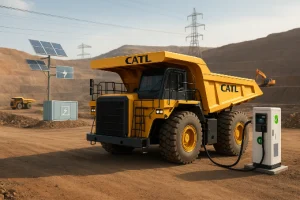
To support the transition to battery-electric mining trucks, Thiess is enhancing its infrastructure. In 2024, two full battery-electric Scania medium trucks were built, with deliveries scheduled for early 2025. The company is also installing charging stations and developing change management strategies to facilitate the adoption of battery-electric vehicles across its fleet.
Additionally, the Thiess Institute is launching workforce training programs focused on battery-electric maintenance skills, ensuring its personnel are equipped to handle the shift to hybrid and electric mining fleets.
Path Forward: A Commitment to Sustainable Mining
Despite missing its 2025 net-zero target, Thiess remains committed to fleet decarbonization through abatement-first strategies. The company’s focus on hybrid vehicles, retrofitting existing mining fleets, and adopting hydrogen and electric solutions demonstrates a long-term approach to reducing emissions in a capital-intensive industry.
As global mining operations strive for sustainability, Thiess’ efforts to integrate low-carbon technologies and enhance workforce capabilities position it as a leader in the transition to cleaner, more efficient mining operations.