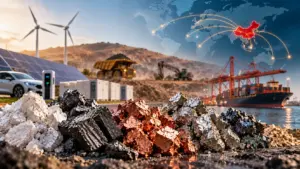
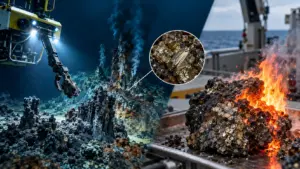
For decades, the Gulf Cooperation Council (GCC) economies were synonymous with oil wealth. But as global energy markets shift toward decarbonization and price volatility erodes long-term stability, Gulf states are accelerating a profound economic pivot. Mining — particularly critical minerals — has emerged as the region’s new frontier.

From Oil Barrels to Mineral Tons
Saudi Arabia and the United Arab Emirates (UAE) are at the forefront of this transformation. Both countries have turned their sovereign wealth funds — the Saudi Public Investment Fund (PIF) and Abu Dhabi’s Mubadala — into engines for acquiring mineral assets across Africa, Latin America, and beyond.
Lithium, copper, nickel, cobalt, and rare earths are the focus. These minerals underpin electric vehicles, clean energy storage, and defense technologies. According to the International Energy Agency (IEA), demand for lithium alone is set to grow fortyfold by 2040. For the Gulf, “white gold” is now as strategically vital as crude oil once was.
Two Models of Expansion
Saudi Arabia favors strategic minority stakes that align with its Vision 2030 industrial policy. Through Ma’aden, it has invested in projects such as Vale Base Metals (Brazil/Canada) and global joint ventures aimed at securing supply while building domestic processing capacity.
The UAE, by contrast, is moving more aggressively. Mubadala and Abu Dhabi’s International Holding Company (IHC) have acquired controlling positions in African copper and cobalt mines, while simultaneously announcing downstream facilities — including a lithium refining plant — to position the country as a processing hub.
This divergence reflects two philosophies: Saudi Arabia’s “industrial ecosystem” approach versus the UAE’s “global acquisitions for control.” Both, however, are united in recognizing that mining is central to long-term resilience in the post-oil era.

Geopolitical Calculus
Beyond economics, this shift is about leverage. In a multipolar world where the U.S. and China are locked in a supply chain contest, Gulf states see minerals as a way to stay indispensable.
Africa has become a key theater. Saudi Arabia recently hosted the Future Minerals Forum in Riyadh, attracting African ministers eager for investment alternatives to China. The UAE’s high-profile move into Zambia’s Mopani Copper Mines signals its willingness to compete head-on with Beijing-backed firms.
More Read
As one analyst at Wood Mackenzie put it, “The Gulf isn’t just hedging against the decline of oil — it’s buying a ticket into the geopolitics of the 21st century’s most contested commodities.”
Wealth Beyond Oil
The numbers underline the seriousness of this pivot. Saudi Arabia’s PIF has earmarked $15 billion for mining and metals investments by 2030. The UAE’s Mubadala has over $300 billion AUM, with an increasing share directed toward energy transition minerals.
For economies historically defined by hydrocarbons, mining is more than diversification — it’s survival. Revenues from strategic mineral assets are expected to feed directly into non-oil GDP growth, job creation, and new export industries across refining, smelting, and advanced manufacturing.
Risks & Challenges
Yet the Gulf’s mining ambitions face hurdles.
- Political risk in Africa and Latin America: Coups, shifting tax regimes, and community opposition have stalled projects before. Gulf investors will need strong local partnerships to manage volatility.
- Environmental concerns: Mining expansion raises questions about water use, biodiversity, and carbon emissions — areas where Gulf states will be judged on ESG performance.
- Competition for assets: Western majors, Chinese SOEs, and now Gulf funds are all chasing the same high-grade copper and lithium deposits. This will drive up valuations and complicate deal-making.
If not managed carefully, these challenges could slow the Gulf’s ability to turn mining bets into sustainable, long-term returns.
Skillings Analysis
- Strategic transition: The Gulf’s wealth model is shifting from extractive oil rents to asset-backed mineral investments.
- Competing playbooks: Saudi Arabia’s equity partnerships contrast with the UAE’s appetite for outright control. This may create competitive friction — but also drive innovation.
- Global leverage: By embedding themselves in the mineral value chain, Gulf states ensure they remain pivotal to both East and West in the clean energy era.
- Risk reality: Success depends on navigating political instability, ESG scrutiny, and intense global competition.
The Road Ahead
The post-oil era has arrived in the Gulf not as a distant aspiration, but as a lived strategy. The region’s sovereign wealth is being redeployed into the mines, smelters, and supply chains that will define global power in the decades ahead.
For the mining industry, this means the Gulf is no longer just a buyer of commodities — it is becoming a strategic player shaping the supply lines of the energy transition.