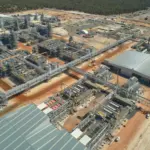
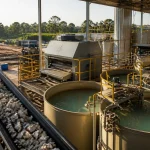
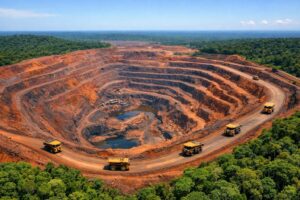
Australian mining operations viewed from above.

By Charles Pitts
Mineral Resources said its financial and operating performance reached the strongest level in its 20-year history as record volumes across mining services, iron ore and lithium helped drive a sharp earnings recovery and lower net debt.
The Australian mining company reported revenue of A$6.5 billion, up 44% from the previous financial year, while underlying EBITDA rose 183% to A$2.6 billion, according to its FY26 full-year results presentation. The company said its underlying EBITDA margin increased to 39%, compared with 20% in the prior year.
Underlying net profit after tax reached A$822 million, reversing an underlying loss of A$112 million in the previous year, Mineral Resources said. Reported statutory NPAT was about A$1.2 billion, including one-off items, according to the company’s results materials.

The result marks a significant change from the pressure Mineral Resources faced during the prior reporting period, when weaker lithium conditions, project spending and balance-sheet concerns weighed on profitability. The FY26 figures show the contribution of higher volumes and improved operating performance across the company’s three main business areas.

FY26 result at a glance
Mineral Resources reported the following full-year metrics:
| Metric | FY26 result | Year-over-year or guidance comparison |
|---|---|---|
| Revenue | A$6.5 billion | Up 44% |
| Underlying EBITDA | A$2.6 billion | Up 183% |
| Underlying NPAT | A$822 million | Versus A$112 million underlying loss |
| Mining Services production | 341 million tonnes | Up 22%; above upgraded guidance of 320–330 million tonnes |
| Iron ore shipments | 29.5 million wet metric tonnes | Record annual volume |
| Lithium sales | 559,000 dry metric tonnes SC6 | Record annual volume |
| Net debt | About A$4.3 billion | Down about A$1.1 billion |
| Liquidity | A$2.4 billion | Up A$600 million quarter over quarter |
| Final dividend | A$0.83 per share | Fully franked |
Source: Mineral Resources FY26 results presentation and Q4 FY26 quarterly activity report.
More Read

The board declared a fully franked final dividend of A$0.83 per share, equivalent to a 20% payout of underlying profit, the company said. That was the first reinstatement of dividends after the difficult prior year.
For the business, the earnings recovery is important because it was accompanied by higher production rather than relying solely on commodity prices. Mineral Resources said all operating segments met or exceeded their FY26 volume and cost guidance.
Mining Services provides the operating base
Mining Services produced a record 341 million tonnes, 22% higher than the previous year and 3% above the company’s upgraded guidance range, Mineral Resources said in its Q4 FY26 activity report.
Fourth-quarter production reached 94 million tonnes, up 18% from the previous quarter. The company attributed the increase primarily to higher volumes across the Onslow Iron production chain and increased stripping activity at Mt Marion.
Mining Services generated underlying EBITDA of A$976 million at a 31% margin, according to the FY26 results presentation. Mineral Resources also said two new joint venture contracts for rehabilitation and ore sorting began during the quarter, while an external crushing contract was renewed.
The segment’s performance gives Mineral Resources a relatively broad earnings base spanning its own operations and external contracts. That diversification is an operating strength, although the reported figures do not remove exposure to contract execution, labor availability, equipment utilization or activity levels across the mining sector.
Skillings has previously examined how autonomous mining technology is changing equipment and operating models, a trend that remains relevant to large-scale mining services businesses seeking higher utilization and lower operating costs.

Mining services haulage and crushing infrastructure.
Onslow Iron reaches a higher-volume phase
Onslow Iron shipped a record 9.6 million wet metric tonnes in the fourth quarter on a 100% basis, equivalent to an annualized run rate of approximately 38.4 million tonnes, Mineral Resources said.
For the full year, the company reported attributable Onslow Iron shipments of 19.7 million wet metric tonnes, above its upgraded guidance range of 17.7 million to 19.4 million tonnes. FY26 FOB costs were A$52 per wet metric tonne, below guidance of A$54 to A$59 per wet metric tonne.
The company said Onslow Iron achieved an average quarterly realized iron ore price of US$87 per dry metric tonne, equal to 82% of the Platts 61% CFR Index. The reported discount to the benchmark reflects the pricing and product characteristics of the material sold, but the company’s release does not provide a full bridge explaining the variance.
Mining Resources also reported that 9.9 million wet metric tonnes were hauled to the Port of Ashburton during the quarter using an average of 112 MinRes jumbo road trains each day. A quarterly transhipper loading record of 9.8 million tonnes was achieved despite a sediment-management campaign at the berth pocket, the company said.
The operation’s higher throughput is central to the outlook because Onslow Iron was designed to become a major source of iron ore volume and cash flow. The company said pre-stripping at Cardo Bore East continued on schedule to support its longer-term product-blending strategy.
Pilbara Hub holds near the top of guidance
Pilbara Hub shipments totaled 9.9 million wet metric tonnes for FY26, at the upper end of the company’s guidance range of 9 million to 10 million tonnes, Mineral Resources said.
The hub’s FY26 FOB cost was A$79 per wet metric tonne, also at the upper end of the company’s A$75-to-A$80 guidance range. Iron Valley supplied 74% of Pilbara Hub shipments during the fourth quarter, while the Lamb Creek project continued to ramp up.
Mineral Resources said Lamb Creek’s mine access road had been connected to Great Northern Highway and was being sealed. Wet commissioning of the fixed crushing plant was targeted for the first quarter of the next financial year. The company subsequently reported that first ore had been processed through the plant six months after ground was broken.
The Pilbara Hub’s performance supports the company’s stated plan to increase iron ore output through existing infrastructure and project development. However, the company’s reported realized price of US$88 per dry metric tonne, or 83% of the Platts 61% CFR Index, shows that volume growth remains linked to product pricing, quality and market conditions.
Lithium volumes rise as processing utilization improves
Lithium sales from Wodgina and Mt Marion reached a combined record 559,000 dry metric tonnes of SC6 during FY26, Mineral Resources said. SC6 refers to spodumene concentrate with a nominal 6% lithium oxide content.
Fourth-quarter sales from the two operations totaled 158,000 dry metric tonnes of SC6, at a weighted average realized price of US$2,425 per tonne, up 15% from the previous quarter.
Wodgina recorded FY26 sales of 317,000 dry metric tonnes of SC6, above upgraded guidance of 270,000 to 290,000 tonnes. Its FY26 FOB cost was A$738 per tonne, near the lower end of the company’s A$730-to-A$800 guidance range.
Mineral Resources said Wodgina production increased 21% quarter over quarter as utilization of three processing trains improved. Plant recovery was 68% as the operation transitioned from Stage 2 ore to Stage 3 feed.
At Mt Marion, FY26 sales reached 242,000 dry metric tonnes of SC6, above guidance of 210,000 to 230,000 tonnes. The operation’s FY26 FOB cost was A$847 per tonne, within guidance of A$820 to A$890 per tonne.
The company said plant improvements allowed it to process a greater proportion of contact ore stockpiles. Ore sorting is planned for lower-grade contact ore stockpiles as the north pit transitions from the N9 to N11 mining area.
Mineral Resources made a final investment decision in May to build a flotation plant and develop underground mining at Mt Marion. The company put the total capital investment at A$490 million on a 100% basis across the next two financial years and said early works and long-lead procurement had begun.

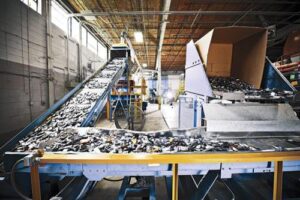
Lithium processing equipment and conveyors in an industrial facility.
Balance-sheet improvement changes the operating backdrop
Mineral Resources reduced net debt by approximately A$1.1 billion during FY26 to about A$4.3 billion, while liquidity increased to A$2.4 billion, including approximately A$1.6 billion in cash at the end of the reporting period, according to the company.
FY26 capital expenditure was approximately A$1.1 billion, in line with guidance. Mineral Resources also said it had refinanced debt into longer-dated, lower-coupon notes.
The balance-sheet improvement gives the company more capacity to fund approved projects and absorb commodity-price volatility than it had at the start of the reporting period. It does not eliminate financial risk: the company continues to carry material debt, while the planned Mt Marion investment and other infrastructure commitments require further capital.
Safety reporting requires a careful comparison
Mineral Resources reported a rolling 12-month lost-time injury frequency rate of 0.00 and a total reportable injury frequency rate of 3.33 as of the end of FY26, under its existing reporting procedure.
The company said it had revised its Injury and Illness Classification Procedure with retrospective adoption from the start of the financial year. Under the revised procedure, the equivalent rolling 12-month LTIFR would have been 1.20 and the TRIFR 7.07, Mineral Resources said.
The company attributed the difference to a broader classification of recordable injuries rather than a change in underlying safety performance. Future periods will be reported under the revised procedure, making comparisons with earlier figures less direct unless the revised basis is used.
Outlook: higher capacity, with execution and price risks
Mineral Resources’ operating outlook is centered on maintaining high volumes at Onslow Iron, sustaining mining-services activity and advancing lithium expansions at Wodgina, Mt Marion and Bald Hill.
The company said Bald Hill restarted operations in May, produced its first concentrate in June and was targeting a ramp-up to full capacity of 140,000 dry metric tonnes of SC6 in the second quarter of the next financial year. Mineral Resources also said it was studying plant-expansion options at Bald Hill.
For Wodgina, the company expects ore quality to remain consistent in the near term before improving as the Stage 3 pit deepens. Pre-stripping of Stage 4 is scheduled to begin in the first quarter of the next financial year, according to the Q4 activity report.
Unconfirmed and forward-looking: Bald Hill’s 140,000-tonne ramp-up target, Wodgina’s planned mining sequence, Mt Marion’s expansion timetable and Onslow Iron’s infrastructure-completion targets are company expectations, not achieved outcomes. Mineral Resources’ forward-looking statements have not been independently verified by Skillings and remain subject to operating performance, capital delivery and commodity-market conditions.
The FY26 result demonstrates that Mineral Resources can convert higher production into stronger earnings and lower debt when its major operations perform at or above guidance. The next test will be whether those volumes and margins can be sustained while the company funds new infrastructure, manages lithium-price exposure and applies its revised safety-reporting framework consistently.