For more than a century, investors have turned to gold as the ultimate hedge against inflation and uncertainty. But as the world enters a decade defined by energy transition, supply chain volatility, and shifting monetary policies, critical minerals like lithium and copper are emerging as potential contenders. The question is no longer just whether gold can retain its dominance, but whether these building blocks of the green economy will evolve into the “safe haven” assets of the 2030s.

Inflation, Gold & Rising AISC: What the Numbers Tell Us
Gold prices have surged above the US$3,200/oz mark in parts of 2025, buoyed by persistent inflation, currency volatility in emerging markets, and supply chain disruptions. For major gold producers, this has meant margin expansion in absolute terms—but also rapidly rising costs. According to recent MiningVisuals Q1 2025 data, Newmont’s AISC (all-in sustaining cost) rose ~14.7% year-on-year, while Barrick saw its AISC increase over 20%, even though production volumes fell significantly.
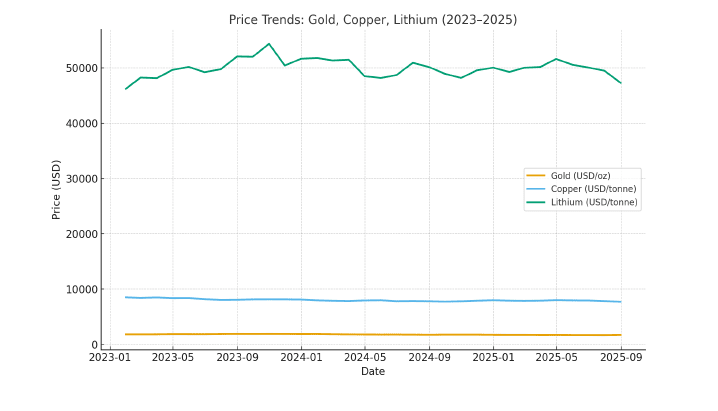
At the same time, demand for gold remains strong. The gold sector recorded consecutive quarters of strong revenue and earnings growth in 2025, helped by a higher average gold price and delayed cost inflation passed through contracts or absorbed by inventories.
But inflation is squeezing non-gold mining operations harder. Rising fuel, labour, energy, transportation, and royalty costs are pushing up input costs for base metals and critical minerals—where mining, refining, and capital intensity already pose steep challenges.
Critical Minerals under Demand Pressure: Copper & Lithium Outlook
According to the International Energy Agency’s Global Critical Minerals Outlook 2025, critical minerals such as copper and lithium are showing signs of becoming supply constrained. Global refined copper demand reached ~27 million tonnes in 2024, up around 3.2% from 2023. Under current policy settings (the “Stated Policies Scenario” or STEPS), demand for copper is projected to grow to ~33 million tonnes by 2035 and ~37 million tonnes by 2050.
More Read

Meanwhile, announced mining and refining projects appear insufficient. IEA estimates that under STEPS, a 30% deficit in primary copper supply is likely by 2035 unless more projects are brought forward, existing ones expanded, ore grades improved, and capital costs moderated.

Lithium’s situation is even more acute under the same framework: expected demand could outstrip supply by ~40% by 2035 if announced extraction and refining plans go ahead but without delays. China dominates refining capacity: while only about 22% of lithium extraction is performed there, the country controls roughly 70% of global refining and 95% of hard-rock lithium processing.
Can Critical Minerals Behave Like Safe Haven Assets?
To act as “safe havens” in the traditional sense, commodities need to preserve value during inflation, be liquid, decoupled from weak industrial cycles, and have supply risk or geopolitical premium baked in. Some critical minerals are moving in that direction:
- Inflation hedging potential: Critical minerals are subject to inflation both in demand (higher use in EVs, grid constructions etc.) and cost side. But cost inflation (in energy, equipment, labour) often eats into margins, whereas gold historically gains more cleanly from inflation due to its monetary role.
- Supply risk & geopolitical exposures: Many refining/refining and processing stages are concentrated in a few jurisdictions (China especially for rare earths, lithium, certain battery metals). Export restrictions and environmental regulation can amplify risk premiums, creating “safe-haven-like” behaviour in times of disruption. IEA and others have flagged these risks.
- Liquidity & market maturity constraints: Unlike gold, which has deep futures, ETFs, sovereign holdings, and jewellery demand, many critical minerals lack standardized liquid instruments. Physical delivery constraints, inconsistent quality/grade, and lack of established secondary markets remain obstacles.
Risks That Could Undermine the Safe-Haven Narrative for Critical Minerals
- Oversupply / over-forecasting in some areas: While copper and lithium face deficits under most scenarios, in certain minerals (e.g. some battery metals, graphite, rare earths) announced capacity may meet or exceed demand if projects come online, assuming no major delays. But in practice, permitting, funding, environmental hurdles often slow projects sharply.
- Cost inflation & interest rates: Capital expenditure has stiffened, both in mining and especially in downstream refining. High interest rates lengthen project payback periods. Many mining firms are revising guidance upward for sustaining costs. IAMGOLD, for example, reported AISC of US$2,140/oz in Q2 2025, ~29% higher YoY, attributable in large part to operating cost inflation, lower volumes, and royalty changes.
- Technological substitution, recycling, ore quality: Improvements in battery chemistries, material substitutes, or aggressive recycling (urban mining) could reduce raw demand growth. At the same time, falling ore grades mean more waste, more energy per unit metal, en pushing costs higher and delaying new supply.
Why It Matters for Mining Companies & the Global Economy
For mining companies, the shifting dynamics mean that those with low-cost, stable jurisdictions, access to refining/downstream processing, and strong ESG/permits pipelines are best positioned. Firms stuck with high AISC, distant projects, or weak access to refinement will see margins squeezed.
For investors and analysts, critical minerals are no longer just long-term growth plays—they may soon become strategic hedges, but only if liquidity, regulatory clarity, and supply chain resilience improve. Gold retains its role—but portfolios may increasingly include exposure to copper, lithium, possibly nickel as partial hedges.
For national economies and policy makers, underpinning infrastructure (refining, permitting, environmental regulation) and strategic supply policies will be decisive. Countries lacking refining capacity may face currency risk, import bills, or dependency.
Skillings analysis
- Critical minerals are showing early signals of safe-haven behaviour—particularly in copper and lithium—but they are not yet substitutes for gold. The inflation vs. demand pendulum still swings unpredictably, especially as many industrial cycles slow.
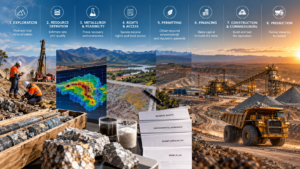
- The long lead time from discovery to production (often over 15–18 years for copper projects) means supply cannot be rapidly scaled; mining firms with project pipelines that are matured and financed gain a strong competitive edge.
- Regulatory, ESG, and geopolitical risk remain large wildcards. Even strong projects may fail to materialize because of permit delays, community opposition, environmental costs, or policy shifts—risks that gold largely avoids given its monetary and cultural embeddedness.
Looking Forward to the Rest of the Decade
As we move through the latter half of 2025 and into 2026, mining companies should closely monitor how inflation trajectories, interest rates, and capital flows evolve. Copper and lithium deficits look likely to crystallize unless announced projects accelerate, financing improves, and downstream/refining constraints are resolved.
Gold will almost certainly continue serving as ballast in asset portfolios and sovereign reserves. But in the 2030s, we may witness a gradual rebalancing: a diversified portfolio of safe‐havens that includes selected critical minerals, especially copper and lithium, alongside gold, could become the norm. The coming quarters will be crucial: projects currently under development, cost escalations made public in Q3/Q4 reports, and policy moves (especially around trade, export, and strategic stockpiling) will offer clearer signals of which minerals truly emerge as “safe havens.”