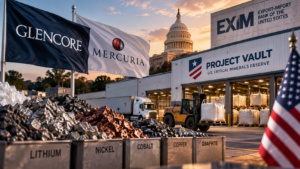
The United States wants to turn minerals on the Pacific seabed into a new source of critical materials. But bringing those resources ashore is only part of the challenge. The nodules must also be processed into products that manufacturers can use.

That is where the US supply chain remains incomplete.
Polymetallic nodules contain manganese, nickel, cobalt and copper. Recovering them from the ocean floor would not, by itself, deliver refined metals to battery, electronics or industrial customers. The material must pass through a series of processing and refining stages, each requiring suitable facilities, technical expertise and investment.
The Metals Company (TMC), which is developing plans to recover nodules from the Clarion-Clipperton Zone (CCZ), has explored more than one way to handle that challenge. Its plans include using existing processing facilities overseas while pursuing a proposed processing and refining hub at the Port of Brownsville, Texas.
The immediate question is not whether nodules can be processed anywhere. It is whether the US can build a domestic operation capable of handling them at commercial scale—and how much of the supply chain may initially depend on facilities abroad.
More Read
Brownsville: A Refinery Still on the Drawing Board
TMC’s proposed Brownsville development is intended to bring more of the processing chain onto US soil. The company has described plans for a large-scale processing and refining complex and secured an exclusive right to negotiate with the Port of Brownsville over approximately 1,466 acres.

The project is moving through development, but it is not yet a refinery under construction. TMC’s preliminary planning has contemplated a facility with capacity of up to 12 million tonnes a year. That figure describes a proposed development, not an operating plant or a committed production rate.
In July 2026, TMC and Mariana Minerals agreed to begin phased concept development and technical design work for the potential facility. The work is intended to help establish the plant’s design and feasibility. It does not amount to a final investment decision.
More Read
That distinction matters. Before Brownsville can process commercial volumes of nodules, the project needs further engineering, financing, permits and construction. TMC’s earlier disclosures also made the ultimate investment decision conditional on US government support.
Overseas Processing Offers a Potential Bridge
Brownsville is not the only route TMC has considered.
The company’s development plans have included sending nodules to existing facilities in Japan and Indonesia for initial processing. That approach could allow the project to use established industrial infrastructure while a dedicated US facility is developed.
TMC has reported industrial-scale processing work at Pacific Metals Company’s facility in Japan, alongside pilot-scale work in North America. Its reported process produces intermediate materials, including a nickel-copper-cobalt matte, which can then undergo further refining.
Under a staged development model, some intermediate material could be shipped to Texas for further processing as domestic capacity becomes available. TMC has also explored alternatives that would bring more of the processing chain into the United States.
Overseas processing could help bridge the gap, but it would bring its own dependencies. The project would need access to third-party facilities, workable processing arrangements and reliable transport for both nodules and intermediate products.
Testing a Process Is Not the Same as Running a Refinery
The metallurgical work is an important part of the project. It is also where the distinction between technical progress and commercial readiness becomes critical.
TMC has reported testing a route that produces nickel-copper-cobalt matte and manganese silicate from polymetallic nodules. Parts of the process have been tested at pilot scale in the US and Canada, while industrial-scale processing has been demonstrated at a facility in Japan. Further refining stages have also been tested in Canada.
These results show that elements of the proposed processing route have been tested. They do not prove that a complete US plant can operate continuously at the proposed scale, recover the expected quantities of metal, control costs and produce materials that meet customers’ specifications.
A commercial facility must do all of those things consistently. It must also manage the practical demands of a large operation, from feedstock handling to waste streams, energy use and product quality.
That is why a successful test campaign cannot be treated as proof that a commercial refinery is ready to operate. The remaining work is not simply to scale up a machine. It is to demonstrate that the whole process can work reliably and economically.
Permits Must Keep Pace With the Project
The offshore operation faces a separate regulatory hurdle.
TMC USA has applied to the National Oceanic and Atmospheric Administration (NOAA) for an exploration licence and commercial recovery permit under the Deep Seabed Hard Mineral Resources Act. The application covers an area of the CCZ, which lies beyond national jurisdiction.
NOAA’s review of the application is distinct from the development of the Brownsville facility. A procedural finding that an application meets information requirements does not authorise commercial recovery.
As of October 1, 2026, NOAA’s published process includes a public-comment period running through October 19 and a virtual public hearing scheduled for October 13. The agency’s published list does not show a commercial recovery permit as issued.
The US process also sits alongside the International Seabed Authority’s framework for mining in areas beyond national jurisdiction. The differing approaches have made deep-sea mining a subject of international legal and policy debate. For companies planning commercial operations, the regulatory pathway remains a key factor in project timing.
The Offshore and Onshore Plans Must Match
TMC’s proposed offshore collection system has a nameplate capacity of 3 million wet tonnes of nodules a year, with commissioning targeted for the fourth quarter of 2027, subject to regulatory approvals. The company’s longer-term plans contemplate a phased expansion of capacity.
That creates a practical challenge. The processing route must be ready when nodules are recovered, and the plant must have enough feedstock to operate efficiently. A proposed 12-million-tonne-per-year processing development should not be confused with the capacity of the initial offshore system.
The two projects also face different risks. Offshore collection depends on regulatory approval and the development of the recovery system. Brownsville depends on engineering, permits, financing and construction. Progress on one does not guarantee progress on the other.
The economics will ultimately depend on how these pieces fit together: the cost of recovering and transporting the nodules, the performance of the processing route, the capital required for the plant and the market for the resulting products.
The Refining Chain Is the Real Test
The US deep-sea mining effort is often framed around access to seabed resources. But access alone will not create a domestic source of refined critical minerals.
TMC has identified overseas processing options and is advancing plans for a Texas facility. Its metallurgical testing provides a basis for further development, but the company still has to demonstrate a complete commercial operation and secure the approvals and capital required to build it.
Brownsville could become a major link in that chain. For now, it remains a proposal, while overseas processing remains part of the company’s development options.
The decisive test will be whether the US can align seabed recovery, processing capacity, permits and financing into a supply chain that works at commercial scale. Until then, domestic refining is an ambition—not an established capability.