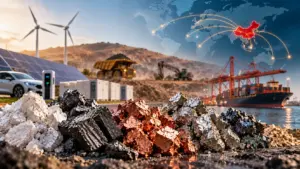
Australia critical minerals projects are entering a new phase—one that focuses less on digging and more on processing and refining. When Alcoa Corporation and Japan’s Sojitz Corporation announced plans for a gallium recovery plant backed by the U.S. and Australian governments, it signaled a structural pivot. The facility will produce about 100 tonnes of gallium annually, roughly 10% of global supply, positioning Australia as a significant mid-stream player in the global critical minerals chain.

Simultaneously, Iluka Resources’ Eneabba rare-earth refinery—the first of its kind in the nation—is set to produce between 17,000 and 23,000 tonnes of separated oxides by 2027. Together, these projects mark a clear strategic shift: Australia critical minerals policy is now about capturing more value at home.
Why the Future of Australia Critical Minerals Depends on Processing
For decades, Western governments treated mining as the solution to supply-chain risk. But the real bottleneck lies further downstream—in refining, separation, and purification. China still controls over 80% of rare-earth processing and dominates gallium and germanium markets.
The U.S.–Australia Critical Minerals Framework, designed to unlock US$8.5 billion in joint investment, directly addresses this gap. Its goal is to make Australia a refining and separation hub, ensuring its mineral feedstock is processed domestically rather than sent to China. For miners, this means higher margins, better traceability, and stronger pricing power.
Alcoa–Sojitz: The Flagship of Australia’s Gallium Ambition
At Alcoa’s Western Australian alumina operations, the company will install gallium recovery circuits in partnership with Sojitz. The Australian government is contributing up to US$200 million in concessional equity, matched by U.S. co-investment and shared offtake rights.
Gallium’s strategic importance lies in semiconductors, radar systems, and renewable energy technologies. By producing roughly 100 tonnes annually, the project will diversify a market that has long relied on China. It also exemplifies how the Australia critical minerals sector is moving toward integrated industrial ecosystems—using by-product recovery and government risk-sharing to create scalable new supply chains.

Iluka’s Eneabba Refinery: Australia Critical Minerals Hub
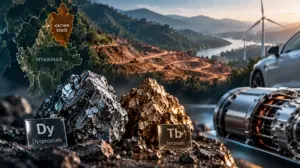
Iluka’s Eneabba refinery represents the centerpiece of this new industrial model. Once completed, it will become Australia’s first integrated facility capable of producing both light and heavy rare-earth oxides, including neodymium, praseodymium, dysprosium, and terbium—essential for EV motors and wind-turbine magnets.
The refinery’s ability to accept third-party feedstock is what makes it transformative. Instead of exporting mixed concentrates, smaller miners will have a domestic buyer and processor. Eneabba, in effect, becomes the national mid-stream hub for Australia critical minerals—a model that could be replicated across Western Australia and the Northern Territory.
More Read
Financing the Future of Australia Critical Minerals
The framework’s financial engine relies on blended capital: public equity, concessional loans, and U.S. Export-Import Bank guarantees. More than US$2 billion in Letters of Interest have been issued to Australian critical minerals developers in rare earths, magnesium, and advanced materials.
One key beneficiary is Arafura Rare Earths, developer of the Nolans project in the Northern Territory. It has received conditional approval for US$100 million in equity from Australia’s Export Finance Agency and up to US$300 million from the U.S. EXIM Bank. Once operational, Nolans could supply 5% of global rare-earth demand, further anchoring Australia’s position in the mid-stream.
Skillings Analysis
- Processing defines competitiveness. Australia critical minerals success will depend on downstream investment, not just extraction.
- Anchor plants change the equation. Eneabba’s open-access model improves financing prospects for multiple miners simultaneously.
- Subsidies ignite momentum—but discipline sustains it. Mid-stream players must reach cost parity with China to survive the next cycle.
What’s Next for Australia Critical Minerals
Over the next year, market watchers expect final investment decisions for Alcoa–Sojitz’s gallium plant, commissioning progress at Eneabba, and the conversion of government Letters of Interest into binding financing. Japan’s involvement in magnet manufacturing and U.S. defence offtakes will likely tighten the trilateral supply web.
If executed effectively, the next five years could transform Australia from an exporter of raw ore into a strategic processor at the heart of the Indo-Pacific’s critical minerals supply chain.