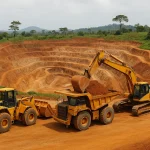
When reports surfaced of a potential US $62 billion valuation tied to the discovery of Kenya rare earth minerals at Mrima Hill in Kwale County, they immediately caught the attention of global mining professionals. The find could reposition East Africa within the global rare-earth supply chain—offering strategic alternatives to China’s dominance and creating new opportunities for miners, refiners, and investors alike.

Recent geological surveys indicate Kenya hosts roughly 40 million tonnes of rare-earth-bearing ore averaging 5 % total rare-earth oxide (TREO) content, alongside about 680 million kg of niobium. This dual-resource potential places Kenya rare earth minerals at the center of an emerging East African mining frontier that could support downstream manufacturing, renewable energy technologies, and electric-vehicle supply chains.
Geological Scale and Composition of Kenya Rare Earth Minerals
The Kenya rare earth minerals discovery ranks among the largest potential deposits globally. According to early reports, Mrima Hill’s mineralized carbonatite complex hosts a combination of light rare-earth elements—notably neodymium, praseodymium, cerium, and lanthanum—alongside heavy elements such as dysprosium and terbium.
Light rare earths are typically easier and cheaper to process, while heavy elements fetch higher premiums in defense and high-tech magnet applications. The combined resource composition positions Kenya rare earth minerals as both technically feasible and economically attractive to investors seeking long-term critical-minerals exposure.
Infrastructure Advantage and Export Readiness
Mrima Hill lies approximately 50 kilometers from the Port of Mombasa, offering Kenya rare earth minerals one of Africa’s most favorable logistics footprints. Coastal proximity drastically reduces transport costs compared to land-locked operations such as those in Burundi or Malawi. The region benefits from paved road networks, access to Kenya’s geothermal-driven national grid, and established customs and export processing systems.
For mining companies, the location translates into faster export turnaround, improved container availability, and better alignment with global supply hubs in Asia and Europe. If commercialized, Kenya rare earth minerals could become one of the most accessible African critical-minerals streams to international markets.

Kenya Rare Earth Minerals and the Global Supply-Chain Shift
China still dominates more than 60 % of global rare-earth production and nearly 85 % of processing capacity. The emergence of Kenya rare earth minerals introduces long-awaited diversification, potentially supporting Western and Asian manufacturers seeking stable, ESG-compliant alternatives.
Analysts note that while the in-ground valuation of $62 billion is eye-catching, the real question lies in processing capability and regulatory stability. Kenya’s past licensing disputes—most notably involving Cortec Mining Kenya in 2013—underscore the importance of clear governance frameworks.
For investors and developers, the challenge will be moving from discovery to commercially proven reserves, a step requiring feasibility studies, metallurgical testing, and stable policy conditions.
ESG and Community Considerations
The Mrima Hill region is not just a mineral deposit—it’s also a culturally protected forest area and biodiversity site. Future development of Kenya rare earth minerals will depend heavily on transparent community engagement and compliance with environmental standards. The government has signaled its commitment to balancing economic gains with conservation under Kenya’s Vision 2030 framework, which prioritizes sustainable extraction.
Mining companies will need to invest early in local infrastructure, education, and community programs to secure a social license to operate. Industry experience shows that ESG alignment often determines project speed and investor confidence in critical-minerals ventures.
Skillings Analysis
- Geopolitical diversification: Kenya rare earth minerals offer strategic leverage for manufacturers seeking to reduce exposure to Chinese supply chains.
- Economics of polymetallicity: Co-production of niobium, phosphate, and manganese alongside rare earths enhances financial resilience and capex justification.
- Execution risk remains high: Processing complexity, environmental regulation, and community approval could make or break timelines for production.
What Comes Next for Kenya Rare Earth Minerals
As the State Department for Mining finalizes exploration and production frameworks, companies such as Iluka Resources and RareX Limited have expressed early interest. The next quarter is expected to bring updates on:
- JORC/NI 43-101-compliant resource statements
- Exploration rights allocation and stakeholder partnerships
- Feasibility assessments on processing pathways
If realized, Kenya rare earth minerals could anchor a new East African critical-minerals corridor, catalyzing investment not only in extraction but also in refining, magnet manufacturing, and export logistics.
Outlook
The discovery of Kenya rare earth minerals at Mrima Hill represents more than geological luck—it’s a potential inflection point for Africa’s role in global technology supply chains. As Kenya refines its mining policy and international partners evaluate entry strategies, the world will be watching how this deposit transitions from promise to production.
If properly managed, the project could redefine the continent’s critical-minerals narrative—and establish Kenya as a sustainable, globally integrated mining powerhouse.